Key Takeaways
- São Jorge is the island of fajãs - over 40 flat coastal plains wedged between cliffs and ocean. No other Azores island has anything close to this. Some you drive to, some you hike down to, one has Europe's only coffee plantation. What is a fajã →
- The cheese here is arguably more famous than the island itself. Queijo de São Jorge, DOP-certified, piquant, aged for months in wheels that weigh 7 to 10 kg. Factory tours run in Calheta. Local food →
- Fajã da Caldeira de Santo Cristo is hike-in only. No road. You walk down from Serra do Topo on the PR1 trail, and at the bottom there's a lagoon with the only clam population in the Azores, plus one of the best surf breaks in the archipelago. Best fajãs →
- São Jorge sits in the Triangle with Pico and Faial. One hour by ferry to Pico, ninety minutes to Faial. Three islands, three personalities, one trip. How to get there →
- Europe's only coffee plantation is at the bottom of a cliff. Fajã dos Vimes, Café Nunes, arabica beans grown under banana trees. You hike down or drive down a road that feels like a dare. Best fajãs →
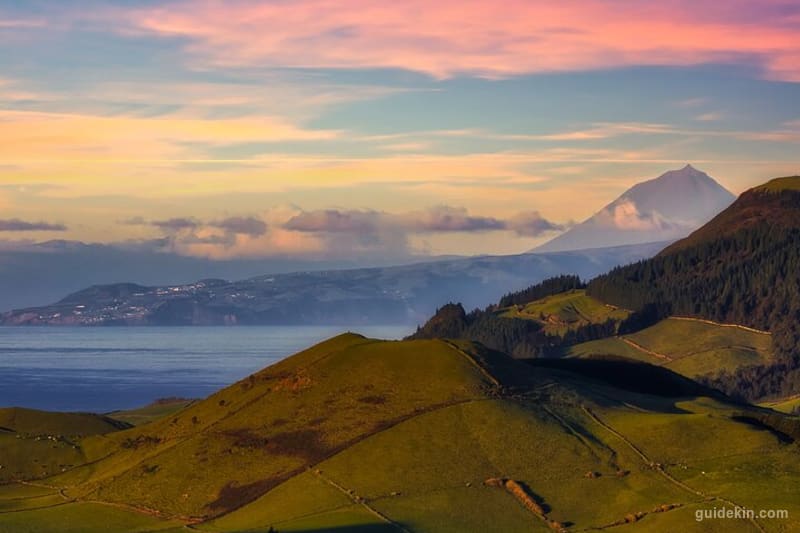
- From the highest point, you can see four islands at once. Pico da Esperança, 1,053 meters. On a clear day: Pico, Faial, Graciosa, Terceira. That view alone justifies the flight. Hiking →
Why Visit São Jorge
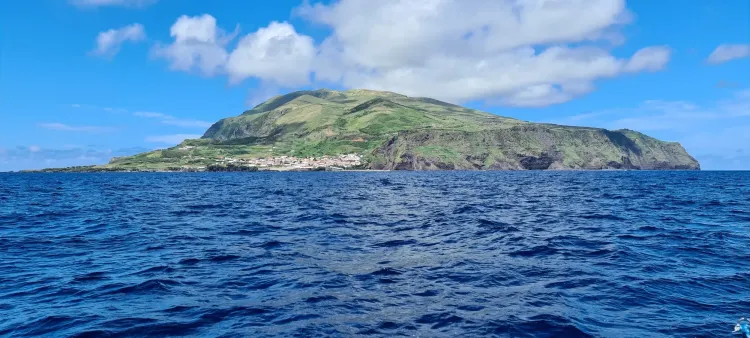
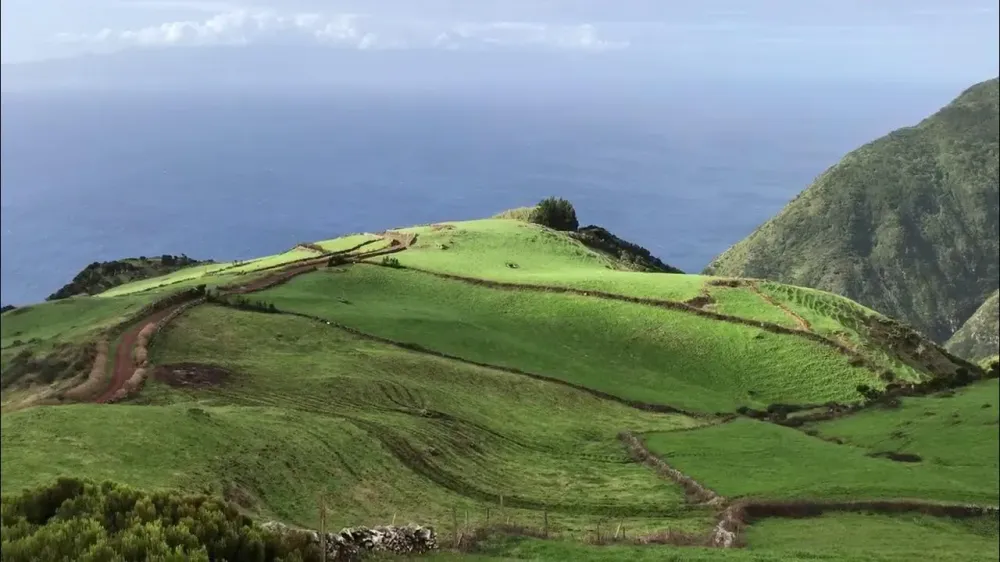
First thing to know about São Jorge Island in the Azores: it's shaped like a dragon. 53 km long, 8 km wide, with a mountainous spine running the entire length. Locals will tell you this. From the air, they're right.
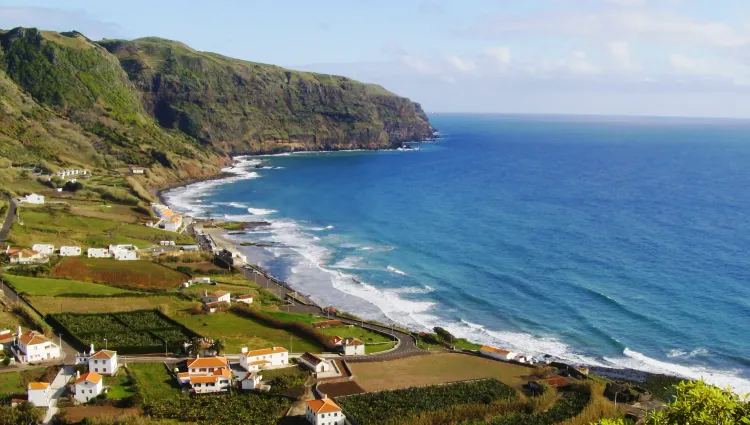
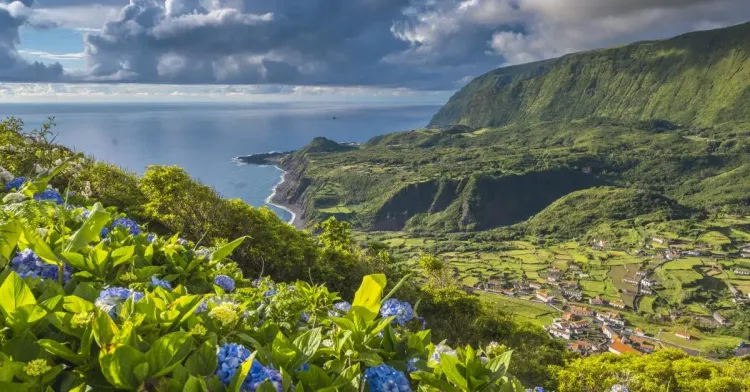
About 8,400 people live here, spread across small towns on the south coast. The north coast is mostly cliffs. Tall cliffs - 400, 500, sometimes 700 meters dropping into the Atlantic. And at the base of those cliffs, tucked between rock and sea, sit the fajãs. Flat platforms of land created by landslides or ancient lava flows. Over 40 of them. São Jorge has more fajãs than all other Azores islands combined.
That's the headline. But there's more to it.
São Jorge is part of the Triangle - three central group islands (São Jorge, Pico, Faial) close enough to see each other on clear days and connected by daily ferries. Pico has the volcano. Faial has the marina at Horta. São Jorge has the cliffs, the fajãs, and the cheese. If you're doing an Azores multi-island trip, the Triangle is the easiest combination to pull off logistically.
UNESCO declared the entire island a Biosphere Reserve in 2016. The Fajãs de São Jorge reserve covers the coastal fajãs and the surrounding marine area. The designation exists because these habitats don't really exist anywhere else - subtropical vegetation on narrow coastal strips, protected by vertical cliffs behind and open ocean in front. Rare plants, endemic birds, a lagoon with clams found nowhere else in the Azores.
Is São Jorge worth visiting? If you want developed tourist infrastructure, no. One proper hotel on the entire island. A handful of rural guesthouses. Roads where the fog rolls in and suddenly your windshield is white. But if you want to hike down a cliff to drink coffee grown under banana trees, eat cheese that's been aging since before your flight was booked, and stand on a summit where four islands float on the horizon line - then yes.
São Jorge doesn't make it easy. That's not a flaw.
The island sits roughly in the center of the archipelago, between Terceira to the northeast and Pico directly to the south. From the south coast, you can see the dark cone of Mount Pico (2,351 m, the highest point in Portugal) rising across the channel on most mornings. On very clear days, Faial appears behind it, and Graciosa floats on the northern horizon. São Jorge's position gives it some of the best views in the Azores without you having to climb anything. But if you do climb - to Pico da Esperança at 1,053 meters - four islands appear at once.
The economy runs on dairy farming, fishing, and a growing stream of visitors. Growing slowly. In 2024, direct flights to São Jorge from the mainland still didn't exist. The island still doesn't have a single traffic light. Good restaurants exist, but you can count them without using both hands. For travelers coming from São Miguel, where tourism infrastructure has caught up with demand, São Jorge feels like stepping back a decade. In a good way.
What Is a Fajã
This word comes up constantly when you read about São Jorge, and almost nobody explains it properly. So here it is.
A fajã (pronounced "fa-ZHAH") is a flat area of land at the base of a cliff, created by one of two processes. A detritic fajã forms when part of a cliff collapses - rock and earth slide down and create a platform at sea level. A lavic fajã forms when a lava flow pours over the cliff edge and solidifies at the bottom, adding new land to the coastline.
Both types exist on São Jorge. The detritic ones are more common and generally larger. The lavic ones tend to be rockier, with basalt formations.
Why does São Jorge have 40+ fajãs when most other Azores islands have almost none? Geology. São Jorge is a long, narrow ridge with steep cliffs on both sides - especially the north coast. Centuries of erosion, earthquakes, and volcanic activity have been chipping away at those cliffs, sending material down to the ocean. Other islands have gentler slopes or wider coastal platforms already. São Jorge has vertical walls, so when rock falls, it creates something flat at the bottom. Simple physics over long stretches of time.
Some fajãs are accessible by car (Fajã do Ouvidor, Fajã de São João). Others require a proper hike down - Caldeira de Santo Cristo, the most famous, has no road access at all. A few are abandoned, overgrown, reachable only by quad bike or with a guide who knows the unmarked paths.
| Fajã | Access | Time to Reach | What to See |
|---|---|---|---|
| Caldeira de Santo Cristo | Hike only (PR1 trail) | 2-3h hike down | Lagoon, clams, surfing, hermitage |
| Cubres | Hike or car (partial) | 1-2h hike or 15 min drive + walk | Lagoon, birdwatching, connected to Santo Cristo |
| Ouvidor | Car | 10 min from road | Natural pool (Poça Simão Dias), basalt columns |
| Vimes | Car (steep road) | 20 min drive from Calheta | Coffee plantation (Café Nunes) |
| São João | Hike (PR3 trail) | 1.5-2h hike down | Coastal scenery, abandoned houses |
| Almas | Car (rough road) | 15 min from road | Quiet, swimming, very few visitors |
People who've been to São Jorge multiple times always say the same thing: you don't run out of fajãs. There's always one more you haven't seen yet.
Best Fajãs to Visit
Fajã da Caldeira de Santo Cristo
The one everyone talks about. No road. You get here by hiking down from Serra do Topo on the PR1 trail (about 8 km, 2-3 hours), or by quad bike if you arrange it locally. There's no other way.
At the bottom: a brackish lagoon connected to the ocean by a narrow channel. This lagoon is the only place in the entire Azores where clams (amêijoas) grow naturally. The harvest is regulated and limited. Restaurants on São Jorge serve them when available, and the taste is different from mainland clams - brinier, firmer. Small, intense.
The beach at Santo Cristo faces west and picks up Atlantic swells with very little to break them. Surfers have known about this for decades. No crowds, no surf shops, no boardwalks. You carry your board down the trail or not at all. A handful of houses, the Hermitage of Saint Christ (rebuilt after the 1835 earthquake), and the ocean. On the first Sunday of September, a pilgrimage brings people from all over the island to this hermitage. Rest of the year, the fajã is mostly quiet.
Fajã dos Cubres
Connected to Santo Cristo by the continuation of the PR1 trail (about 45 minutes between them). Cubres has a small lagoon that sparkles green in afternoon light. Easier to reach - you can drive part of the way. Good for birdwatching. Less dramatic than Santo Cristo but worth the stop, especially if you're already on the trail.
Fajã do Ouvidor
If the hike to Santo Cristo isn't for you, come here instead. Accessible by car. The main attraction is Poça Simão Dias - a natural ocean pool framed by prismatic basalt columns. The columns look almost carved, geometrically precise, dark grey against blue-green water. This might be the single most photographed spot on São Jorge, and for good reason.
The Guidekin team considers Ouvidor the best fajã for visitors who want the São Jorge experience without a multi-hour hike. Drive down, swim in the pool, look at the columns, drive back. Easy half-day.
Fajã dos Vimes
Europe's only coffee plantation, and it's at the bottom of a cliff you have to drive down a narrow road to reach. Arabica beans, grown under banana trees and hydrangeas, at sea level on the north coast. Café Nunes roasts and serves the coffee on site. Small cups, strong flavor, and you drink it looking out at the ocean from a terrace surrounded by subtropical vegetation.
The road down is steep and winding. Some rental companies mention it in the fine print. Take it slow. The coffee at the bottom is worth the drive.
Fajã de São João
Reached via the PR3 trail, a hike of about 1.5-2 hours down from the central ridge. Less visited than Santo Cristo. The fajã has some abandoned stone houses, a small chapel, and a swimming area. Good for solitude. The trail itself is the real draw - dense vegetation, views opening up as you descend.
Best Time to Visit São Jorge
| Season | Avg Temp | Rain | Sea Temp | Best For |
|---|---|---|---|---|
| Summer (Jun-Sep) | 22-25C | Low | 20-23C | Swimming, natural pools, festivals, whale watching (Apr-May peak) |
| Spring (Apr-May) | 17-20C | Moderate | 17-18C | Hiking (green trails, wildflowers), fewer visitors |
| Autumn (Oct-Nov) | 18-21C | Moderate-High | 19-21C | Quieter, warm sea, lower prices |
| Winter (Dec-Mar) | 14-17C | High | 15-17C | Cheapest, emptiest, fog-heavy, some trails muddy |
São Jorge weather is Azorean weather. Cloud, sun, rain, and wind can cycle through in a single morning. The north coast gets more rain and fog than the south coast. Velas (south side) sees noticeably more sun than anywhere on the north shore.
Summer is the obvious choice. Warmest, driest, best conditions for swimming in natural pools and reaching the fajãs. July and August fill up what little accommodation exists. Semana Cultural das Velas happens in July - the island's biggest festival week.
But summer isn't necessarily when the Guidekin team would go. We'd pick late May, June, or September. Trails are green without the heat. Accommodation is easier to find. Prices drop. The sea in September is still warm from summer. You can hike to Santo Cristo without sweating through your pack.
April and May bring whale watching season. Sperm whales pass through the central Azores, and São Jorge's position in the Triangle puts it in the migration corridor. Operators run boat trips from Velas harbor.
Winter is for people who don't mind rain and want the island to themselves. Everything still works - restaurants, guesthouses, roads. But fog sits on the central ridge for days, viewpoints show you nothing, and some trail sections get slippery. Budget travelers take note: winter rates are the lowest all year.
How to Get There
São Jorge has a small airport (SJZ) at the western end of the island, near Velas. No direct flights from mainland Portugal. You connect through São Miguel (Ponta Delgada) or Terceira (Angra do Heroismo) on SATA Air Açores.
| Route | Method | Time | Approx. Cost |
|---|---|---|---|
| São Miguel → São Jorge | SATA flight | ~50 min | EUR80-130 return |
| Terceira → São Jorge | SATA flight | ~30 min | EUR60-100 return |
| Pico (Madalena) → São Jorge (Velas) | Ferry (Atlânticoline) | ~1h | EUR10-15 one-way |
| Faial (Horta) → São Jorge (Velas) | Ferry (Atlânticoline) | ~1.5-2h | EUR15-20 one-way |
| Pico → São Jorge | SATA flight | ~10 min | EUR40-60 one-way |
The Triangle advantage. If you're already on Pico or Faial, São Jorge is a short ferry ride away. Atlânticoline runs daily connections between the three islands year-round, with more frequent service in summer. The Pico-São Jorge crossing takes about an hour and gives you views of both islands the entire way. For more on Pico and how to combine it with São Jorge, check our Pico Island guide.
Flights from São Miguel. SATA has a few weekly flights. Schedules change seasonally. Book early for summer - the planes are small (turboprop, under 80 seats) and fill up.
Ferry cancellations. Azores ferries cancel for rough seas. More common in winter, but summer isn't immune. If your plan depends on a specific crossing, have a backup day. Atlânticoline posts updates on their website the evening before.
Getting around São Jorge. Rent a car. There's no public transport worth relying on. The island is 53 km end to end, one main road along the south coast, side roads dropping to the fajãs. Some of those side roads are steep, narrow, and foggy. Drive carefully. Book the car well in advance - the island has a limited fleet and summer availability goes fast.
Hiking Trails
São Jorge has 10 official marked trails (PRs) plus the Grande Rota (GR1 SJO), a 47 km linear route along the central ridge from Fajã dos Vimes to Ponta dos Rosais. Hiking here is real hiking. The elevation changes are dramatic - you're often descending 500+ meters from the ridge to a fajã at sea level, then climbing back up.
PR1 SJO: Serra do Topo to Fajã da Caldeira de Santo Cristo and Fajã dos Cubres
The signature hike. Starts high on the eastern ridge, descends through laurel forest and endemic vegetation into the Caldeira de Santo Cristo, then continues along the coast to Cubres. About 10 km total. Plan 3-4 hours one way.
The descent is steep in places. Proper footwear matters. You lose about 700 meters of elevation on the way down, and your knees will remind you. The payoff: arriving at Santo Cristo from above, the lagoon appearing through the trees, the ocean beyond it. Then clams and coffee at the bottom, if you've arranged it.
"Trails on São Jorge go up or they go down. There's very little flat walking. Pack water, pack layers, check the weather that morning. When the fog lifts mid-trail and you see the fajã below you for the first time, nothing in the Azores compares." - Guidekin team
PR4 SJO: Pico da Esperança
The highest point on São Jorge at 1,053 meters. This trail loops around the summit area, about 5.5 km, 2-3 hours. On a clear day you see Pico (with its 2,351m volcano towering across the channel), Faial, Graciosa, and Terceira. Four islands at once. On a cloudy day, you see the inside of a cloud.
Morning gives you the best odds for clear views. The summit is exposed - wind up there can be serious even when it's calm in Velas.
PR2 SJO: Serra do Topo to Fajã dos Vimes
Similar to PR1 but descends the opposite (south) side. About 7 km, 2-3 hours. Ends at the coffee plantation in Fajã dos Vimes. Good combination: hike down, drink the coffee at Café Nunes, get picked up by car (arrange in advance with your accommodation or a taxi).
| Trail | Distance | Time | Elevation Change | Highlights |
|---|---|---|---|---|
| PR1 SJO (Serra do Topo → Santo Cristo → Cubres) | ~10 km | 3-4h | -700m | Lagoon, clams, surfing, the famous fajã |
| PR2 SJO (Serra do Topo → Fajã dos Vimes) | ~7 km | 2-3h | -600m | Coffee plantation, subtropical vegetation |
| PR4 SJO (Pico da Esperança) | ~5.5 km | 2-3h | ~300m | Highest point (1,053m), views of 4 islands |
| PR3 SJO (Pico do Pedro → Fajã de São João) | ~5 km | 2h | -500m | Abandoned fajã, solitude, coastal views |
| GR1 SJO (Grande Rota) | ~47 km | 2-3 days | Varies | Full island traverse, ridge walking |
A warning. Weather on the central ridge changes fast. You can start a hike in sunshine and reach the fajã in fog and rain. A waterproof layer isn't optional, it's equipment. The trails are well-marked but not all have mobile signal. Download offline maps before you start.
The trail network is maintained by the regional government. Conditions are generally good, but after heavy rain some sections get muddy. The Visit Azores website has updated trail status information.
Water Activities
If you're looking for sandy beaches on São Jorge, you're looking in the wrong place. There aren't any. What the island has instead is volcanic rock coastline, natural ocean pools, and some of the clearest water in the Azores.
Natural pools. This is how people swim on São Jorge. Poça Simão Dias at Fajã do Ouvidor is the standout - basalt columns framing a natural pool of Atlantic water. Poça dos Frades near Calheta is smaller, easier to find. The bathing area at Fajã das Almas is accessible by car and rarely crowded. Preguiça and Fajã Grande have pool complexes built into the rock - concrete edges, ladders, but ocean water filling and draining with the tide.
Snorkeling and diving. São Jorge is consistently rated one of the best snorkeling islands in the Azores. Visibility often exceeds 15 meters. The volcanic rock coastline creates underwater formations - caves, arches, channels - that you don't get on sandy-bottomed islands. Diving around Urzelina reveals volcanic tubes and walls rich with marine life. Local operators run trips from Velas marina.
Surfing. Fajã da Caldeira de Santo Cristo is the spot. West-facing, exposed to Atlantic swells, no offshore islands or headlands to block the waves. Consistent breaks. The catch: you hike your board in. No road, no parking lot, no rental shop at the beach. Surfers who make the effort have the lineup mostly to themselves.
Whale watching. April through May is peak season for sperm whales passing through the central Azores channel between São Jorge and Pico. Operators in Velas run half-day trips. Later in summer, dolphins and other cetaceans are the main sightings. The deep channel between São Jorge and Pico drops to over 1,000 meters close to shore, which is why large marine animals pass through so reliably.
Coasteering and SUP. Available through local operators in Velas during summer months. Coasteering uses the cliff-to-water geography that São Jorge has in abundance - you're jumping into deep water off volcanic rock ledges with 500-meter cliffs behind you. SUP works best in the sheltered areas on the south coast, particularly around the Velas marina on calm mornings.
Boat trips. Operators in Velas run coastal tours along the north shore, passing the fajãs from the ocean side. This gives you a perspective you can't get from land - the scale of the cliffs, the way the fajãs look like green shelves wedged into the rock face. Some tours combine coastline viewing with snorkeling stops. A good option if your legs need a rest day between hikes.
Towns and Villages
Velas
The capital, on the southwest coast. Marina, a handful of restaurants, a couple of cafes, a supermarket. Jardim da Republica is the main square, shaded, with a view across the channel to Pico. The Sea Gate (Portão do Mar, dating to 1799) is the old entrance from the harbor into town.
Velas is where most visitors base themselves, because this is where most services are. The ferry terminal, the marina, the few tourism offices that exist. Accommodation options cluster here and in the surrounding parishes. The town is small enough to walk end to end in 20 minutes.
A 1980 earthquake damaged several buildings in Velas. You can still see the effects in the architecture - older stone structures next to 1980s reconstruction. In 2022, a seismic crisis (a swarm of small earthquakes over several weeks) reminded everyone that São Jorge is volcanically active. No major damage, but it made the news.
Calheta
Second town, eastern end of the south coast. Quieter than Velas. This is the cheese side of the island. The Cooperativa de Lacticínios de São Jorge has its factory here, and you can arrange tours to see how the famous Queijo de São Jorge is made. The town has a few restaurants, a swimming area, and a church that's been standing since the 1500s.
Urzelina
Small village between Velas and Calheta. The reason to stop: the bell tower of the old church, half-buried in lava from the 1808 eruption. The lava flow engulfed the church but left the tower standing, with its upper half poking out above the solidified rock. It's one of those sights that makes you stare. A small interpretive panel explains what happened. The new church sits nearby, built after the eruption destroyed the original.
Urzelina also has a good swimming area on the coast and a couple of casual restaurants. You won't spend a full day here, but a stop on your way between Velas and Calheta takes 30-45 minutes and gives you something you won't forget.
Topo and Norte Pequeno
Topo sits at the eastern tip, the oldest settlement on São Jorge. Small, quiet, with views toward São Miguel on clear days. The islet of Topo (Ilhéu do Topo) just offshore is a nature reserve and nesting site for seabirds.
Norte Pequeno, on the north coast, is mostly interesting as the starting point for the road down to Fajã do Ouvidor. The village itself is a handful of houses and dairy farms. The kind of place where cows outnumber cars on the road. Stop if you need directions. Someone will help.
Local Food and Drink
Queijo de São Jorge
The cheese. DOP-certified (Denominação de Origem Protegida), semi-hard, piquant, aged anywhere from 3 to 7+ months. Each wheel weighs 7 to 10 kg. The flavor sharpens with age - young wheels are mild and creamy, older ones develop an almost spicy bite.
São Jorge cheese is produced from raw cow's milk. The cows graze on pastures that sit on volcanic soil at 400-700 meters altitude, exposed to Atlantic weather. That soil, that grass, that climate - cheesemakers here will tell you the terroir matters as much for cheese as it does for wine. Whether that's marketing or truth, the cheese does taste different from anything on the mainland.
The Cooperativa in Calheta runs factory tours where you can watch the production process and taste wheels at different aging stages. They have a shop attached. Expect to buy more than you planned.
"São Jorge cheese might be the most recognizable food product from the entire Azores. More people know the cheese than know the island. We recommend buying a wedge of the 7-month aged variety directly from the cooperative in Calheta - it tastes different here than anywhere else." - Guidekin team
Clams from Santo Cristo
The amêijoas da Caldeira de Santo Cristo are endemic to the lagoon at the famous fajã. The only naturally occurring clam population in the Azores. Harvest is strictly regulated by the regional government. When available, restaurants in Velas and Calheta serve them simply - steamed, garlic, white wine. Small, briny, with a mineral quality that comes from the volcanic lagoon water.
Don't expect to find them every day. The supply is limited and seasonal.
Coffee from Fajã dos Vimes
Arabica, shade-grown under banana trees, at what is genuinely Europe's only coffee plantation. Café Nunes grows, roasts, and serves the coffee on site. Production is tiny - a few hundred kilos per year. You can buy small bags to take with you, but most of the coffee is consumed right there, in espresso cups, on the terrace.
The taste: mild acidity, smooth body, slightly fruity. Not the strongest coffee you'll ever drink, but certainly the most unlikely.
Other Local Specialties
Espécias - small pastries flavored with cinnamon and fennel, traditional to São Jorge. Each parish has a slightly different recipe. Suspiros (meringues) appear at festivals.
Sopas do Espirito Santo - the ceremonial soup served at Holy Ghost festivals. On São Jorge, the recipe uses mint rather than dill (Santa Maria's version). Bread-based, with beef broth, rich and filling.
Fresh fish appears on every menu. Lapas (limpets) grilled with garlic butter are what you eat at a harbor bar while deciding what else to order. The catch changes daily. The fishermen in Velas marina sell directly from their boats some mornings.
Festivals and Events
São Jorge takes its festivals seriously. The island has a deep connection to the Festas do Espirito Santo (Holy Ghost Festivals), which run from May through September. Each parish takes a turn hosting. Communal pots of Sopas do Espirito Santo are served free to anyone present. Processions, music, rope bullfighting (tourada a corda - the bull is controlled by a rope held by pastores, and runs through the village streets).
| Festival | When | Where | What to Expect |
|---|---|---|---|
| Festas do Espirito Santo | May-Sep | Island-wide (rotating parishes) | Processions, communal soup, rope bullfighting |
| Semana Cultural das Velas | July (week-long) | Velas | Music, concerts, sailing regatta, exhibitions, food |
| Pilgrimage to Santo Cristo | First Sunday, September | Fajã da Caldeira de Santo Cristo | Hike to the hermitage, mass, community gathering |
| Festival de Julho | July | Calheta | Live music, food stalls, local culture |
Semana Cultural das Velas is the big one for visitors. A full week of events in the capital - live music on the harbor, sailing races, art exhibitions, food stalls. Accommodation fills up. Book months ahead.
The pilgrimage to Santo Cristo in September is something different. Hundreds of people hike down the trail to the fajã for a mass at the hermitage. The return hike up in late afternoon, after the ceremony, after the food, is its own kind of experience.
Practical Tips
- Rent a car. No public transport. The island is 53 km long with one main road and many side roads to fajãs. Book well in advance for summer - the fleet on São Jorge is small.
- Accommodation is limited. One proper hotel (São Jorge Garden Hotel, near the airport). Everything else is rural tourism houses, guesthouses, and Airbnb. Total capacity on the island is low. For July-August, book 2-3 months ahead minimum.
- Stay on the south coast. Velas, Urzelina, and Calheta get more sun than the north. The central ridge blocks weather systems coming from the north, so the south side is drier and warmer.
- Budget from EUR46/night. Rural guesthouses start around EUR46-65/night for a double. The hotel runs EUR80-120. Meals at restaurants cost EUR12-20 for a full plate with fish. Cheese and coffee purchases add up if you get into it.
- How many days. Three to four is the minimum to see the main fajãs, do one proper hike, and eat your way through the cheese and coffee. Five to seven days lets you hike multiple trails, visit smaller fajãs, take a day trip to Pico by ferry, and have buffer for weather.
- Sample 4-day itinerary. Day 1: Velas, Urzelina (buried bell tower), Fajã do Ouvidor (Poça Simão Dias). Day 2: PR1 hike to Santo Cristo and Cubres (full day). Day 3: Fajã dos Vimes for coffee, cheese cooperative tour in Calheta, Pico da Esperança viewpoint if weather allows. Day 4: Ferry day trip to Pico or relax at natural pools.
- Triangle itinerary idea (7-10 days). Three to four nights on São Jorge (fajãs, hiking, cheese, coffee), two to three nights on Pico (climb the mountain, wine heritage area, whale watching), one to two nights on Faial (Horta marina, Capelinhos volcano, Peter Cafe Sport). Daily ferries between all three. This is the most popular multi-island combination in the Azores for a reason.
- Phone signal. Works in towns and along the main road. Drops out on trails and in some fajãs - especially Santo Cristo. Download offline maps.
- Fog is normal. The central ridge sits at 700-1,000 meters. Clouds park there regularly. If Pico da Esperança is fogged in, try again the next morning. Early mornings tend to be clearest.
Browse Azores tours and experiences on Guidekin to find guided hikes, whale watching, and island-hopping options across the archipelago.
FAQ
Is São Jorge island worth visiting?
Yes, if you like hiking, food, and places that haven't been smoothed out for tourism. São Jorge has the best fajãs in the Azores, world-class cheese, Europe's only coffee plantation, and trails that drop you 700 meters from mountain ridge to ocean. It's not the easiest Azores island to visit - limited accommodation, limited transport, limited everything. That's also what keeps it genuine.
How many days do you need on São Jorge?
Three to four days covers the highlights: one big hike (PR1 to Santo Cristo), Fajã do Ouvidor for the natural pools, the cheese cooperative, and Fajã dos Vimes for coffee. Five to seven days lets you hike multiple trails, visit smaller fajãs, and take a ferry to Pico.
How do you get to São Jorge?
Fly to São Miguel or Terceira, then connect on a SATA Air Açores flight to São Jorge airport (SJZ). You can also take the Atlânticoline ferry from Pico (about 1 hour) or Faial (about 1.5-2 hours). No direct flights from mainland Portugal.
What is São Jorge known for?
Three things above all: the fajãs (40+ coastal platforms at the base of cliffs, unique in the Azores), Queijo de São Jorge (DOP-certified cheese, arguably the most famous food product in the archipelago), and the Triangle connection with Pico and Faial for island-hopping.
Do you need a car on São Jorge?
Yes. No public buses worth relying on. The island is 53 km long. Side roads to the fajãs are steep and narrow. Taxis exist but you'd spend more on taxis in three days than on a rental for a week. Book the car early, especially for summer.
What is a fajã?
A fajã is a flat area of land at the base of a sea cliff, formed either by a landslide (detritic fajã) or by a lava flow that reached the coast (lavic fajã). São Jorge has over 40 of them - more than all other Azores islands combined. Some are accessible by road, others only by hiking trail.
Start Planning Your São Jorge Trip
São Jorge is the Azores island that rewards effort. The best fajã requires a three-hour hike. The best coffee is at the bottom of a cliff. The best cheese needs to be tasted at the source, in a cooperative that hasn't changed its methods in decades. The best viewpoint sits above 1,000 meters in conditions that change by the hour.
None of that happens by accident, and none of it happens without planning ahead. Book the car early. Book the accommodation early. Check the ferry schedules. Download offline maps for the trails. Pack layers, waterproof gear, and hiking shoes that can handle mud and volcanic rock.
Then go. Hike down to Santo Cristo. Drink espresso at Café Nunes while looking at banana trees and the Atlantic. Stand on the rim of Pico da Esperança and count islands on the horizon. Buy a wheel of 7-month cheese from the cooperative and figure out how to get it home in your carry-on.
São Jorge doesn't advertise itself. The fajãs do that work instead.