Key Takeaways
- Best overall: Sintra. Fairytale palaces, 40 min by train, €4.50 return. Full details →
- Best beach day: Cascais and the coast. Train from Cais do Sodré, 35 min, free beaches and seafood. Details →
- Most underrated: Arrábida and Setúbal. Secret beaches, wild dolphins, fresh seafood. Car or tour recommended. Details →
- Best medieval town: Óbidos. Walled town, ginjinha in a chocolate cup, 1 hour by bus. Details →
- Quick comparison: See our full table with transport, travel time, and costs for all 8 destinations. Planning table →
- Common questions: Can you do Porto in a day? Is a car needed? Best trips by train? FAQ →
How to Plan Your Day Trips
Lisbon is one of the best-connected capitals in southern Europe for day trips. Within a two-hour radius you have medieval walled towns, Roman ruins, world-class surf, turquoise beaches, pilgrimage sites, and more palaces than you can fit into a week.
Six of the eight destinations in this guide are reachable by public transport. Two (Arrábida and Ericeira) really need a car or organized tour. Below is a comparison of all eight so you can decide which ones match your interests, budget, and schedule.
Here's the full comparison:
| Destination | Distance | Transport | Travel time | Day trip cost (approx.) | Best for |
|---|---|---|---|---|---|
| Sintra | 30 km | Train from Rossio | 40 min | €40–55 | Palaces, history |
| Cascais | 30 km | Train from Cais do Sodré | 35 min | €15–30 | Beach, seafood |
| Arrábida/Setúbal | 50 km | Car or tour | 45 min | €30–60 | Nature, beaches, wine |
| Óbidos | 85 km | Bus from Sete Rios | 1 hr | €20–30 | Medieval town, ginjinha |
| Nazaré | 120 km | Bus from Sete Rios | 1 hr 45 min | €20–35 | Giant waves, fishing culture |
| Évora | 130 km | Train from Oriente | 1 hr 30 min | €25–40 | Roman ruins, wine, food |
| Fátima | 130 km | Bus from Sete Rios | 1 hr 30 min | €20–25 | Pilgrimage site |
| Mafra/Ericeira | 40 km | Car or bus + taxi | 45 min | €20–35 | Palace, surf town |
By train: Sintra, Cascais, and Évora have direct, frequent train connections. Buy a Viva Viagem card (€0.50) and load it with credit. Trains are cheap, reliable, and run every 20–30 minutes.
By bus: Óbidos, Nazaré, and Fátima are best reached by bus from Sete Rios terminal (Rede Expressos or Rodoviária do Oeste). Book tickets online at rede-expressos.pt.
By car: Arrábida, Ericeira, and combination trips (Óbidos + Nazaré, or Mafra + Ericeira) work best with a rental. Driving south across the Ponte 25 de Abril bridge to Arrábida takes 45 minutes without traffic. With traffic, especially on Friday afternoons, double that.
By guided tour: If you don't want to deal with logistics, browse our day tours from Lisbon for small-group options with local guides.
How many day trips should you plan? If you have a week in Lisbon, three day trips is the sweet spot. Sintra on one day, a beach trip (Cascais or Arrábida) on another, and one cultural trip (Évora, Óbidos, or Nazaré) on the third. That leaves four days for Lisbon itself, which is about right for a city with this much to explore.
1. Sintra
Sintra is the default day trip from Lisbon for good reason. Four palaces, UNESCO World Heritage status, and a microclimate that wraps the hilltop in morning fog. The train from Rossio station takes 40 minutes and costs €4.50 return.
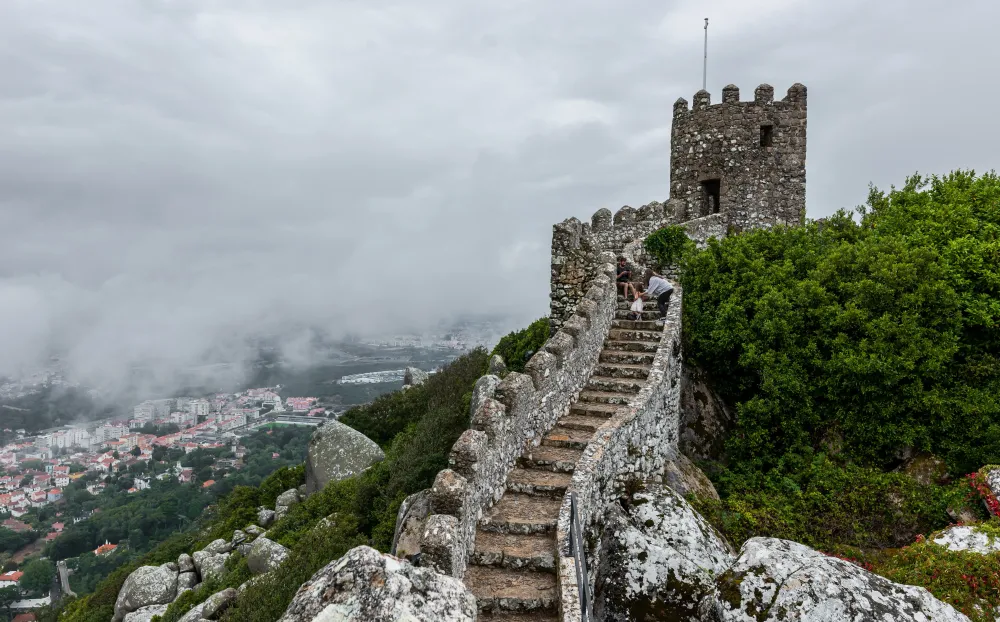
The essentials: Pena Palace (the colorful one), Moorish Castle (the ramparts with views), Quinta da Regaleira (the one with the underground well), and the National Palace (the white one in town with twin chimneys). Visit in that order. Start early. Take the 7 AM train and you'll beat the tour bus crowds by two hours.
"Sintra is the one day trip where the order you visit things matters more than what you visit. Go top-down, start at Pena, and work with gravity." - Guidekin team
Budget about €40–55 per person for train, bus 434, and entry tickets. The Pena + Moorish combo ticket saves a couple of euros.
We wrote an entire guide on this. Read our complete Sintra day trip guide for the full palace-by-palace breakdown, restaurant recommendations, and a minute-by-minute schedule.
2. Cascais and the Coast
Cascais is the easiest day trip from Lisbon. The train from Cais do Sodré runs every 20 minutes, takes 35 minutes, and the ride itself is half the experience. The line hugs the Tagus estuary, passes through Belém and Estoril, and ends at the ocean.
The town is compact. You can walk from the station to the marina, the fish market, and the rocky coastline in 15 minutes. Cascais was a fishing village until the Portuguese royal family turned it into a summer retreat in the late 1800s, and it still has that mix of old fishermen's houses and grand villas.
What to do:
- Walk the coastal path from Cascais to Boca do Inferno ("Hell's Mouth"), a dramatic sea cave 20 minutes west. The waves crash into a collapsed grotto, and the spray reaches the railings on windy days.
- Continue along the coast to Praia do Guincho, a wide windswept beach popular with surfers and kitesurfers. Too rough for casual swimming, but the scenery is spectacular.
- Eat grilled fish at Casa da Guia or at one of the restaurants on Rua Frederico Arouca in the old town. A full seafood lunch costs €15–25.
- Visit the Museu Condes de Castro Guimarães, a small palace-museum by the marina. Free entry on Sundays.
Lunch tip: The fish market (Mercado da Vila) near the marina sells fresh catches every morning. Several restaurants around it serve what was caught that day. Cervejaria Económica on Travessa da Alfarrobeira is a no-frills local spot with grilled fish and cold beer at honest prices.
Estoril is one stop before Cascais on the same train line. The casino (Europe's largest when it opened in 1942, and Ian Fleming's inspiration for Casino Royale) is the main draw. The beach is calmer than Cascais. You can easily walk between the two towns along the seaside promenade (30 minutes).
Cabo da Roca: If you have the energy after Cascais, bus 403 runs west to Cabo da Roca (30 min), the westernmost point of continental Europe. A lighthouse sits on the cliff edge, and on clear days the views stretch endlessly over the Atlantic. It's windy, exposed, and worth the detour. From Cabo da Roca you can continue by bus to Sintra, creating a Cascais-Cabo da Roca-Sintra loop. It's a long day, but doable if you start early.
If you want a guided experience along this coast, check out Cascais tours from Lisbon.
Getting there: Train from Cais do Sodré, every 20 min, €2.25 one way. Last return at 1:30 AM. The train ride itself passes through Belém (you'll see the Tower of Belém and the Padrão dos Descobrimentos from the window) and Estoril before reaching Cascais. Sit on the right side for the water views.
3. Arrábida and Setúbal
This is the day trip that most first-time visitors miss, and the one the Guidekin team recommends to anyone who's already done Sintra and Cascais. The Serra da Arrábida is a limestone mountain range south of Lisbon that drops sharply into the Atlantic. The beaches below, sheltered from Atlantic swells, have clear turquoise water that looks more like Croatia than Portugal.
Praia de Galapinhos was voted the best beach in Europe by European Best Destinations in 2017. It's a 15-minute walk down a steep trail from the road. Bring water and good shoes. In July and August, the road closes to private cars and you take a shuttle bus instead.
Setúbal sits at the eastern edge of the park. It's a working port city, not a resort town, and the seafood is some of the best and cheapest near Lisbon. The local specialty is choco frito (fried cuttlefish). Order it at any restaurant near the Mercado do Livramento, a market that rivals Lisbon's Time Out Market but without the tourist markup.
Azeitão, a village between Lisbon and Arrábida, is the wine detour. The region produces excellent Moscatel de Setúbal (a sweet dessert wine) and bold reds from the Península de Setúbal DOC. José Maria da Fonseca and Bacalhôa wineries both offer tastings from €10–15 per person.
Dolphins: Setúbal is one of the few places in Europe where you can see wild bottlenose dolphins. The Sado estuary has a resident pod of about 30 dolphins. Boat trips from Setúbal marina cost €30–40 and run from April to October.
Cabo Espichel: If you're driving and want to extend the trip, Cabo Espichel is 30 minutes southwest of Sesimbra. A lonely baroque sanctuary sits on a cliff above the Atlantic, and just below the cape you can find real dinosaur footprints embedded in the limestone (Jurassic-era sauropod tracks). The site is free, uncrowded, and unlike anything else on this list.
Getting there: You need a car or a tour. The Arrábida beaches have no public transport. Driving from Lisbon takes 45 minutes via the A2 motorway and Ponte 25 de Abril. Parking at Galapinhos is limited, arrive before 10 AM in summer. If you don't have a car, several tour operators run Arrábida day trips from Lisbon that include beach time, a wine tasting in Azeitão, and dolphin watching in Setúbal.
4. Óbidos
A medieval walled town 85 kilometers north of Lisbon. The entire old center sits inside 14th-century walls, and you can walk the full circuit along the top in about 20 minutes. The streets below are narrow, whitewashed, and lined with bougainvillea.
Óbidos was a traditional wedding gift from Portuguese kings to their queens. The town takes its history seriously. During the annual Medieval Market (July), locals dress in period costumes and the streets fill with jousting, falconry, and spit-roasted meat.
The thing everyone does: Buy a cup of ginjinha (sour cherry liqueur) served in a small chocolate cup. You drink the ginjinha, then eat the cup. It costs €1.50 and every shop on the main street sells it. It's touristy. It's also genuinely good.
What else: The Church of Santa Maria has blue-and-white azulejo tiles covering the interior walls, floor to ceiling. The Livraria de Santiago is a bookshop inside a converted church. The castle at the top of the hill is now a pousada (heritage hotel) but you can walk in and look around.
When to go: Óbidos is small, so it feels crowded in the middle of the day during summer. Arrive by 10 AM or visit after 4 PM and you'll have the walls mostly to yourself. The Medieval Market (usually two weeks in July) is fun but packed. The International Chocolate Festival (late March/April) is smaller and more manageable.
Budget: There's no entrance fee to the town itself. Walking the walls is free. Lunch at a restaurant inside the walls costs €10–18. A cup of ginjinha is €1.50. You can comfortably do Óbidos on €20–30 including transport.
Getting there: Bus from Sete Rios terminal (Rodoviária do Oeste), 1 hour, about €9 one way. Buses run roughly every hour. Buy tickets at the station or online.
Combine with: Nazaré is 45 minutes further north. If you have a car, the Óbidos + Nazaré combo fills a perfect day. Morning in Óbidos, lunch and afternoon in Nazaré, back to Lisbon by evening.
5. Nazaré
Nazaré is famous for two things: giant waves and old fishing culture. The big wave season runs from October to March, when swells at Praia do Norte can reach 20–30 meters. An underwater canyon focuses the Atlantic swell into the largest waves in the world. Garrett McNamara's 2011 record (23.8m) put Nazaré on the global surf map, and the town hasn't looked back.
Even outside wave season, Nazaré is worth the trip. The Sítio viewpoint, reached by a funicular (€1.50 one way), offers a wide view over the beach and the town below. The old fish-drying racks still line the sand, and older women in traditional seven-petticoat skirts sit on the beach wall selling dried fish and embroidered cloths.
Where to eat: The restaurants along Avenida da República serve fresh grilled fish and caldeirada (fish stew). Expect €12–18 for a full meal. Avoid the restaurants closest to the funicular, walk a block inland for better prices. Try the sardines if you're visiting between June and October, that's when they're in season and at their best.
The big wave experience: Even if you're not there during the October–March swell season, the Nazaré Surf Museum near the lighthouse at Praia do Norte tells the full story. The videos of surfers riding 20+ meter waves are genuinely jaw-dropping. Entry is €5. The lighthouse viewpoint above the break is free and open year-round.
São Martinho do Porto: If you're driving, this small bay town is 15 minutes south of Nazaré. The bay is almost fully enclosed, creating a natural swimming pool with calm, warm water. It's the opposite of Nazaré's wild surf. Families with young kids often split the day: Nazaré for sightseeing, São Martinho for swimming.
Getting there: Bus from Sete Rios, 1 hr 45 min, €13 one way (Rede Expressos). Two or three departures per day. Check schedules in advance since the last return bus can be early.
6. Évora
Évora is the best cultural day trip from Lisbon. A small city in the Alentejo plains, two hours southeast by train. Inside the old walls: a Roman temple (the Temple of Diana, 2nd century AD), a 12th-century cathedral with rooftop views, and the Capela dos Ossos, a chapel decorated with the bones of over 5,000 monks. The inscription above the door reads: "We bones that are here, for yours we wait."
The Alentejo region around Évora produces some of Portugal's best red wines. If you have time after the main sights, stop at a wine bar in the old town. Ervideira and Herdade do Esporão are two labels to look for.
Évora is also one of the best places in Portugal to eat traditional Alentejo cooking. The bread-based soups (açorda, migas) are hearty and cheap. Carne de porco à alentejana (pork with clams) is the regional signature dish.
Where to eat: Praça do Giraldo is the central square, lined with cafés and restaurants. For something local, try Botequim da Mouraria on Rua da Mouraria, a tiny wine bar with Alentejo cheeses, cured meats, and wines by the glass. Taberna Típica Quarta-Feira on Rua do Inverno is another local favorite, no-frills food at Alentejo prices. Budget €12–18 for a full lunch with wine.
Getting there: Train from Oriente station, 1 hr 30 min, €12–16 one way (Intercidades, book at cp.pt). Three to four trains per day. The train station in Évora is a 15-minute walk from the old town.
The city itself is compact. You can walk from the train station to the Roman temple in 15 minutes, and all the main sights are within a 10-minute radius of Praça do Giraldo.
Important: Évora is a long day trip. Leave early (7–8 AM train) and expect to return by 8–9 PM. If you'd rather take it slow, an overnight stay is worth considering. The Alentejo countryside around Évora, with its cork oak forests and rolling plains, is beautiful and deserves more than a rushed visit.
7. Fátima
Fátima is one of the most important Catholic pilgrimage sites in the world. In 1917, three shepherd children reported seeing the Virgin Mary here, and today 6–8 million pilgrims visit each year. The Sanctuary of Our Lady of Fátima is enormous: the esplanade in front of the basilica is twice the size of St. Peter's Square in Rome.
Even for non-religious visitors, the scale of the place is impressive. The Basilica of the Holy Trinity (completed in 2007) seats 8,633 people. The Chapel of Apparitions marks the exact spot of the reported visions. Candle-lighting areas line the sanctuary, and on pilgrimage days the whole space fills with people.
Who should go: Fátima is primarily for visitors with a personal or cultural interest in Catholic history. If that's not you, the other destinations on this list offer more for a general traveler.
How long to spend: Three to four hours is enough to see the sanctuary, the chapel, and the basilica. Fátima is not a place where you need a full day unless you're attending a specific ceremony. The 12th and 13th of each month are the biggest pilgrimage days (the anniversary months of the apparitions), and the crowds are immense.
Getting there: Bus from Sete Rios, 1 hr 30 min, about €13 one way (Rede Expressos). Multiple departures daily. The bus drops you within walking distance of the sanctuary.
Combine with: Fátima and Óbidos are about an hour apart by car. Some visitors combine them in one day, especially if driving. Tomar (home of the Convent of Christ, another UNESCO site) is 30 minutes from Fátima and makes a strong alternative pairing.
8. Mafra and Ericeira
These two are 10 kilometers apart and make a natural pair. Mafra has the palace, Ericeira has the surf and seafood.
Mafra National Palace is one of the largest baroque buildings in Europe. The monastery-palace was built by King João V in the 18th century with Brazilian gold, and it shows. The library alone holds 36,000 books in a vaulted hall that stretches 83 meters. The basilica has six organs that were designed to play simultaneously. UNESCO listed it as a World Heritage Site in 2019.
The palace was the setting for José Saramago's novel "Baltasar and Blimunda." Saramago won the Nobel Prize in Literature, and the novel describes the brutal construction of the building. Knowing that history makes walking through the corridors more interesting.
Ericeira is a whitewashed fishing town 10 minutes from Mafra. It was designated a World Surfing Reserve in 2011 (one of only a few in the world). The waves at Ribeira d'Ilhas and Coxos draw surfers from across Europe. Even if you don't surf, the town is charming: narrow streets, blue-trimmed houses, and seafood restaurants overlooking the break.
Where to eat in Ericeira: Mar d'Areia on the beach serves excellent grilled fish. Prim is more upscale with a tasting menu. Budget €15–25 for lunch.
Ericeira beaches: Praia dos Pescadores is the town beach, sheltered and good for swimming. Praia de São Sebastião, south of town, is wider and less crowded. For surfing, Ribeira d'Ilhas (5 min drive north) is the most consistent break, and several surf schools offer lessons for beginners (€35–45 for a 2-hour group lesson including board and wetsuit).
Getting there: You need a car for this combo. Mafra is 30 minutes from Lisbon via the A8. Ericeira is 10 minutes further west. The Mafrense bus runs from Lisbon (Campo Grande) to Mafra but service to Ericeira is limited. With a car, you can easily do Mafra in the morning (allow 1.5 hours for the palace) and Ericeira for lunch and afternoon, returning to Lisbon by early evening.
Practical Tips
- Start early. Every destination on this list is better before 10 AM. Fewer crowds, cooler temperatures, better parking at Arrábida.
- Train vs bus: Trains (Sintra, Cascais, Évora) are punctual and comfortable. Buses (Óbidos, Nazaré, Fátima) are reliable but check schedules carefully since some routes have only 3–4 departures per day.
- Don't try to combine two distant destinations. Sintra + Cascais works (same train line). Óbidos + Nazaré works (both north, 45 min apart). But Sintra + Évora or Fátima + Arrábida in one day doesn't.
- Pack sunscreen and water for Arrábida. There are no shops at the beaches. The trail down to Galapinhos is exposed and steep.
- Rent a car for flexibility. One day with a rental (€25–40) unlocks Arrábida, Mafra + Ericeira, and the Óbidos + Nazaré combo. Pick up near Oriente station to avoid central Lisbon traffic.
- Book bus tickets for Nazaré and Fátima in advance. Weekend buses fill up, especially in summer.
- Sundays are tricky. Some museums and palaces close on Mondays. Some restaurants outside Lisbon close on Sundays. Check opening hours before you go, especially for Mafra Palace and the wineries in Azeitão.
- Bring cash for small towns. Card payments are common in Lisbon but less reliable in Óbidos, Nazaré, and smaller restaurants in Setúbal. Have €20–30 in cash as backup.
"If you only have time for two day trips from Lisbon, make them Sintra and Arrábida. One gives you palaces and history, the other gives you the best beaches within an hour of the city." - Guidekin team
FAQ
What is the best day trip from Lisbon?
Sintra. It has the most to see (four palaces, UNESCO status, stunning gardens) and the easiest transport (40-minute train, €4.50 return). If you've already done Sintra, Arrábida is the next best choice for nature, or Évora for culture.
Can you do a day trip from Lisbon to Porto?
Technically yes. The high-speed train takes 2 hours 40 minutes each way. But that leaves you about 5 hours in Porto, which is rushed for a city that deserves at least two days. We'd recommend an overnight trip instead.
What is the easiest day trip from Lisbon by train?
Cascais. The train runs every 20 minutes from Cais do Sodré, takes 35 minutes, and drops you right in the town center. No buses, no transfers, no planning needed.
Is Cascais or Sintra better for a day trip?
They're different experiences. Sintra is palaces, forests, and history. Cascais is beach, seafood, and a relaxed coastal vibe. If you can only do one, Sintra has more to see. If you want to unwind, Cascais.
Do you need a car for day trips from Lisbon?
Not for most. Sintra, Cascais, Évora, Óbidos, Nazaré, and Fátima are all reachable by train or bus. You need a car for Arrábida beaches and the Mafra + Ericeira combo.
What is the most beautiful town near Lisbon?
Óbidos for medieval charm (walled town, bougainvillea, ginjinha). Ericeira for coastal beauty (white-and-blue fishing village, surf breaks). Sintra for dramatic scenery (fog, forests, hilltop palaces).
Pick Your Perfect Day Trip
Every destination on this list is a different flavor of Portugal. Palaces and fog in Sintra. Turquoise water at Arrábida. Giant waves in Nazaré. Roman ruins in Évora. Chocolate cups of ginjinha in Óbidos.
The beauty of Lisbon's location is that none of these are more than two hours away. Pick one, leave early, and come back with a story. And if you want someone else to handle the transport and timing, our local guides know every one of these routes by heart.