Pour a glass of Madeira and you are drinking history. This is the amber, faintly smoky fortified wine that the island gave its name to, the wine the American founders raised to toast the Declaration of Independence in 1776, and very nearly the only wine in the world that gets better when you treat it badly. Heat it, shake it, ship it across the tropics and back, and Madeira only improves. A bottle can outlive the person who opens it, and an open bottle keeps for months. No wonder it crossed oceans in the holds of sailing ships and ended up in the cellars of presidents, poets and emperors alike.
For a wine this storied, tasting it is refreshingly easy and cheap. The old lodges sit right in the center of Funchal, and a tour with tastings costs less than a decent lunch. Here is a local's guide to Madeira wine: what makes it unlike anything else, the four styles to know, and where to taste it without overpaying. For the wider island, start with our things to do in Madeira guide, and pair this with a wander through the capital in our Funchal guide.
Read on for how the wine is made, the grapes that define it, and where to raise your first glass.
Key Takeaways
- Madeira is a fortified wine made nearly indestructible by deliberate heating and oxidation. What makes it different →
- It comes in four classic styles, from bone-dry Sercial to syrupy-sweet Malmsey. The four grapes →
- Taste it at a historic lodge in Funchal; tours start around €15 with tastings. Where to taste →
- The grapes grow on terraced vineyards near Camara de Lobos and the green north. The vineyards →
- Serve a dry Madeira chilled as an aperitif and a sweet one with dessert; an open bottle lasts. How to drink it →
What Makes Madeira Wine Different
Most wines are coddled, kept cool, dark and still. Madeira is the opposite, and that is the whole secret. The island's winemakers discovered, centuries ago, that wine carried as ballast on ships crossing the tropics came back transformed: gently cooked by the heat, slowly oxidized by the rocking voyage, and somehow better for it. They called those barrels vinho da roda, wine that had been "around," and rather than ship every bottle around the world, they learned to recreate the effect at home.
That deliberate heating and oxidation is why Madeira tastes the way it does, all caramel, roasted nuts, dried fruit and a bright streak of acidity, and why it is almost impossible to ruin. The same process makes it astonishingly long-lived: vintage Madeira from the 1800s still drinks beautifully, and unlike most wine, an opened bottle will happily sit on your shelf for weeks or months without fading. That is why old bottles change hands at auction for serious money, and why the wine list at a good Funchal restaurant can read like a history book, with bottles older than the dining room you are sitting in.
Local tip: That durability makes Madeira the perfect edible souvenir. A bottle survives the flight home in a suitcase, keeps for ages once you open it, and tastes of the island long after your tan has gone. Buy the one you loved at the tasting, not the one at the airport.
A Short History in One Glass
Madeira's wine story began soon after Portuguese settlers reached the uninhabited island in the 1400s. Sugar made the first fortunes; wine made the lasting name. By the 1600s and 1700s, Madeira sat squarely on the great Atlantic shipping routes to the Americas, India and beyond, and passing ships filled their holds with the local wine, fortified with spirit so it would survive the crossing. The barrels that rounded the equator came back transformed, and both a legend and an industry were born.
British merchants built that industry, and their names still hang over the lodges: Blandy, Leacock, Cossart Gordon, many later gathered into the Madeira Wine Company. The wine became a fixture of the English-speaking world and was adored in the American colonies above all. It was Madeira the founders are said to have raised to toast the Declaration of Independence in 1776, and Madeira that filled the glasses of Washington and Jefferson.
Disaster nearly ended it. In the mid-1800s the vine diseases oidium and then phylloxera swept the island and gutted the vineyards, and the industry has been rebuilding, terrace by stubborn terrace, ever since. That hard history is part of why a glass of Madeira tastes like more than just a drink.
How It's Made: Estufagem and Canteiro
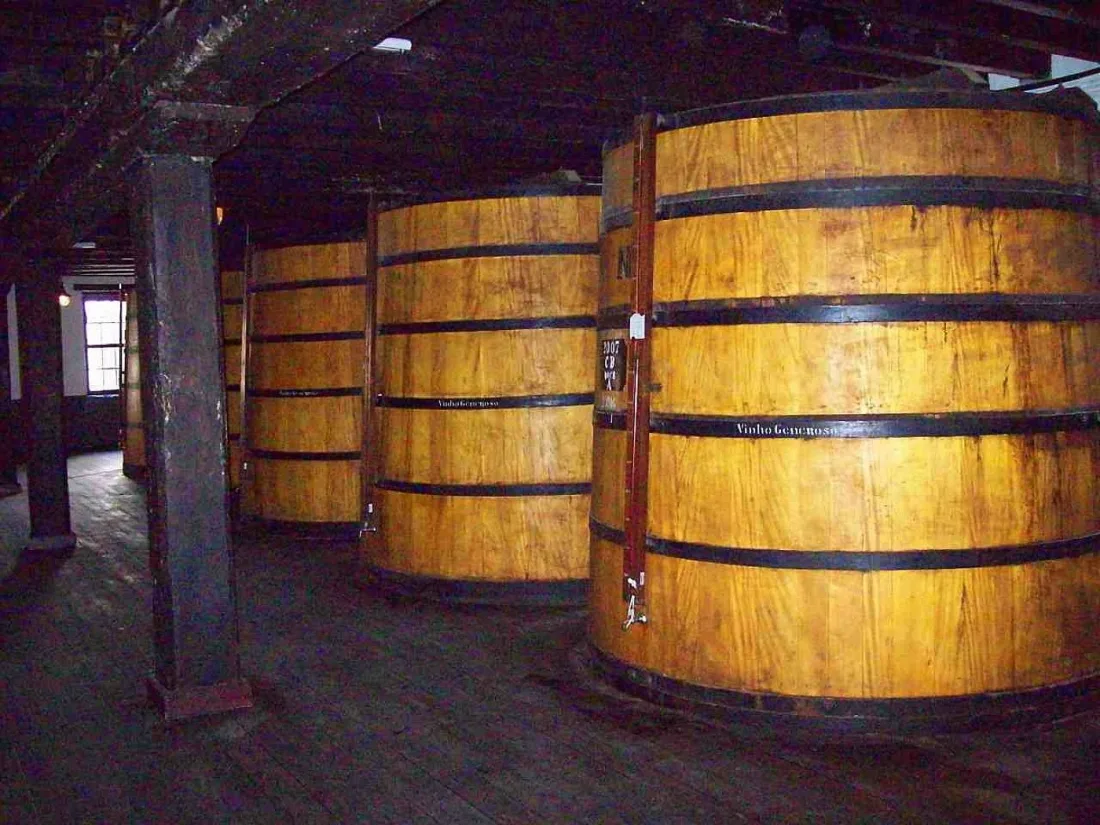
Photo: Nemracc, CC BY-SA 3.0 (Wikimedia Commons)
The start is ordinary enough: grapes are harvested, pressed and fermented, and then fortified with a neutral grape spirit that stops the fermentation and locks in the sweetness. The timing of that splash decides the style, added early for the sweetest wines and weeks later for the driest. Then comes the heat, and Madeira splits into two methods.
The everyday wines, the three- and five-year bottlings, go through estufagem, warmed in stainless-steel tanks to around 45 to 50 degrees Celsius for at least three months, a deliberate cooking that would horrify a Bordeaux winemaker but fast-forwards the aging. The finest wines take the slow road, the canteiro method, resting in oak casks in the warm lodge attics for years, sometimes decades, heated only by the Madeiran sun on the roof. Up there the wine loses a little to evaporation every year, the so-called angel's share, and slowly concentrates into something deeper and darker; a great canteiro Madeira may spend twenty, fifty, even a hundred years in the attic before anyone bottles it. The longer and gentler the heat, the more complex the wine, which is why a canteiro-aged Madeira costs what it does.
"If a tasting offers you an estufagem three-year-old next to a canteiro-aged older wine, take it. You will taste, in two sips, the difference between a clever shortcut and time itself." - Guidekin team
The Four Noble Grapes: Sercial to Malmsey
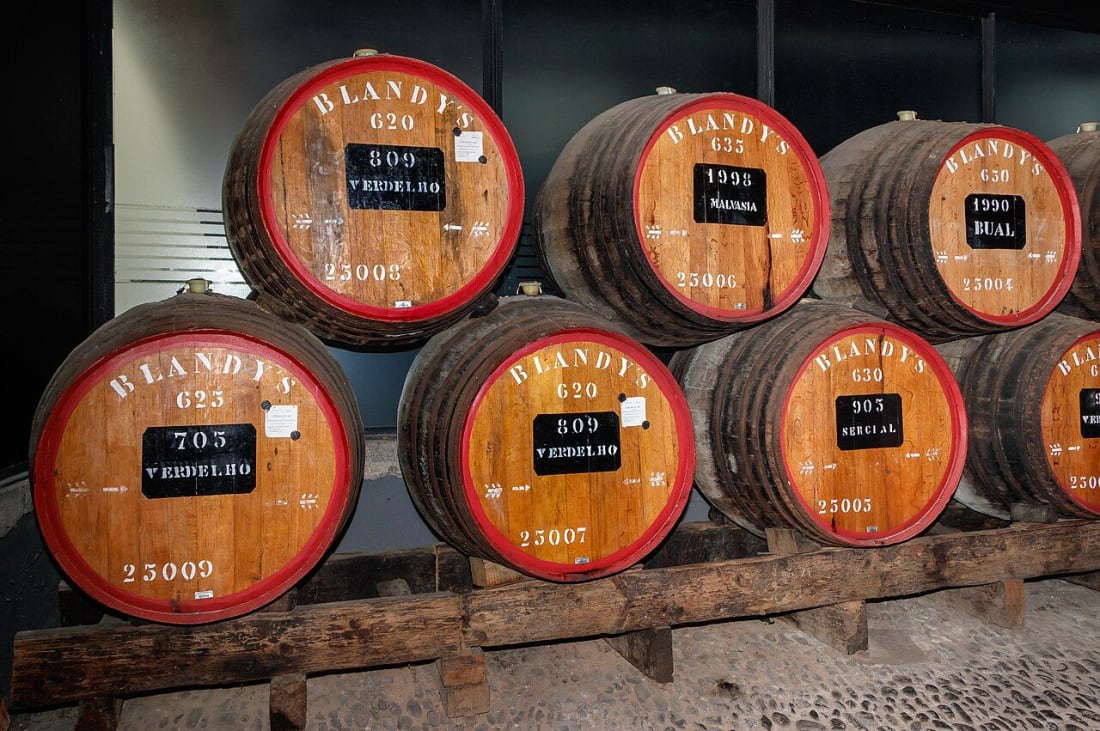
Photo: H. Zell, CC BY-SA 3.0 (Wikimedia Commons)
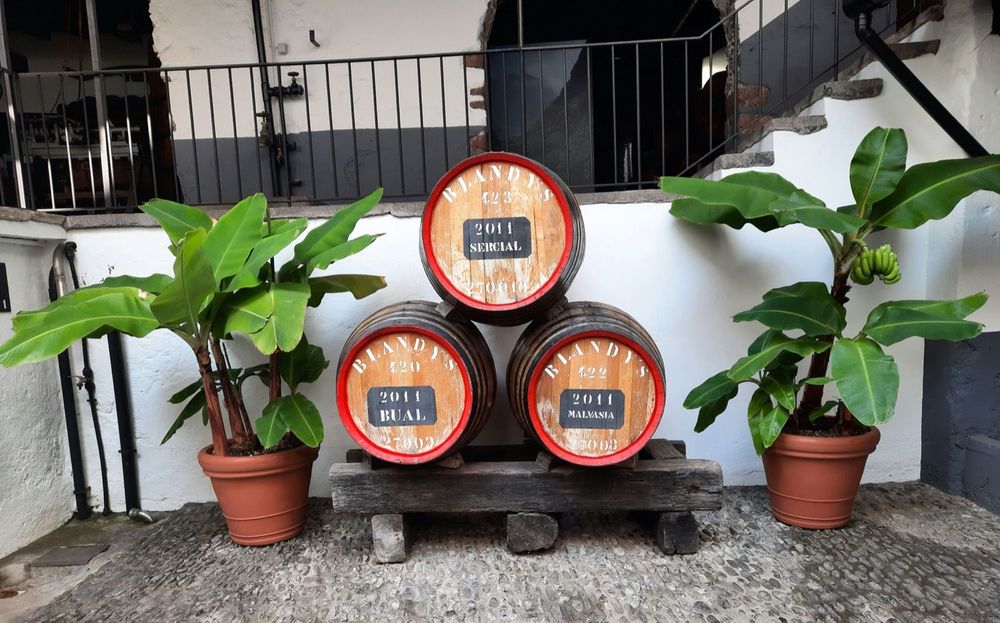
Classic Madeira is built on four "noble" grapes, and the easy way to remember them is as a sweetness scale from driest to sweetest.
- Sercial is the driest, pale and high in acid, with a steely, citrus-and-almond bite. Serve it chilled as an aperitif.
- Verdelho is medium-dry, a touch fuller and smoky, the everyday all-rounder and a fine match for soup or smoked fish.
- Bual (or Boal) is medium-sweet and rich, raisiny and dark, lovely with cheese.
- Malmsey (from the Malvasia grape) is the sweetest, deep brown and luscious, all dried fig and toffee, made for dessert.
Below the noble grapes, most cheaper and three-year wines are made from Tinta Negra, the island's workhorse variety, and you will also see "rainwater," a light, medium-dry old export style. At the top sit the Frasqueira (vintage) wines, made from a single year's harvest and aged at least 20 years in cask before bottling, the bottles people cellar for generations. For most of the 20th century the noble grapes grew so scarce that Tinta Negra quietly filled the majority of bottles; today the island is replanting Sercial, Verdelho, Bual and Malmsey across its terraces, so the classic styles are easier to find than they have been in a hundred years.
Planning tip: Do not judge Madeira by the splash that comes in a sauce. The cooking "Madeira wine" on supermarket shelves is a salted, basic version; the real thing, tasted properly at a lodge, is a different drink entirely.
Reading the Label: Age Statements
Once you know the four grapes, the numbers on the label do the rest. Most Madeira carries an age. The 3-year and 5-year wines are the everyday bottles, often made from Tinta Negra and aged by estufagem, while 10-year, 15-year and 20-year wines step up in depth and price, blended to an average age in the canteiro attics. Above them sit two collector tiers: a Colheita (a single-harvest wine aged at least five years) and the Frasqueira (a true vintage from one year, aged a minimum of 20 years in cask before bottling).
You will also meet Rainwater, a lighter medium-dry old export style, and the basic unaged wine sold for the kitchen. For most visitors the sweet spot is a 10-year in the style you liked at the tasting: old enough to be complex, young enough to be affordable.
Planning tip: For one bottle to carry home, a 10-year Bual or Malmsey is the easy crowd-pleaser, while a 10-year Sercial or Verdelho suits drier palates. Splurge on a Frasqueira only if a particular year means something to you, because a birth-year Madeira, still perfect decades on, is a famously good gift.
Where to Taste It in Funchal
The best part: you can taste serious Madeira in the middle of town, cheaply, any day of the week. Unlike the wine regions of the mainland, where tasting means a drive into the country, Madeira keeps its cellars in the heart of Funchal, a few minutes' walk from the cathedral and the Old Town. A few names to know.
Blandy's Wine Lodge on Avenida Arriaga is the grand, polished introduction, set in a 17th-century courtyard building. Its Lodge Tour runs about €15 with two tastings, a Premium tour around €20 with three, and a Vintage Premium tour near €54 that opens the Vintage Room and pours a Frasqueira (2026 prices). It is open daily, and worth booking ahead in summer. We'd start here if it is your first real taste of Madeira: the guided walk through the dim, cask-stacked lodge, past 19th-century barrels and the hushed Vintage Room, gives the wine its history before you ever lift a glass.
For something older and more intimate, Pereira d'Oliveira keeps a wonderfully creaky tasting room in a building dating to the 1600s, where the pours are generous, free, and often come with a slice of syrupy cake. The shelves behind the counter hold dusty bottles going back well over a century, and the staff pour them with the easy generosity of people who have done this their whole lives. It is less a tour than a glimpse into a working museum, and it costs nothing. Henriques & Henriques and H.M. Borges round out the old houses, with free tastings of their younger ranges. Both are unpretentious, family-rooted names that have been making wine here for well over a century, and a stop at either rounds out a picture the polished lodge tour alone cannot give you. The respected Barbeito keeps no shop in the center, so tasting its modern, elegant wines means a short trip out to Camara de Lobos, a worthwhile detour for the curious.
Local tip: Do the paid Blandy's tour for the history and the cellars, then wander to a free old tasting room like d'Oliveira for the soul of the thing. The contrast, the museum and the living shop, teaches you more than either alone, and the free pours are no less serious.
Beyond Funchal: the Vineyards
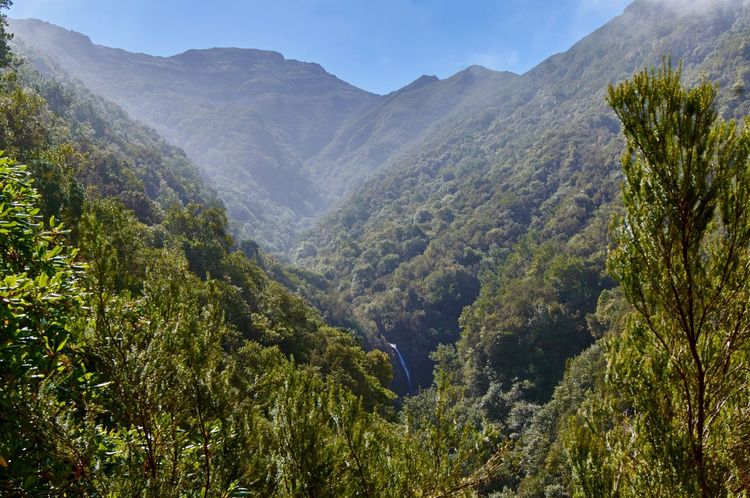
The wine is aged in town, but it is grown on the hills. The heartland is around Camara de Lobos and Estreito de Camara de Lobos, the steep fishing-village slopes just west of Funchal, where vines climb terraced poios (the dry-stone terraces) so sheer that the grapes are still carried down by hand, in baskets, at harvest. More vineyards cling to the cooler, greener north around Seixal and Sao Vicente, where the sea mist softens the heat.
A trip out to the vineyards turns a glass into a place. You see why Madeira is a wine of stubborn effort, every terrace hand-built, every harvest hand-hauled, and most cellar tours and tastings can be paired with a vineyard visit. Browse the island's Madeira wine and food experiences to find one that climbs into the hills rather than staying in town.
Detour: Camara de Lobos is a lovely half-day on its own, a working harbor of painted fishing boats that Winston Churchill once sat down to paint. Combine a vineyard tasting with lunch on the seafront and you have one of the island's most relaxed afternoons.
How to Drink Madeira
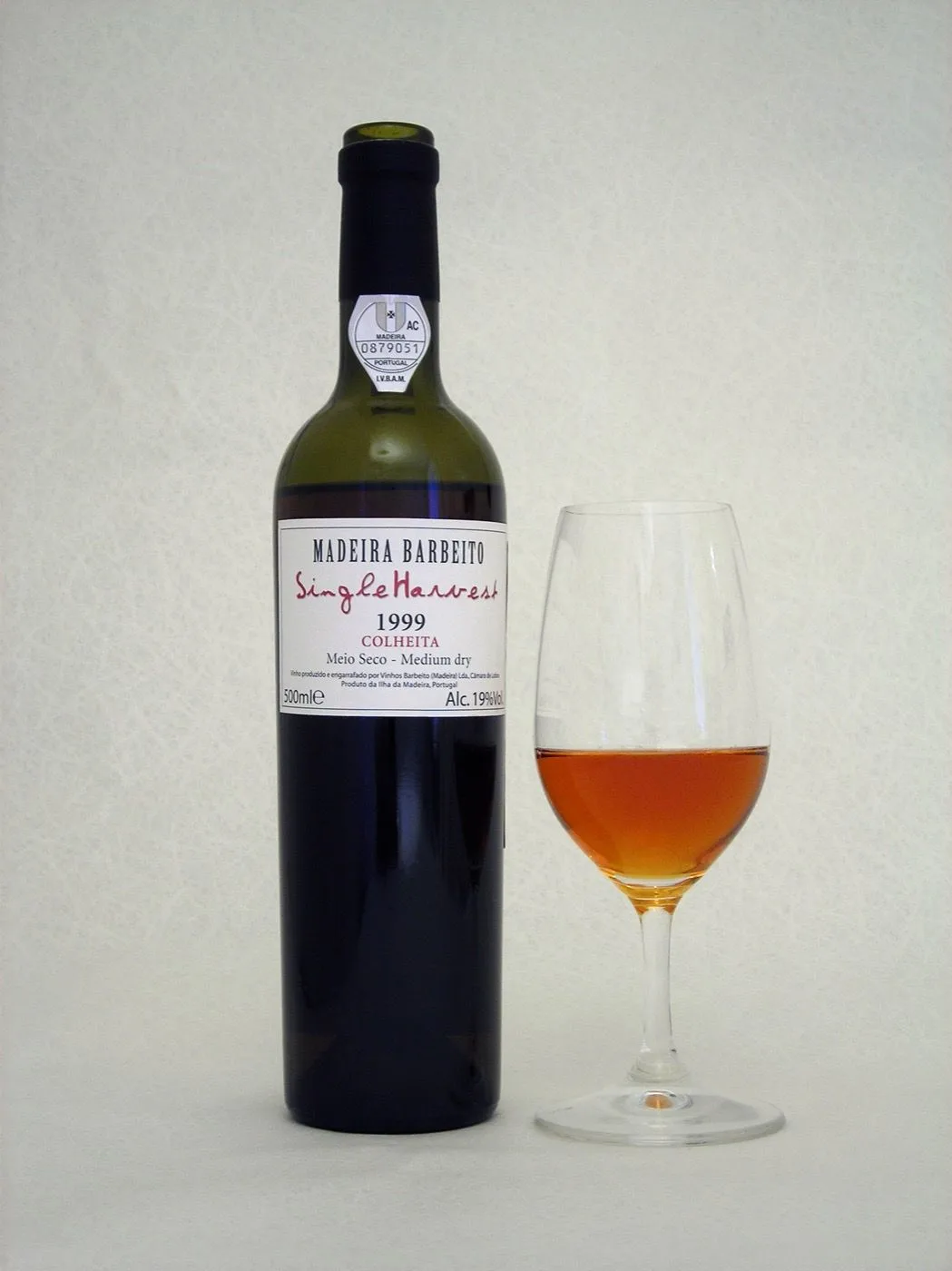
Photo: Origenes.Adamantius, CC BY-SA 4.0 (Wikimedia Commons)
Madeira is the most forgiving wine to serve. Chill a Sercial or Verdelho lightly and pour it as an aperitif with olives, almonds or that other island staple, a slice of bolo de mel (the dark Madeira honey-and-spice cake). Save the Bual for cheese and the Malmsey for after dinner, on its own or beside something chocolate. A small glass is plenty; this is a wine to sip, not swig. It is also a natural partner to the island's own sweets, from a dense slice of dark bolo de mel (honey-and-spice cake) studded with nuts to a simple bowl of toasted almonds, and on Madeira a small glass is the traditional way to welcome a guest to the house.
And forget the rules about finishing the bottle. Because it is already oxidized and heated half to death, an opened Madeira keeps for weeks or even months, slowly evolving rather than spoiling. Keep it corked in a cool cupboard and pour a glass whenever the island calls.
Local tip: Madeira is the great kitchen wine too, the secret behind a proper molho de vinho Madeira (Madeira sauce) and many a sauce and cake, but never cook with the bottle you would happily drink. Keep an everyday 3-year for the pan and your good 10-year for the glass, and the two will never be confused.
When to Visit: the Madeira Wine Festival
If you can time it, come for the Madeira Wine Festival in late August and early September, when the harvest is celebrated across the island. Expect costumed grape-treading in stone lagares (the old pressing troughs), folk dancing, and stalls pouring the season's first must beside espetada and bolo do caco. The Funchal festivities center on the Avenida Arriaga, while the rural celebration up in Estreito de Camara de Lobos, usually the following weekend, is the more traditional of the two, with whole streets given over to the vine. It is the island at its most joyfully old-fashioned, and the one time you can follow the whole chain, terrace to treading to glass, in a single day.
Madeira Wine at a Glance
| Style | Sweetness | Serve | Drink it with |
|---|---|---|---|
| Sercial | Driest | Chilled | Aperitif, olives, almonds |
| Verdelho | Medium-dry | Lightly chilled | Soup, smoked fish |
| Bual (Boal) | Medium-sweet | Room temp | Cheese, dried fruit |
| Malmsey (Malvasia) | Sweetest | Room temp | Dessert, chocolate, bolo de mel |
| Frasqueira (Vintage) | Varies | Room temp | Sipping slowly, special occasions |
Practical Tips
- Tour cheap, taste serious. A lodge tour with tastings starts around €15, and several old houses pour for free.
- Pair a paid tour with a free room. Blandy's for the history, d'Oliveira for the atmosphere.
- Buy the bottle you loved, not the airport one. Madeira travels and keeps superbly, so a tasting is really a chance to choose the souvenir you will actually enjoy back home.
- Go up to the vineyards around Camara de Lobos if you have a half day, to see where it grows.
- Sip, don't down it. Even the dry styles are intense; a small glass goes a long way.
- Mind the cooking stuff. Salted supermarket "Madeira" is for the pan, not the glass.
FAQ
What is Madeira wine?
Madeira is a fortified wine from the Portuguese island of Madeira, made distinctive by deliberate heating and oxidation that give it caramel, nutty, dried-fruit flavors and an almost indestructible shelf life. The technique was discovered by accident, when barrels shipped through the tropics came back tasting better, and it ranges from bone-dry to richly sweet. Few wines on earth pack as much history into a single glass.
What are the types of Madeira wine?
The four classic "noble" styles run from driest to sweetest: Sercial, Verdelho, Bual (Boal) and Malmsey (Malvasia). Cheaper and three-year wines often use the Tinta Negra grape, and top vintage wines are labeled Frasqueira. When a label simply gives a number of years, such as 10 or 15, that is the average age of the blend inside the bottle.
Where can you taste Madeira wine in Funchal?
At historic lodges in the center: Blandy's Wine Lodge on Avenida Arriaga (tours from around €15 with tastings), and free tasting rooms like Pereira d'Oliveira, Henriques & Henriques and H.M. Borges. Most are walkable from the Old Town.
How much does a Madeira wine tasting cost?
Blandy's tours run roughly €15 to €54 (2026) depending on how many and how old the wines are, while several traditional houses offer free tastings of their younger ranges. Even the grand vintage tour at Blandy's costs less than a comparable tasting on the mainland, and the old family tasting rooms ask nothing at all, which makes it one of the best-value wine experiences in Portugal.
How long does Madeira wine last once opened?
Unusually long. Because it is already heated and oxidized, an open bottle keeps for weeks or even months in a cool cupboard, slowly evolving rather than spoiling, which makes it a perfect souvenir. The lodges still pour vintage wines from the 1800s that are very much alive, which tells you all you need to know about its staying power.
How should you serve Madeira wine?
Chill the dry styles (Sercial, Verdelho) and serve them as an aperitif; serve the sweet styles (Bual, Malmsey) at room temperature with cheese or dessert. Use a small glass, pour just a little, and remember there is no need to finish the bottle that night, since it keeps for weeks once open.
Raise a Glass to the Island
Madeira wine is the island in a bottle: stubborn, sun-baked, and built to last. Tour a centuries-old lodge, taste your way from dry to sweet, and carry home the one bottle that tasted most like your trip. Few drinks reward a little curiosity so generously, or remember a holiday so faithfully, as the glass you raise to the island that made it. When you are ready to plan it, browse Madeira wine and food experiences and find a tasting, or a vineyard, to call your own.