Picture yourself in a kayak at dawn, gliding into the Benagil sea cave as a single column of sunlight drops through the hole in its roof onto an empty crescent of sand. Now picture the same cave at eleven in the morning: a churn of thirty boats, and a rule that says you can no longer set foot on that sand at all. That gap, between the Algarve everyone photographs and the one locals actually enjoy, is the whole point of this guide. There are endless things to do in the Algarve, but the difference between a great trip and a frustrating one is almost always timing and knowing where to point yourself.
Portugal's south coast is really three coasts wearing one name, and the fastest way to spoil a short trip is to chase all of them. So here is a local's guide to the Algarve: how the region splits, what to do in each part, where the real beaches and the best food hide, and how to get around once the tolls vanished. For one of its star sights, dive deeper with our Benagil Cave guide.
Read on for the three coasts, the caves, the beaches, the food, and the planning that ties it together.
Key Takeaways
- The Algarve is three regions in one: the cliffy central coast, the wild surf southwest, and the warm, calm east. Pick your coast →
- The central Algarve has the famous caves and golden-cliff beaches, including Benagil. Central Algarve →
- The eastern Algarve has the warmest sea, cheap island ferries, and far fewer crowds. Eastern Algarve →
- Skip July and August: June and September bring near-identical weather with fewer people. When to go →
- A car unlocks the west; the train-linked east works well without one. Getting around →
The Best Things to Do in the Algarve, Coast by Coast
Before you book anything, make one decision, because it shapes everything else. The Algarve splits into three very different stretches. The central and western coast, the Barlavento (the windward shore) around Lagoa and Lagos, is the postcard Algarve of orange cliffs, sea caves and turquoise coves. The southwest, around Sagres, is the wild Atlantic edge: cooler, windier, emptier, made for surfers. And the east, the Sotavento (the leeward coast) around Faro and Tavira, is flat, calm and warm, all lagoon and barrier islands.
They sit a long way apart. Driving from Tavira in the east to Lagos in the west crosses the entire region, well over an hour on the motorway even without stops, and trying to "do" both ends in a few days means spending most of your holiday behind the wheel. Pick a coast, base yourself there, and lean into it; the other ends will keep for another trip, or a single long day out.
Local tip: Match the coast to your trip. Families and first-timers usually want the calm, warm east or the lively center; surfers and solitude-seekers want the southwest; cave-and-cliff photographers want the center.
"Ask a local for the best part of the Algarve and they will ask a question straight back: do you want the cliffs or the lagoon? Answer that one honestly and the whole trip more or less plans itself." - Guidekin team
The Central Algarve: Benagil, Caves and Golden Cliffs
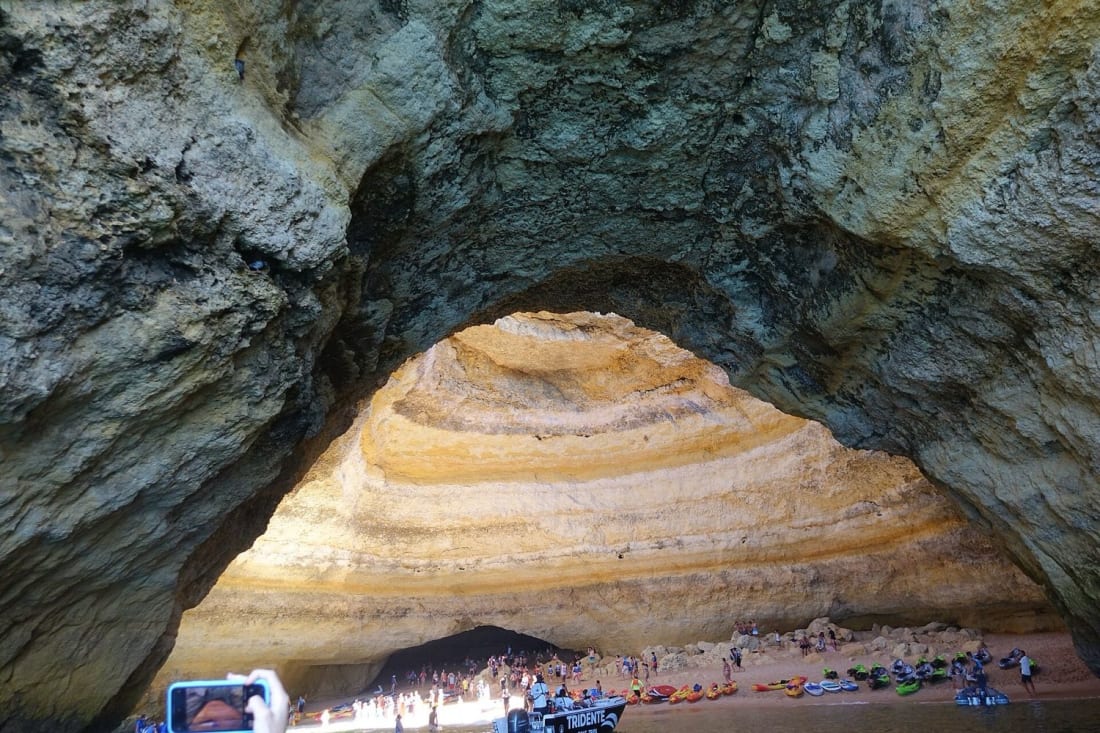
Photo: Joseolgon, CC BY-SA 4.0 (Wikimedia Commons)
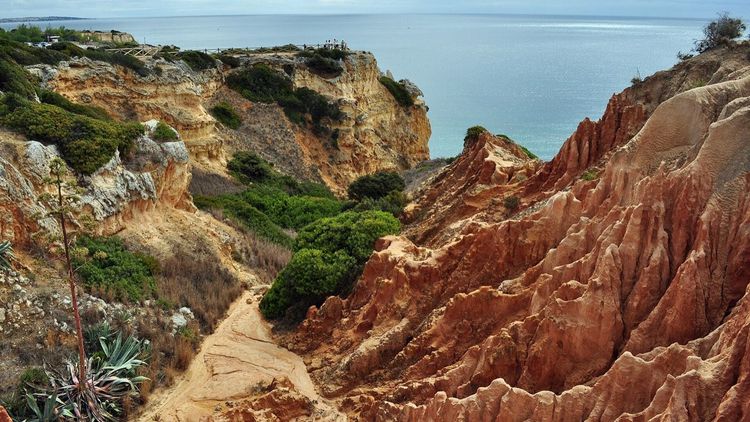
This is the Algarve of the brochures, and it lives up to it. The star is the Benagil Cave, the domed sea cave with a skylight, but since August 2024 you can no longer swim in or land on its inner beach; you go by licensed boat (about two minutes inside) or, far better, a guided kayak or SUP (about eight minutes). Go at first light or in shoulder season, or simply walk five minutes from the Benagil car park to peer down through the skylight for free. Our Benagil Cave guide has the full 2026 playbook, and you can compare trips among the area's boat tours.
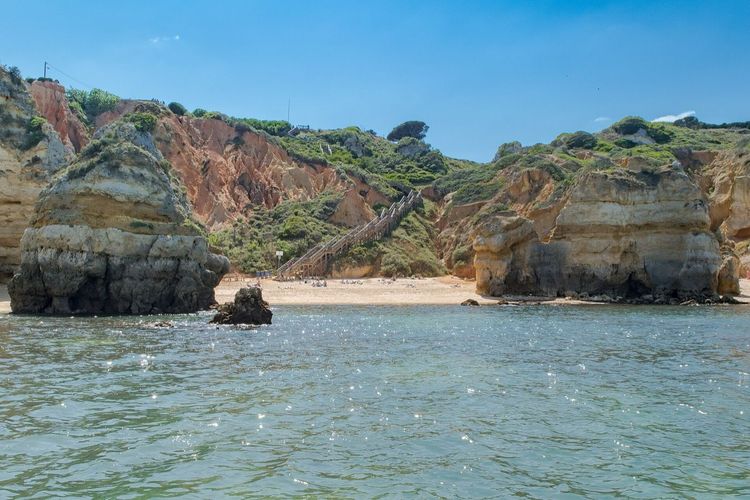
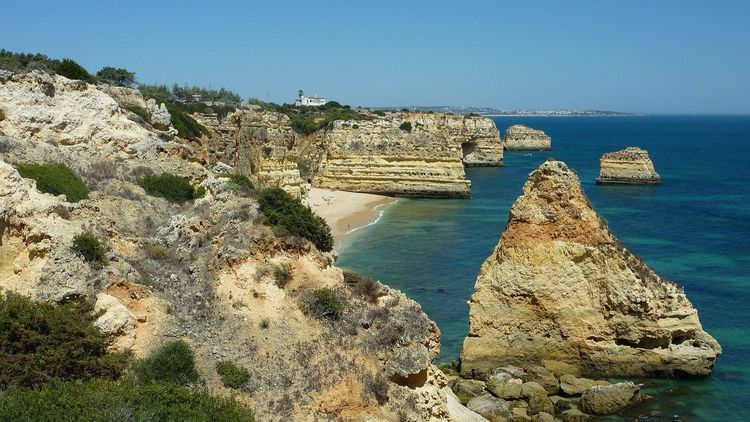
Beyond the cave, Praia da Marinha (named by Michelin among Europe's ten most beautiful beaches) hides a heart-shaped double arch best seen at lower tide, and the Seven Hanging Valleys Trail strings the coves together over about 5.7km of clifftop from Marinha toward Carvoeiro, a walk of roughly two and a half hours one way past hidden beaches most visitors never find. Walk part of it, taste wine at a quinta (a wine estate) in nearby Lagoa, and stroll the Carvoeiro boardwalk to the Algar Seco caves at golden hour. One catch worth planning around: Marinha's small clifftop car park fills within an hour or two of sunrise in summer, after which the access road closes, so an early start here is not optional, it is the whole strategy. It is worth the alarm clock, because the first light on those ochre cliffs, with the coves below still empty, is exactly the Algarve you came to see.
Lagos and the Western Cliffs
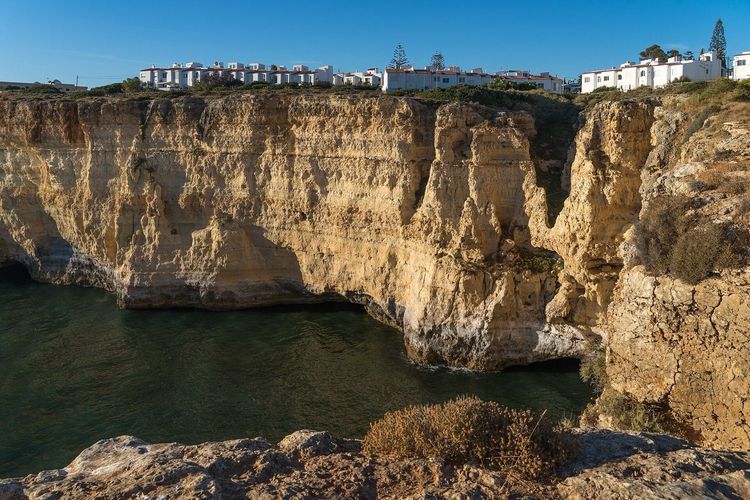
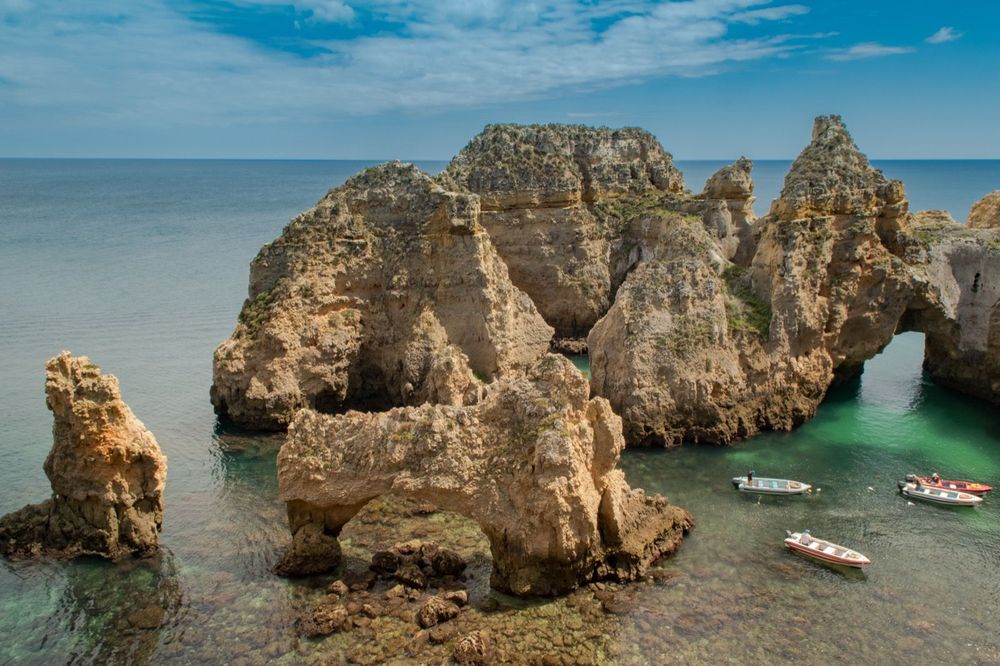
A little further west, Lagos is the best base on the cliff coast: a walled old town wrapped around a marina, with the Algarve's most spectacular rock formations on its doorstep. The headline is Ponta da Piedade, a tangle of ochre sea-stacks and grottoes you can see three ways: a small-boat tour (around €20 to €35), a guided kayak (about €40), or for free, the clifftop boardwalk and the 182 wooden steps down to the water.
The town's beaches are a roll-call of coves: sheltered Praia do Camilo down its long staircase, photogenic Dona Ana, and the 4km sweep of Meia Praia, which has its own little train halt and the region's best windsurfing. Lagos also carries a heavy history: the first sale of enslaved Africans in modern Europe took place inside these walls in 1444, and the old market building is now a sober museum confronting that past, a dark counterweight to the holiday glamour. See the cliffs early, because the water turns into a beehive of boats by late morning.
Sagres and the Wild West
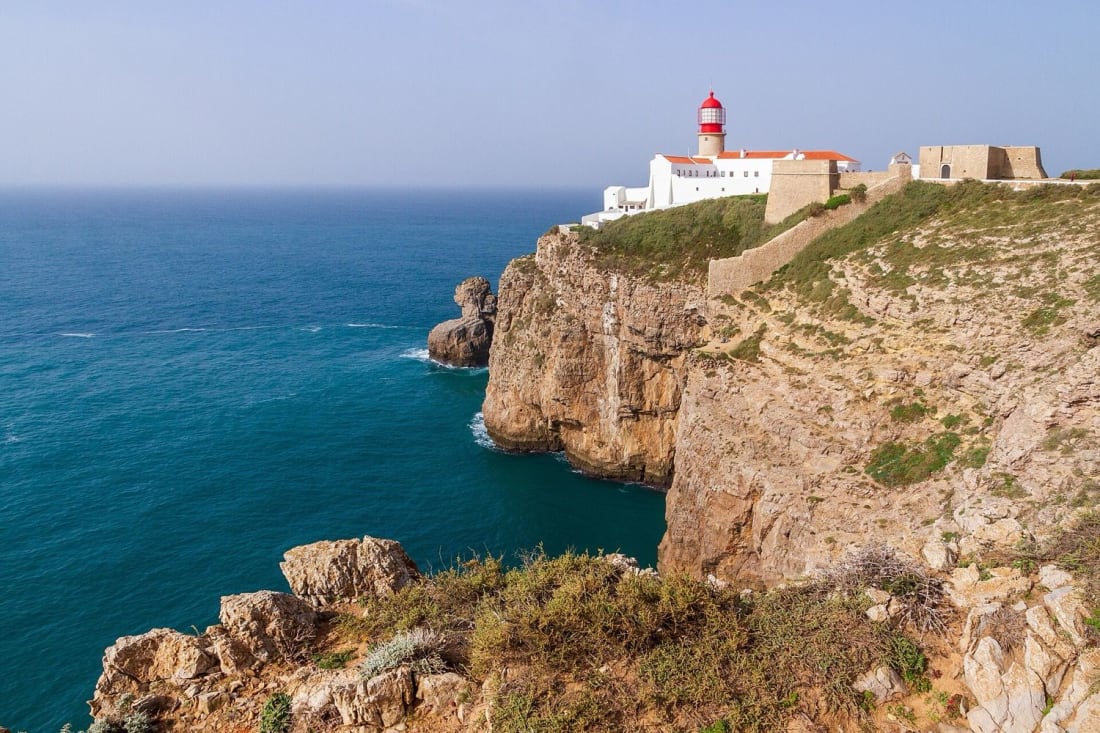
Photo: Matthias Süßen, CC BY-SA 4.0 (Wikimedia Commons)
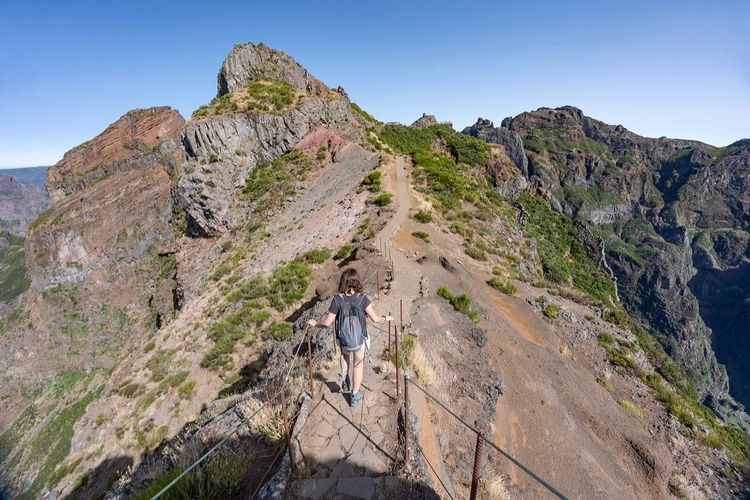
Keep driving west and the Algarve changes climate. The southwest, around Sagres, is wind-scoured, raw and gloriously empty, all inside the protected Costa Vicentina natural park. This is Portugal's surf country, and the air is cooler and the water colder (around 20 to 22C) than the sheltered south.
Stand at Cabo de Sao Vicente, the southwesternmost point of mainland Europe, where a powerful 19th-century lighthouse throws its beam up to 60km out to sea, and watch the sun drop off the edge of the continent. Tour the windswept Fortaleza de Sagres (about €3), take a beginner surf lesson at Amado or Bordeira (half-day group lessons run roughly €40 to €60 with gear), or walk a stage of the Rota Vicentina coastal trail. A quirky institution waits at the cape itself: a German sausage van that has billed itself as the Last Bratwurst Before America since 1996. The surrounding natural park, nearly 900 square kilometers of protected cliff and dune, is the only place on earth where white storks nest on sea stacks. A car is essentially mandatory out here, and a hoodie is not a bad idea even in summer.
Detour: North of Sagres, Aljezur has a free hilltop Moorish castle and a local obsession with sweet potatoes, while Odeceixe sits on a perfect river-meets-sea beach where you can swim on the calm freshwater side when the Atlantic is too wild.
Faro and the Eastern Algarve: Ria Formosa
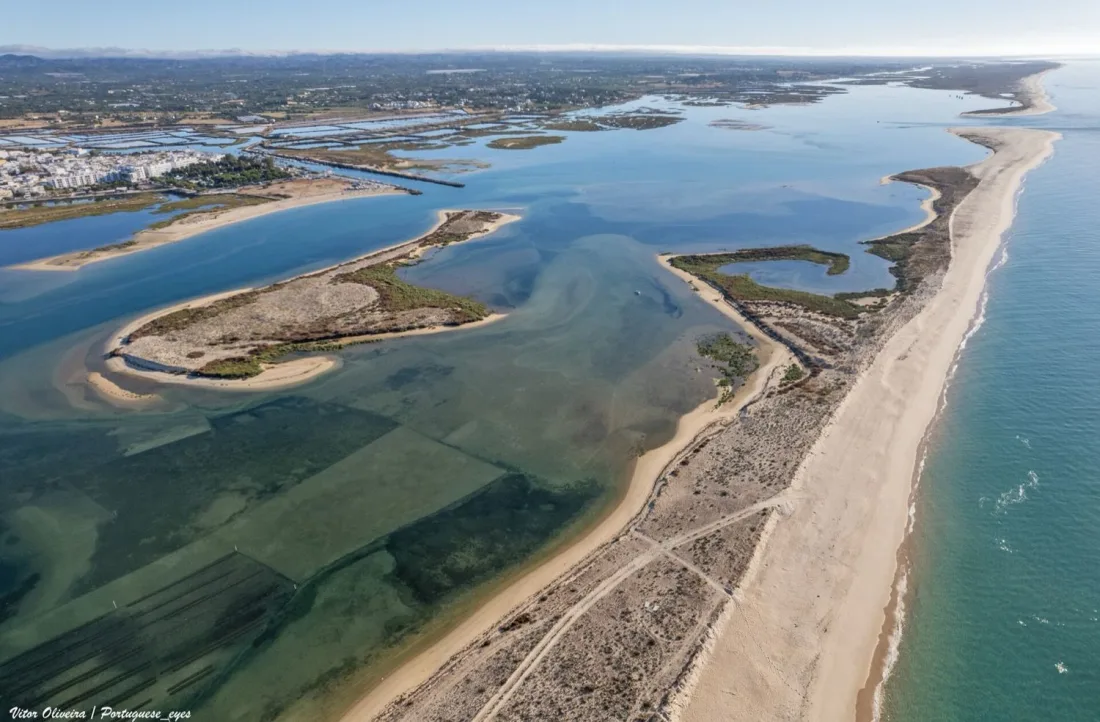
Photo: Vitor Oliveira from Torres Vedras, PORTUGAL, CC BY-SA 2.0 (Wikimedia Commons)
The eastern Algarve, the Sotavento, is the region's quiet, nature-led half, and the smart choice if you want warm water and no crowds. Here the cliffs give way to the Ria Formosa, a ria (a sheltered coastal lagoon) stretching some 60km behind a chain of barrier islands you reach by cheap little ferries.
Start in Faro, dismissed by most as "just the airport," which is exactly why its walled old town, cathedral and eerie bone chapel stay so calm. That chapel, the Capela dos Ossos, is lined with the bones of more than a thousand monks, a startling, quiet thing to stumble on behind a sleepy cathedral square. From the working fishing port of Olhao, ferries reach the lived-in island villages of Culatra and Armona for about €4 return. Further east, elegant Tavira straddles a river under an old arched bridge, with a short, cheap ferry to the long sands of Ilha de Tavira, where Praia do Barril is guarded by a strange and lovely graveyard of rusting anchors stranded in the dunes, the last relic of a tuna fishery that once defined this whole coast. The lagoon islands hold the warmest sea on mainland Portugal, often 25C in high summer, and you reach the city itself via Faro's boat tours and ferries and the coastal train.
Albufeira and the Resort Heart
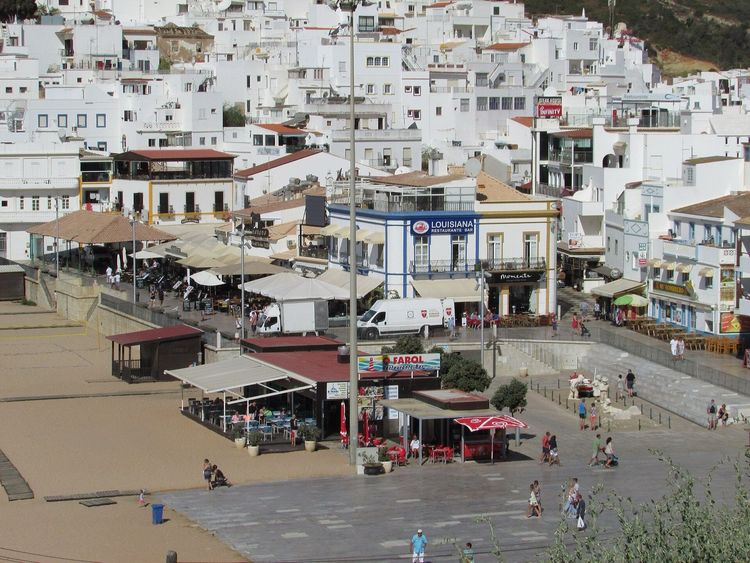
Smack in the middle sits Albufeira, the Algarve's tourism engine, whose population swells from about 40,000 to perhaps 300,000 in summer. It is divisive, and honestly the famous Strip of bars and clubs is skippable unless a big night out is your thing. But the whitewashed Old Town climbing up to the Pau da Bandeira miradouro (viewpoint) is genuinely pretty, and our full Albufeira guide explains how the town splits into three separate places, and the beaches are superb.
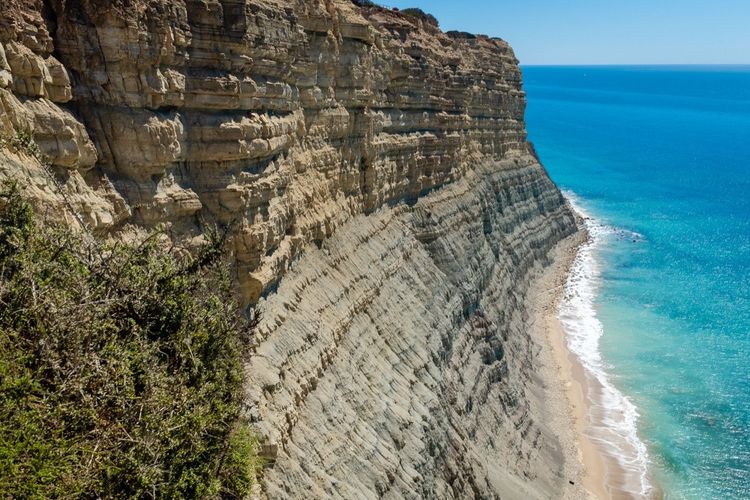
The standout is Praia da Falesia, a 6km ribbon of sand under glowing orange-and-white cliffs up to 30 metres high that topped TripAdvisor's best-beach-in-the-world list in 2024. Nearby Vilamoura brings the largest marina in the region, an 825-berth showpiece ringed with restaurants, plus a casino, six golf courses and the Roman ruins of Cerro da Vila. Families have their pick of big water parks. Browse things to do in Albufeira to build a day around it, and remember that walking ten minutes from any beach access point loses most of the crowd.
Inland Algarve: Castles, Mountains and Markets
Almost everyone stays on the coast, which is why the interior is such a pleasure. Drive twenty minutes uphill and the resorts vanish into orange groves and cork oaks.
The medieval capital of Silves is crowned by one of Portugal's best-preserved Moorish castles, in deep-red sandstone (about €2.80 to enter), and throws a huge medieval fair each August. Higher still, the Serra de Monchique (a serra is a mountain range) climbs to Foia, the Algarve's 902m roof, with a thermal spa village whose springs surface at a constant 32C, walking trails, and the local firewater, medronho (arbutus-berry brandy), a fierce clear spirit of around 40 to 50 percent distilled in copper stills up in these hills. Add the Saturday mercado (market) town of Loule, busiest before mid-morning, and the Roman fish mosaics at Milreu near Estoi, and you have a cooler, quieter Algarve most visitors never meet.
Planning tip: In high summer, flip your day. The interior can hit 38C by noon, so do inland sights in the cool morning and retreat to the breezy coast in the afternoon.
The Best Beaches (and How to Pick One)
The Algarve flies more Blue Flags than any other Portuguese region (91 in 2025), so the real question is not whether a beach is good but which kind you want. For drama, the central cliff coves (Marinha, Camilo, Benagil) win. For warm, calm, shallow water, the eastern lagoon islands are unbeatable, and a €2 ferry buys you far more space than a towel-fight at a resort. For surf and space, the wild west (Amado, Bordeira, Arrifana). Each praia (beach) keeps its own crowd and mood, from family-friendly flats to surfers-only swells, so it pays to match the beach to your plan for the day rather than chasing a name off a ranking.
One hard-won local rule: a "best beach" is useless if the staircase is shut. The cliff coves erode, and access closes without warning (Praia do Camilo's steps were flagged dangerous in early 2026). Check on the day, never sit beneath an undercut cliff, and remember the photogenic west coves are colder and rougher than they look.
What to Eat in the Algarve
The Algarve cooks differently from the rest of Portugal, with a Moorish sweet tooth, a deep love of marisco (shellfish), and the freshest seafood in the country. The dish to find is cataplana, a fragrant fish-and-shellfish stew steamed in a hinged copper pot; it tastes most of this coast, and ordering one for two is the right way to settle into a long Algarve lunch. Inland near Albufeira, Guia is the self-declared capital of frango piri-piri (spicy grilled chicken). On the coast, chase grilled sardines (fattest from July to September, despite the June festivals), octopus in Santa Luzia, where it is still caught in Phoenician-style clay pots, and fresh oysters at tiny Cacela Velha above its lagoon. None of it is fancy, and that is the charm; the Algarve eats simply, and very well.
Local tip: Eat where Portuguese families eat, which means the eastern fishing towns, not the resort strips. The cheapest genuinely great meal on the whole coast is a plate of grilled fish upstairs at Olhao's old market hall, surrounded by locals doing exactly the same.
Planning: Getting There, Around, and When to Go
Almost everyone arrives through Faro Airport, the region's only commercial airport, just 4km from the city and well connected across the coast. It is Portugal's third-busiest airport, handling close to ten million passengers a year with the UK its largest market, so cheap flights are plentiful. Getting around got much easier in 2025: the A22 motorway has been completely toll-free since January, so the old dread of the coastal road and electronic tolls is gone. Faro to Albufeira is about 40 minutes, Faro to Lagos about an hour, Faro to Sagres around an hour and a half.
If you would rather not drive, base in the east: a single coastal train line links Lagos, Portimao, Albufeira, Faro and Tavira cheaply, so the flat eastern towns work car-free. The photogenic west, though, effectively needs wheels. Coming from the capital? Pair this with our best day trips and routes from Lisbon for the drive down.
As for timing, do not default to July and August. June and September deliver near-identical heat and warm sea with far fewer people and lower prices; even in peak summer the central sea only reaches about 21 to 23C. Five to seven days is the sweet spot for a first trip. On money, reckon on roughly €65 a day at the simple end and €160 or more for mid-range comfort, with the eastern towns noticeably cheaper than glossy Albufeira and Vilamoura, and a peak August week costing two to three times a quiet month.
The Algarve at a Glance
| Coast | Character | Best for | Base |
|---|---|---|---|
| Central (Lagoa, Carvoeiro) | Golden cliffs, sea caves | Benagil, scenic coves, hiking | Carvoeiro, Lagoa |
| Western cliffs (Lagos) | Sea-stacks, walled town | First-timers, boat trips | Lagos |
| Southwest (Sagres) | Wild Atlantic, surf | Surfers, solitude, sunsets | Sagres, Aljezur |
| East / Sotavento (Faro) | Lagoon, warm sea, islands | Families, calm, car-free | Tavira, Olhao, Faro |
| Resort heart (Albufeira) | Big resorts, nightlife | Families, golf, going out | Albufeira, Vilamoura |
| Inland (Silves, Monchique) | Castles, mountains | History, cool escapes | Day trips |
Practical Tips
- Pick one coast. The region is bigger than it looks; trying to do all three at once means more or less living in the car.
- Go in June or September. Almost the same weather as August, far fewer people, cheaper rooms.
- Visit Benagil early or by kayak. No swimming or landing since 2024, so plan the new way and beat the boats.
- Use the toll-free A22 to drive, or base in the train-linked east if you would rather not.
- Walk ten minutes from beach car parks to leave most of the crowd behind.
- Check cliff-beach access on the day. Staircases erode and close without notice.
FAQ
How many days do you need in the Algarve?
Five to seven days is the sweet spot for a first trip, enough for Benagil, the Seven Hanging Valleys Trail, a couple of towns and real beach time. Two or three days works only if you stick to one small area, since the region is large and spread out.
Which part of the Algarve is best?
It depends on your trip. The central coast (Lagoa, Carvoeiro) has the famous caves and cliffs; Lagos is the best all-round western base; the southwest (Sagres) is for surf and solitude; and the east (Tavira, Faro, the Ria Formosa islands) has the warmest, calmest water and the fewest crowds.
Can you still go inside the Benagil Cave?
Yes, but only by licensed boat or a guided kayak or SUP. Since August 2024 you cannot swim to it or land on the beach inside, and you cannot walk in. You can also look down through the skylight for free from the clifftop above.
When is the best time to visit the Algarve?
June and September are ideal: warm, sunny and far less crowded than July and August, with lower prices. The swimming season runs roughly June to October, and the eastern lagoon has the warmest sea.
Do you need a car in the Algarve?
For the central and western coast, effectively yes, as the best beaches and viewpoints are scattered and bus links are patchy. The eastern Algarve is the exception: a coastal train links the main towns, so you can happily base there car-free.
Is Faro Airport far from the resorts?
No. Faro Airport is 4km from Faro city and well placed for the whole coast: about 40 minutes to Albufeira and an hour to Lagos on the now toll-free A22.
Choose Your Coast and Go
The Algarve rewards the traveller who chooses. Pick the cliffs or the lagoon or the surf, base yourself there, go early to the famous sights, and leave the rest for next time. The region is generous to travellers who slow down, and stingy to those who try to grab all of it at once. Do that and the south coast delivers some of the best beaches, food and light in Europe, without the crowds you were dreading. When you are ready to plan, browse Algarve tours and experiences in Faro and Albufeira, and for current conditions the official Visit Algarve and Visit Portugal sites are a useful last read before you book.