Key Takeaways
- Faro is the capital of the Algarve and the gateway most people fly into, then leave straight away. That is a mistake. The old town, the lagoon and the island beaches make it worth two or three days of its own. Ria Formosa and the →
- The walled Cidade Velha (old town) is the heart of things to do in Faro: cobbled lanes, a cathedral you can climb, and one of Portugal's eeriest sights, a chapel lined with human bones. The Old Town →
- Faro's beaches are not in the city. They sit out on the barrier islands of the Ria Formosa lagoon, reached by a short ferry or boat trip, and they are some of the wildest sand in the Algarve. Ria Formosa and the →
- Faro makes a relaxed base for the eastern Algarve, with Tavira, Olhao and the Roman ruins at Estoi all close by. Day Trips from Faro →
- Go for the shoulder months. May, June, September and October give you warm water and island beaches without the July crowds. When to Visit and →
Faro Is More Than the Airport
Most visitors see Faro for about twenty minutes, the stretch between the plane and the rental car desk, before they drive off to a resort. For years that was the town's reputation: the place you pass through on the way to the Algarve. It is also why Faro is one of the most underrated towns in southern Portugal.
Stay a night or two and a different town shows up. Faro has a walled old quarter that has barely changed in centuries, a working harbour on the edge of a vast lagoon, and a string of beach islands you reach by boat instead of by road. It is smaller and quieter than Albufeira or Lagos, with far fewer bars and a lot more everyday Portuguese life. The crowds that fill the rest of the Algarve in summer mostly skip it.
So if you are looking for things to do in Faro beyond catching a flight, here is what actually fills a couple of days, from the cathedral and the bone chapel to the wild beaches out on the Ria Formosa.
The Old Town: Faro's Cidade Velha
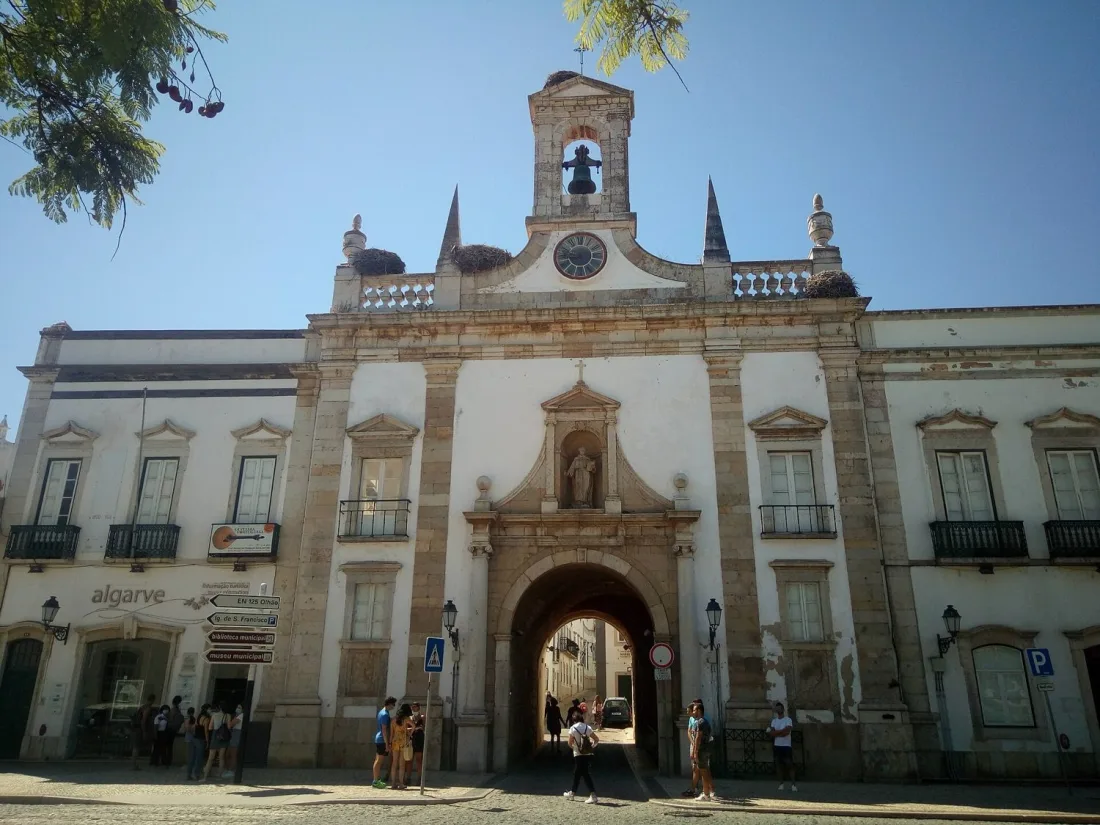
Photo: Hugo Ferreira, CC BY-SA 4.0 (Wikimedia Commons)
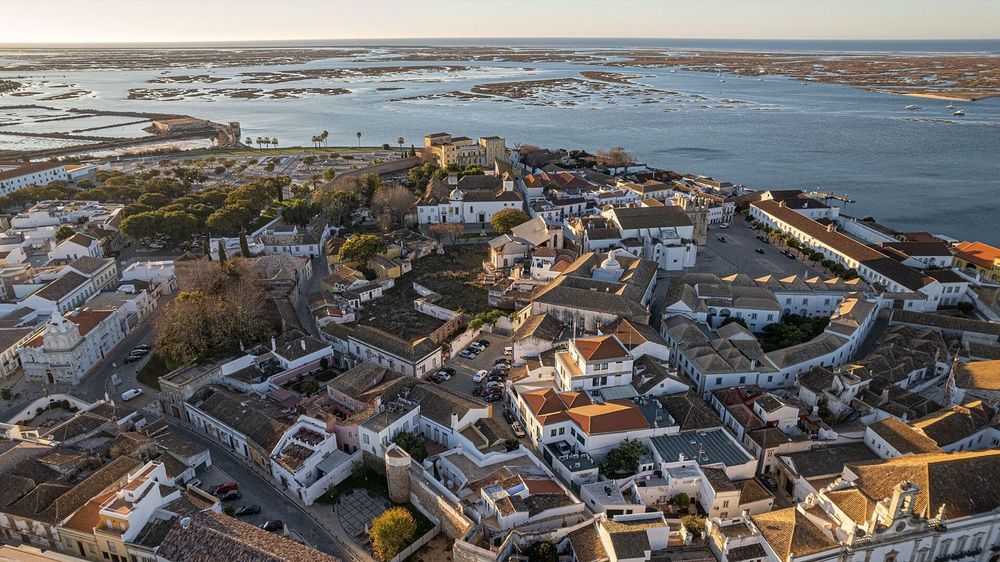
Start where Faro started. The Cidade Velha, the old town, sits behind a ring of medieval and Renaissance walls right next to the marina, and stepping through the gate is the moment the town finally makes sense.
You enter under the Arco da Vila, a grand neoclassical archway built where the Moorish gate once stood. Look up: there is almost always a stork nesting on top of it, and on the rooftops and bell towers all around the old town. Inside the walls the noise drops away. The lanes are cobbled and narrow, the buildings low and whitewashed with the odd splash of azulejo tiles, and orange trees line the squares. It is the kind of place you wander without a map for an hour and come out the other side relaxed.
The old town is compact, which is part of its charm. Faro old town is something you walk, not something you plan. A guided walking tour is worth it here if you want the history behind the walls, the sieges, the earthquake of 1755 that flattened much of the town, and the layers of Moorish, Christian and Jewish Faro that are easy to miss on your own. Otherwise just follow the lanes toward the cathedral square at the centre.
There is more inside the walls than first appears. The Museu Municipal, set in a sixteenth-century convent with a quiet cloister, holds Roman mosaics dug up around the region and is worth half an hour out of the sun. Faro also kept one of Portugal's oldest Jewish communities, and you can still trace its mark in the old quarter and at the Jewish heritage cemetery just outside the centre. Around the marina, the nineteenth-century Teatro Lethes, a tiny jewel-box theatre modelled on La Scala, is one of those small surprises that tell you Faro was once a wealthier, more confident town than its airport reputation suggests.
Climb the cathedral tower late in the afternoon. From the top you get the whole old town spread below you, the lagoon and its islands stretching out to the sea, and the storks at eye level on the rooftops. It is the best view in Faro and almost nobody is up there.
The Cathedral and the Bone Chapel
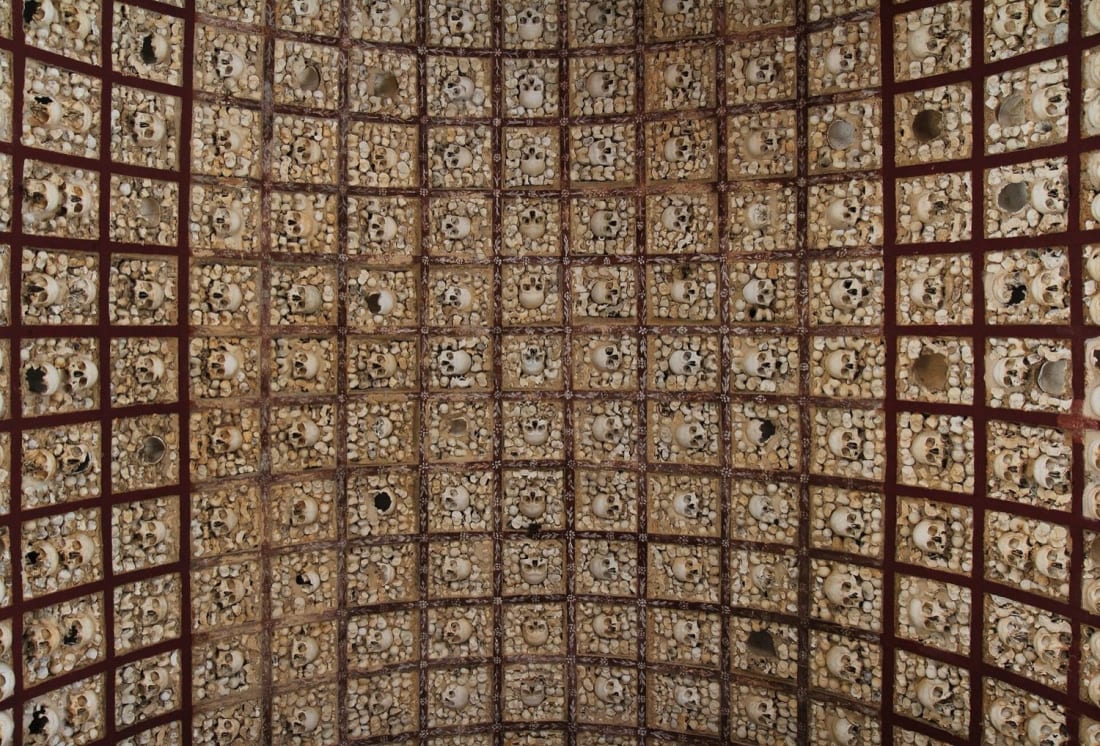
Photo: Till Niermann, CC BY 3.0 (Wikimedia Commons)
Two churches anchor a visit to Faro, and they could not be more different.
The Sé, Faro's cathedral, stands on a wide orange-tree square in the old town. It is a patchwork of styles, built and rebuilt after earthquakes and raids since the thirteenth century, with a Gothic tower, baroque chapels and walls of blue azulejo tiles inside. The reason to go is the tower. A narrow climb takes you up to a terrace with the best panorama in town, over the rooftops and out across the Ria Formosa.
Then there is the Capela dos Ossos, the Bone Chapel, attached to the Igreja do Carmo a short walk from the old town. The small chapel is lined, walls and ceiling, with the bones and skulls of more than a thousand monks, arranged in careful patterns. An inscription over the door translates as a reminder that the bones waiting here are waiting for yours. It sounds grim, and it is, but it is also quietly beautiful and one of the most photographed corners of Faro. Igreja do Carmo itself, gilded and baroque, is worth the few minutes before you step into the chapel out the back.
Between the two churches and the old town walls, you have a solid half day in the centre before you even think about the water.
Ria Formosa and the Island Beaches
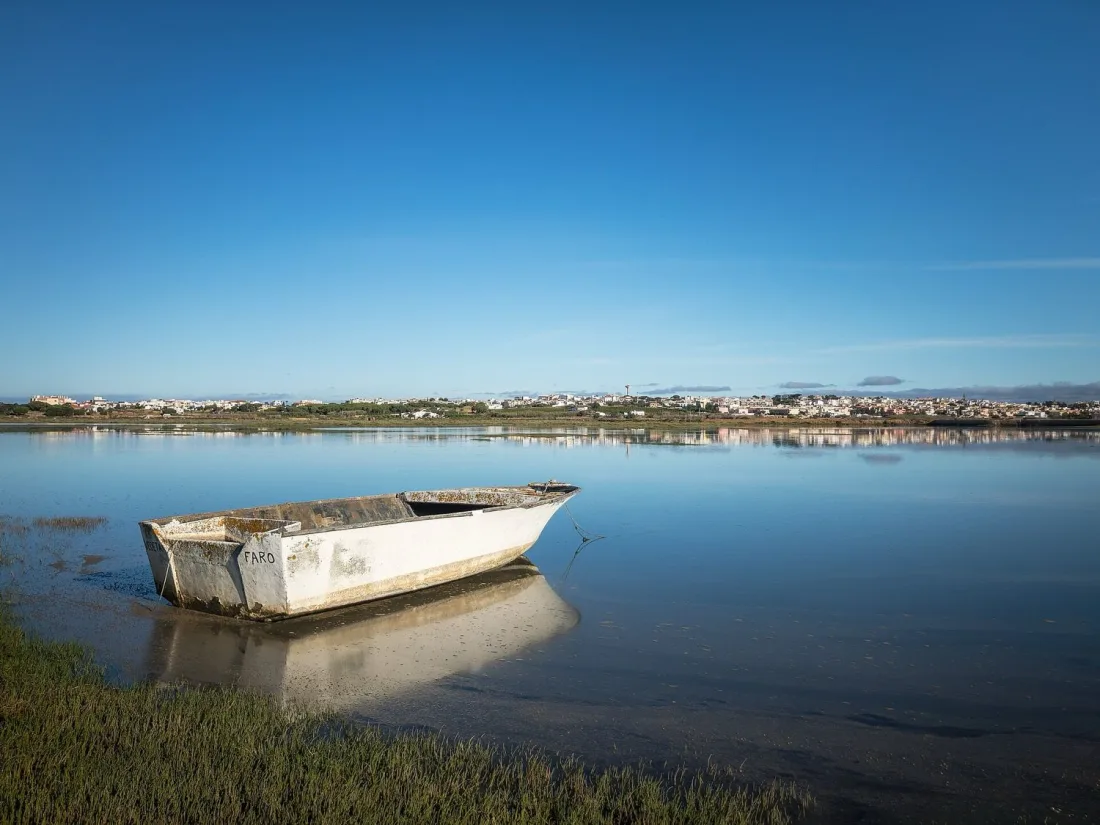
Photo: Jules Verne Times Two, CC BY-SA 4.0 (Wikimedia Commons)
Here is the thing first-timers get wrong: Faro's beaches are not in Faro. The famous Algarve sand is out on a chain of low barrier islands that shelter the city from the Atlantic, and the water in between is the Ria Formosa, a protected lagoon of marshes, channels and sandbanks that is one of the richest wetlands in Europe. Flamingos feed here, seahorses live in the shallows, and the clam and oyster beds supply half the Algarve.
This is where the best things to do in Faro move onto the water. A Ria Formosa boat trip threads through the channels between the islands, and a good guide will pull up at the sandbanks where the birdlife gathers and explain how the whole lagoon shifts with the tides. The Ria Formosa holds one of the largest seahorse populations in the world, and in spring and autumn the salt pans turn pink with flamingos, so the wildlife is a genuine draw and not just a backdrop.
The boat trips come in a few shapes, so it pays to pick by what you want from the day. Wildlife and birdwatching tours run slow and low through the channels, often on quiet solar-powered catamarans, and stop where the herons, spoonbills and flamingos feed. Beach-drop trips ferry you out to an island like Deserta for a few hours of empty sand and come back for you later. Sunset cruises trade the beach for the light, with the lagoon going gold as the herons head to roost. Most leave from the harbour right beside the old town, so you can fold one into an afternoon without a car.
The beaches themselves, the Faro beaches people search for, are spread across the islands:
| Beach / island | How to reach it | Good for |
|---|---|---|
| Praia de Faro (Ilha de Faro) | Road bridge or bus, 7 km from town | Easiest access, surf, beach bars |
| Ilha Deserta (Barreta) | Ferry from the old town harbour | Wild, empty sand, one restaurant, no buildings |
| Ilha do Farol | Ferry from Faro or Olhao | Lighthouse, small community, calm lagoon side |
| Ilha da Culatra | Ferry from Faro or Olhao | Fishing village, no cars, local feel |
Ilha Deserta is the one to pick if you want the wild version: a single boardwalk, miles of empty sand, and nothing else. The ferries leave from the harbour right by the old town, so you can do the cathedral in the morning and be on an island beach by lunch.
Day Trips from Faro
Faro sits at the quieter, eastern end of the Algarve, which makes it a handy base for day trips that skip the resort strip.
- Tavira, about 40 minutes east, is the prettiest town in the eastern Algarve, with a Roman bridge, a castle and its own set of island beaches on the Ria Formosa.
- Olhao, ten minutes away, has the best fish market in the region and its own ferries out to Culatra and Armona.
- Estoi has the Palacio de Estoi and, next to it, the Roman ruins of Milreu, with mosaics and the remains of a temple, a low-key Roman site most Algarve visitors never reach.
For the headline natural wonder of the Algarve you will want to head west to the Benagil sea cave, the cathedral-like grotto with a hole in its roof. It is a longer drive from Faro than from the western resorts, so it works best as a full-day trip or a stop on a wider tour. If you are planning the region as a whole, our guide to things to do in the Algarve maps out which coast suits which kind of trip.
Where to Eat in Faro
Faro eats like a working Portuguese town, not a resort, which is good news. The seafood comes straight off the Ria Formosa, so this is the place for clams, oysters and the local cataplana, a copper-pot stew of fish and shellfish meant to share.
In and around the old town you will find proper tascas and seafood restaurants where the menu depends on the morning's catch. The Mercado Municipal, the covered market a short walk from the centre, is where to see what the lagoon produces, and a few of the best lunches in town are the simple grilled-fish spots near it. Faro is also a stronghold of Portuguese conservas, tinned fish done properly, which makes the easiest edible souvenir you will carry home.
If you only do one food thing, sit down somewhere by the water for a cataplana and a bottle of white from the Algarve hills, and take your time over it. That is how Faro eats.
A Day or Two in Faro
If you have one day, keep it simple. Spend the morning in the Cidade Velha: through the Arco da Vila, up the cathedral tower for the view, then over to the Igreja do Carmo for the Bone Chapel. Have lunch near the Mercado Municipal where the fish is freshest, and take an afternoon boat from the old town harbour out onto the Ria Formosa, either for the birdlife or to be dropped on an island beach. Back in time for dinner and a glass of Algarve white by the marina.
With a second day you can slow right down. Give the morning to an island, Ilha Deserta if you want nothing but sand and sea, Culatra or Farol if you want a small fishing community and a lighthouse. Spend the afternoon on a day trip east to Tavira or the Roman ruins at Estoi, both close and both quiet. Two days in Faro is the sweet spot: enough to see the town, the lagoon and one island without ever feeling rushed.
When to Visit and Getting Around
Faro is at its best in the shoulder months. May, June, September and early October give you warm sea, open island ferries and long days without the peak summer crowds, and the lagoon birdlife is especially good in spring and autumn. July and August are hot and busiest, though Faro still feels calmer than the western resorts. Winter is mild and quiet, with the old town and cathedral open but fewer boats running.
Getting around is easy. The old town, cathedral, bone chapel and harbour are all walkable from the centre. For the islands, you take a ferry or a boat tour from the old town harbour, and Praia de Faro is a short bus ride or drive over the bridge. You do not need a car to enjoy Faro itself, though one helps for the day trips east to Tavira and Estoi.
Faro at a Glance
| Best for | Old-town wandering, the lagoon, wild island beaches, eastern Algarve base |
| How long | 2 to 3 days |
| Must-see | Cidade Velha, the cathedral tower, the Bone Chapel, an island on the Ria Formosa |
| Beaches | On the barrier islands: Deserta, Farol, Culatra, Praia de Faro |
| Best time | May, June, September, October |
| Getting to the beach | Ferry or boat tour from the old town harbour |
FAQ
Is Faro worth visiting?
Yes, if you give it more than the airport. Faro has one of the best-preserved old towns in the Algarve, a dramatic bone chapel, and access to wild island beaches on the Ria Formosa lagoon that most resort visitors never see. It is quieter and more authentic than Albufeira or Lagos. Two or three days is enough to enjoy it properly.
How many days do you need in Faro?
Two to three days. One day covers the old town, the cathedral and the Bone Chapel. A second gets you out on the Ria Formosa to an island beach. A third leaves room for a day trip to Tavira, Olhao or the Roman ruins at Estoi.
What is there to do in Faro old town?
Walk through the Arco da Vila gate into the walled Cidade Velha, climb the cathedral tower for the view over the lagoon, wander the cobbled lanes and orange-tree squares, and spot the storks nesting on the rooftops. The old town is compact and made for slow exploring on foot.
What beaches are near Faro?
Faro's beaches are on the barrier islands of the Ria Formosa, reached by ferry or boat from the old town harbour. Ilha Deserta is the wildest and emptiest, Ilha do Farol and Ilha da Culatra have small island communities, and Praia de Faro is the easiest to reach by road. The lagoon water between is calm and shallow.
Faro or Albufeira: which is better?
It depends on the trip. Albufeira is the Algarve's big resort town, with the beaches, bars and nightlife to match. Faro is smaller, calmer and more genuinely Portuguese, better for history, the lagoon and wild island beaches. For a party beach holiday, pick Albufeira. For old-town character and nature, pick Faro.
Make Faro a Stop, Not a Layover
Faro spends most of its life being passed through, which is exactly why it rewards anyone who stops. Spend a morning in the walled old town, climb the cathedral tower for the view, sit with the storks and the bones, then take a boat out across the lagoon to a beach with nothing on it. Do that and you will understand why the people who actually live in the Algarve keep Faro for themselves.
Ready to explore? Browse tours and experiences in Faro and start planning the part of the Algarve that everyone else flies past.
Cover photo: © Arne Müseler / arne-mueseler.com / CC BY-SA 3.0