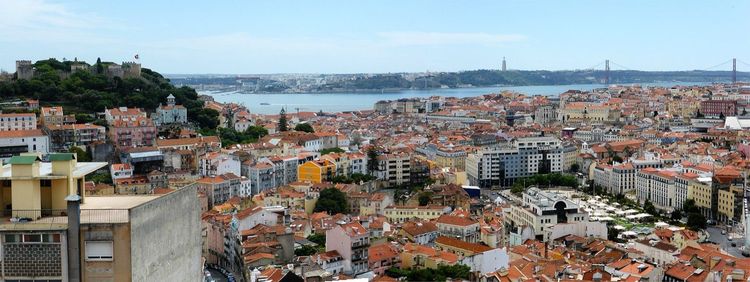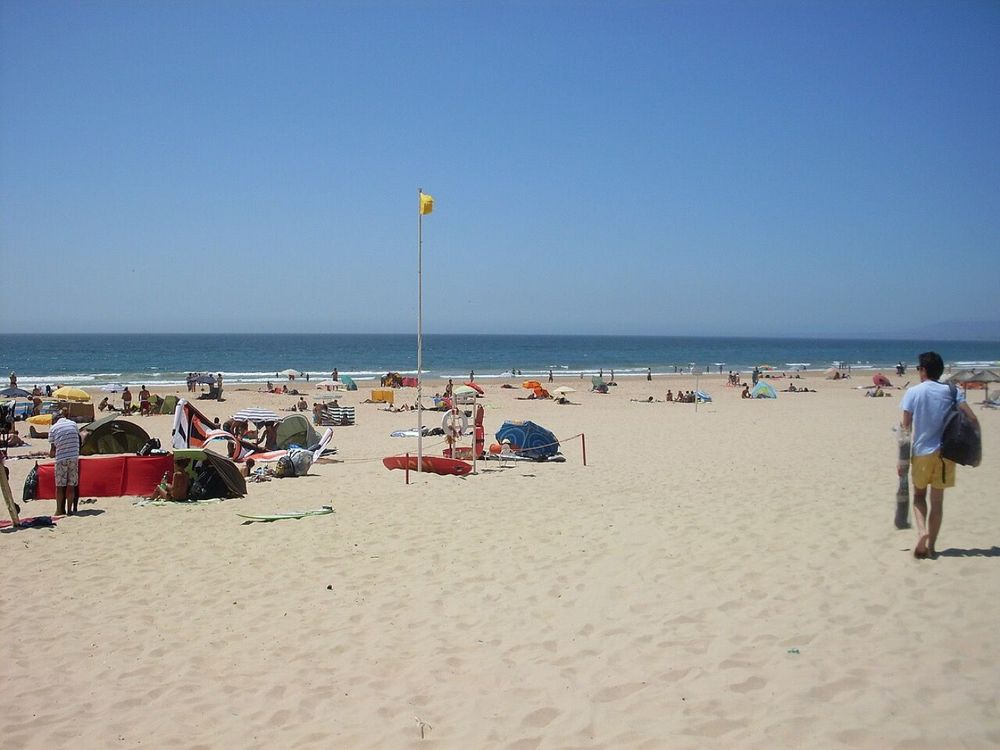
By nine on a July Saturday the queue for the 3708 at Cais do Sodré runs half a block, and nobody standing in it has a suitcase. They carry towels, cool boxes, folding windbreaks and the occasional surfboard, and twenty minutes later the bus crosses the 25 de Abril bridge and empties them all onto the same stretch of sand.
Costa da Caparica is two things wearing one name. There is the town, a working stack of apartment blocks, campsites and cheap seafood restaurants with no old quarter to speak of, and there is the coast behind it, roughly 15km of unbroken areal (open sand) running south to a fishing village called Fonte da Telha. The town is plain, and the sand is why half of Lisbon crosses the water every summer weekend.
Key Takeaways
- Direct buses run from central Lisbon: 3708 from Cais do Sodré, 3709 from Marquês de Pombal, 3710 from Areeiro. Getting there →
- The Transpraia beach train has not run since 2020, whatever the guidebooks say. Its return is still unapproved. The train story →
- Beaches get quieter the further south you go, and bus 3012 from the Cacilhas ferry reaches Fonte da Telha at the far end. South along the dunes →
- Ten Almada beaches hold a Blue Flag for 2026, most of them within walking distance of the town terminal. The town end →
- The Atlantic here tops out around 18 to 20°C in summer. Bring a wetsuit if you plan to stay in longer than a swim. Surfing →
How do you get to Costa da Caparica from Lisbon?
Three direct buses cross the bridge from central Lisbon to the Caparica terminal: 3708 from Cais do Sodré, 3709 from Marquês de Pombal, 3710 from Areeiro. The ride takes 30 to 40 minutes outside rush hour, and the terminal sits a five-minute walk from the sand.
All three are red-tier lines on the Carris Metropolitana network, which means €2.60 if you pay the driver and €1.55 if you tap a pre-loaded navegante (the regional transit card). Buy the card once at any metro machine, load it with credit, and the same piece of plastic covers the metro, the ferry and the beach buses for the rest of your trip.
The prettier route goes by water. Take the ferry from Cais do Sodré to Cacilhas, which costs a couple of euros and hands you the whole city skyline on the way back, then catch bus 3011 to Costa da Caparica or 3012 straight through to Fonte da Telha. Neither of those buses is fast. Both of them beat sitting in bridge traffic on a Saturday morning.
There is a third option almost nobody mentions. The Fertagus train from Roma-Areeiro, Entrecampos or Sete Rios crosses the lower deck of the 25 de Abril bridge and stops at Pragal, in Almada, where buses 3024 and 3025 finish the job. It is the fastest way out of Lisbon when the road above is jammed.
A taxi or Uber covers the 16km in 20 to 25 minutes, which is worth it for a group of four and pointless for a couple.
Planning tip: Load the navegante with at least €10 before you set off. The card readers on board do not sell credit, and the queue at the terminal machine on a hot Sunday is its own small ordeal.
Which beach is yours
The coast reads as one long strip on a map. On the ground it breaks into distinct moods, and picking the wrong one is the difference between a good day and a parking argument.
| Stretch | Getting there | Character | Best for |
|---|---|---|---|
| Cova do Vapor | Ferry to Trafaria, then bus 3009 | Village at the river mouth, calmer water | Small children, a quiet lunch |
| São João da Caparica / Praia do Norte | Bus to terminal, 15 min walk north | Wide, sandy, surf schools and a campsite | First surf lesson, families |
| Town beaches (Praia Nova, CDS, Rainha, Saúde) | Walk from the terminal | Bars, showers, lifeguards, crowds | Arriving by bus with no plan |
| Dune beaches (Mata, Sereia, Infante, Rei, Castelo) | Car, or bus 3044 to Praia da Mata | Sand backed by pines, spaced-out beach bars | Space, long walks, sunsets |
| Bela Vista and Praia 19 | Car, or the walk south from Rei | Naturist, relaxed, no facilities to speak of | Nude bathing, absolute quiet |
| Fonte da Telha | Bus 3012 from Cacilhas | Fishing village, kitesurfers, cliff backdrop | Seafood lunch, wind sports |
Everything north of the town is easy and busy. Everything south of it gets progressively emptier until the beach bars run out entirely.
The town end: easy sand and esplanadas
If you arrive without a car, this is where you land, and there is no shame in staying. Ten beaches in the Almada council hold a Blue Flag for 2026, including Praia Nova, Rainha, Sereia, Mata, Infante and São João da Caparica, which means lifeguards, water testing, showers and accessible ramps.
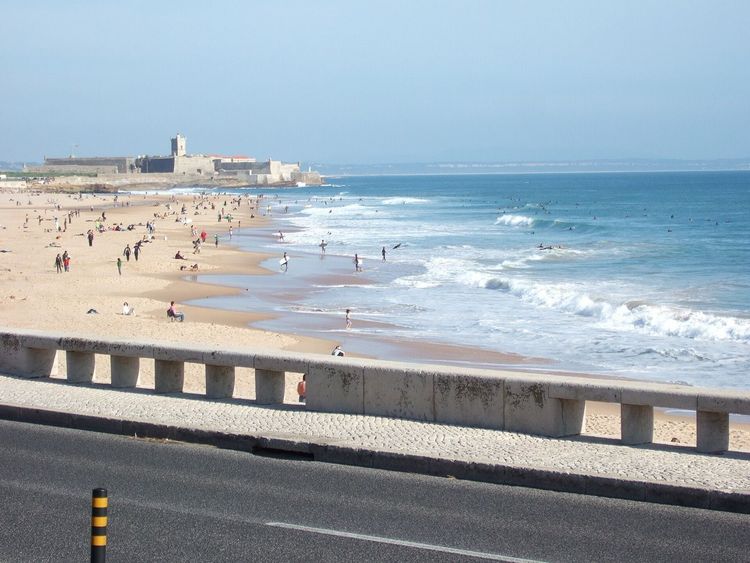
The town beaches sit behind a promenade lined with esplanadas (open-air café terraces) where a beer and a plate of grilled sardines still costs less than a cocktail in Cais do Sodré. Groynes stick out into the water in front of the town, the only part of this coast that erodes rather than grows.
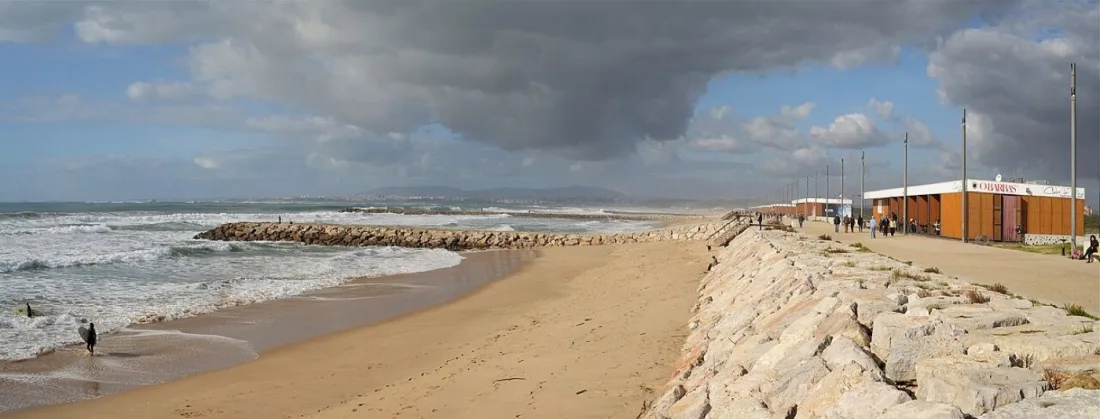
Photo: Alvesgaspar, CC BY-SA 3.0 (Wikimedia Commons)
Walk north for 15 minutes and the crowd density halves. São João da Caparica has the widest sand of the northern section, a pine-shaded campsite behind it, and the highest concentration of surf schools on the coast.
The rule locals live by: however busy the beach looks from the promenade, walking 20 minutes in either direction will buy you three times the space for free.
Local tip: Listen for the bola de Berlim (custard-filled doughnut) sellers working the towel line with insulated boxes. Buying one is standard behaviour on a Portuguese beach, and the going price sits around a euro and a half.
South along the dunes
South of the town the road narrows into the Estrada das Praias and runs behind the dunes for about 6km. Along it sit roughly 14 beach areas, each with a car park, a bar or a restaurant, and a wooden walkway over the sand: Mata, Sereia, Infante, Rei, Castelo, Morena, Cabana do Pescador. If one car park is full, the next one is two minutes away.
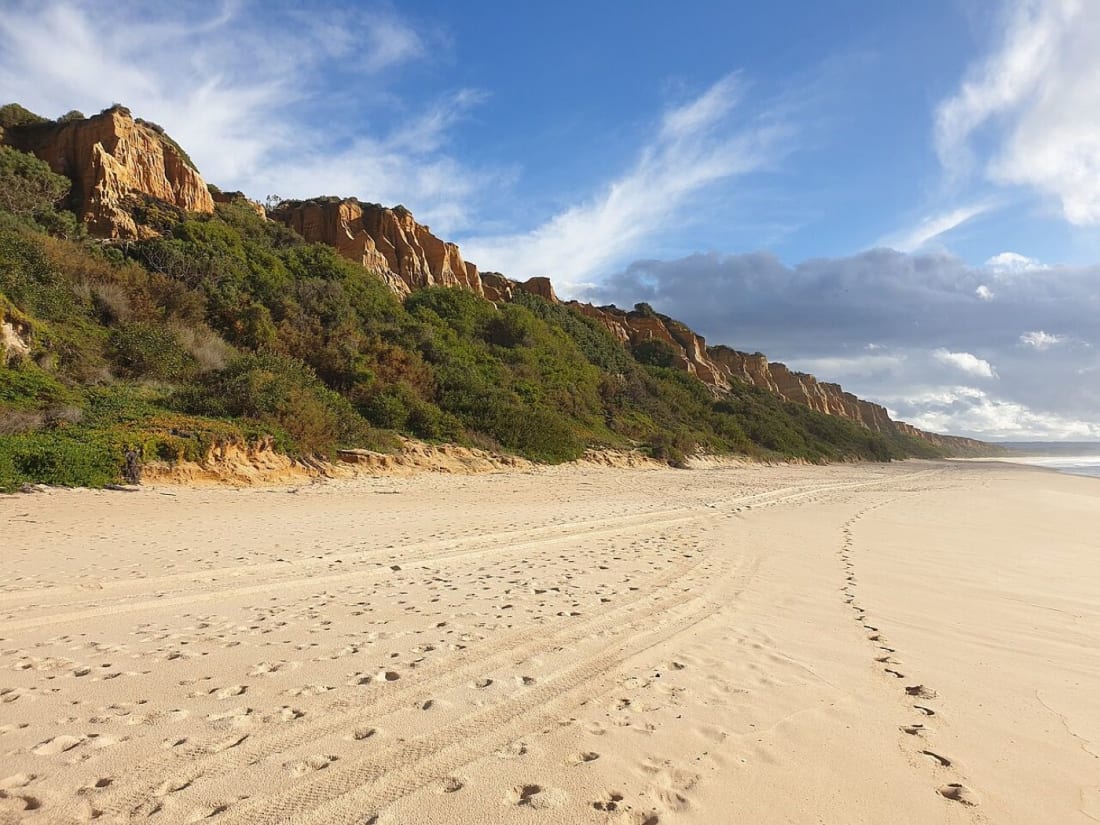
Photo: Plexique, CC BY-SA 4.0 (Wikimedia Commons)
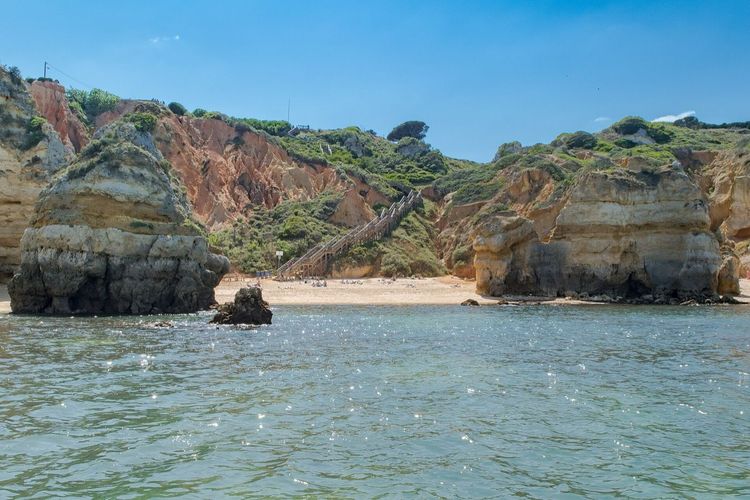
All that emptiness survives because almost nothing was ever built here. The southern half of the coastline sits inside a protected landscape, the Arriba Fóssil (fossil cliff), whose crumbling prehistoric cliff face rises behind the pines and has been shielded from development by decree since 1984. The woodland on top of it, the Mata dos Medos, was seeded in the 18th century under King João V, who wanted the dunes stopped before they marched inland and swallowed farmland. It worked, and it is why your beach has a forest behind it rather than a resort.
Most guides tell you that without a car this section is unreachable. That has been out of date for a while. Bus 3044 runs from Costa da Caparica down to Praia da Mata on the blue local tariff, which is €1.25 on board and €0.85 with the card. Bus 3012 runs the whole way from the Cacilhas ferry to the beach at Fonte da Telha, 50 stops of it, and bus 3030 links Fonte da Telha with the university campus at Monte de Caparica. The buses are slower than the train ever was. They exist.
Detour: From Praia do Rei you can walk south along the sand to Bela Vista and Praia 19 in about half an hour, past the point where the beach bars stop and the cliff takes over. Take water. There is nothing to buy down there.
Whatever happened to the Transpraia?
The Transpraia beach train is not running, and has not run since 2020. Anything you read about catching it to Fonte da Telha this summer is out of date.
For 60 years a narrow-gauge train shuttled along the back of these beaches, dropping bathers at numbered stops from the town to Fonte da Telha. It stopped for the pandemic, never restarted, and the track was largely dismantled in 2019. In 2023 a French entrepreneur, Gregory Bernard, bought the operation and began restoring it, with the hangar reopened as an art space showing work by 27 artists including Vhils.
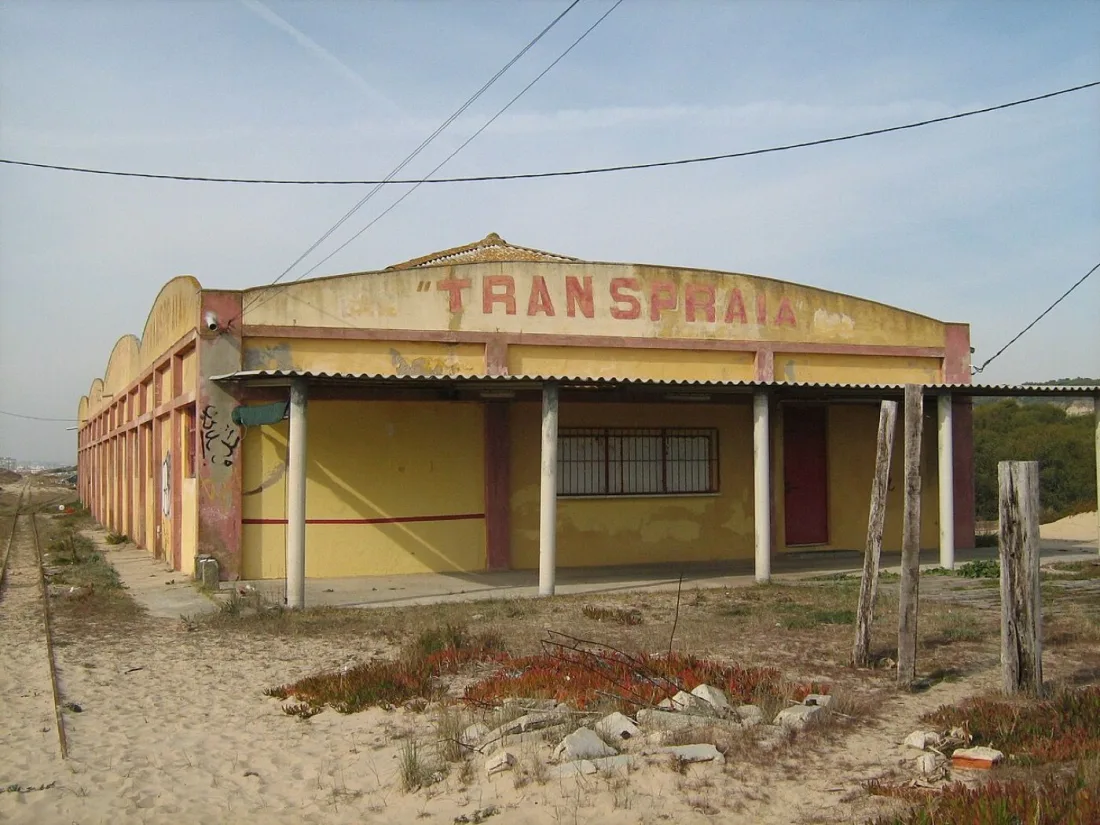
Photo: Mecanismo, CC BY-SA 3.0 (Wikimedia Commons)
As of July 2026 the project has run test rides on sections of the line and is aiming at a summer return. Almada council has not signed off. Its published position is that the train in its current state is too polluting and inefficient to reactivate, that it is still waiting for a formal plan, and that the rails themselves are State property, so the owner does not yet hold authorisation to restore them. There is no official website and no ticket on sale.
Plan your day as though the train does not exist, because right now it does not. If it comes back, treat it as a bonus rather than a transport strategy.
Fonte da Telha and the naturist south
Fonte da Telha sits at the southern end of the developed coast, 10km from the town, and it is the only settlement down here worth the name. Fishing boats still launch straight off the sand, the restaurants along the front grill whatever came in, and the cliff behind the village gives the whole place a backdrop the town end lacks.
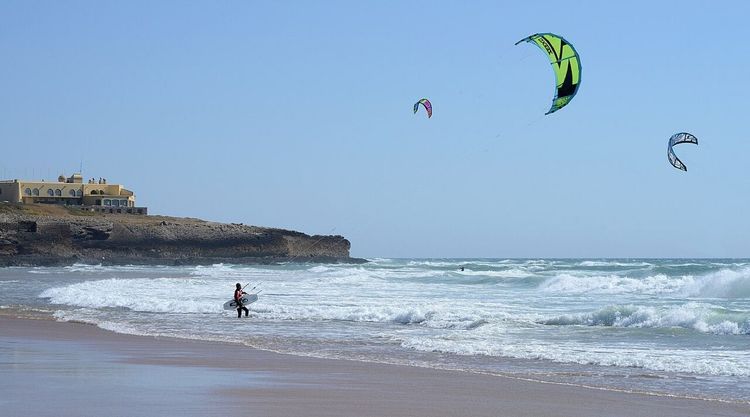
The wind that makes this stretch tiring for sunbathing makes it excellent for kitesurfing, and on a strong afternoon the sky above the water fills with canopies. Away from the bars, north and south of the village, the beach turns naturist without much ceremony.
Between Fonte da Telha and the town lie Bela Vista and Praia 19. Bela Vista was the first beach in Portugal formally designated for naturism, and Praia 19, named after the old train stop that served it, has been the country's best-known gay beach for decades. Both are quiet, both are backed by the fossil cliff, and neither has facilities beyond a seasonal bar.
Sunday lunch here is a family institution, which means the good tables disappear by one o'clock. Arrive at noon or resign yourself to eating at three.
Learning to surf on a cold ocean
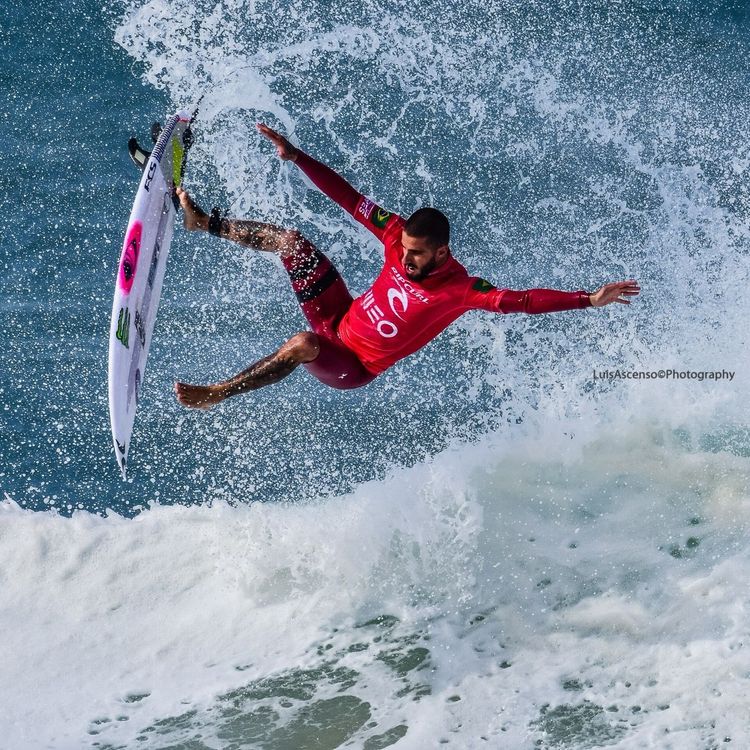
Caparica is where Lisbon learns to surf. The beach break works most of the year, the sand bottom forgives beginners, and São João da Caparica alone supports a row of schools. Gecko Surf School has been running here since 2016, and Surf Pro holds certification from the Portuguese Surfing Federation and Turismo de Portugal, which is the paperwork worth checking before you hand over a card.
A group lesson with board and wetsuit sits in the €30 to €40 range, and hiring the kit alone costs roughly €15 for a half day and €25 for a full one. You will want the wetsuit. The Atlantic here reaches 18 to 20°C at its warmest and feels colder than that on a windy afternoon.
Currents are the real hazard, not the water temperature. Swim between the flags where lifeguards are posted, and treat the empty southern beaches with more caution precisely because nobody is watching. Our surfing in Portugal guide explains where this coast sits among the country's breaks, and why autumn beats August for anyone past the beginner stage.
Planning tip: September is the best month here by a margin. The sea hits its annual maximum, the swell organises itself, the schools have space, and the beach bars carry on as though nothing has changed.
Is Costa da Caparica worth visiting?
Yes, for the beach, and only for the beach. The town has cheap seafood, a decent promenade and no particular charm, so treat it as a gateway rather than a destination.
That honesty matters, because plenty of visitors arrive expecting Cascais and leave feeling shortchanged. Cascais is a resort town with a historic centre worth wandering around for an afternoon, while Caparica is 15km of Atlantic sand with a service town attached to the northern end. If your day is built around long swims, a surf lesson and grilled fish eaten with your feet in the sand, this coastline beats anything else within an hour of Lisbon.
Compare it with the alternatives before committing. The beaches near Lisbon guide sets all four coasts side by side, and the sheltered turquoise coves at Arrábida are the better call if you want calm water rather than waves. If it is wind and dunes you are after, Praia do Guincho does that better than anywhere near the city. For the national picture, our best beaches in Portugal guide places this coast against the Algarve and the islands.
Practical Tips
Planning tip: Parking is paid across the town and expanding. Almada's operator WeMob charges €0.40 an hour in green zones, €0.60 in yellow and €0.80 in red, and the paid area keeps growing with beach-season demand. The car parks along the Estrada das Praias are the cheaper play.
Local tip: The nortada (the northerly summer wind) usually builds after two in the afternoon. Mornings are calm and bright, afternoons get gusty, and the windbreaks you see planted around every Portuguese family are not decoration.
Planning tip: Sunday is the worst day on this coast. Buses queue, car parks fill by eleven, and the same beach feels twice as small. Tuesday and Wednesday are a different place entirely.
Local tip: Watch for xávega, the traditional net-hauling still practised from these beaches, where a boat lays a long net offshore and the catch is dragged in from the sand. It happens early, it is free to watch, and the fish goes straight to the restaurants behind you.
FAQ
How far is Costa da Caparica from Lisbon?
Costa da Caparica sits about 16km from central Lisbon, roughly 25 minutes by car over the 25 de Abril bridge. Direct buses take 30 to 40 minutes; the ferry-and-bus route via Cacilhas takes closer to an hour.
How much is a taxi from Lisbon to Costa da Caparica?
A taxi or Uber from central Lisbon usually runs €20 to €30 depending on traffic, pickup point and time of day. The direct bus costs €1.55 with a pre-loaded navegante card, which is why most people take it.
Is Costa da Caparica safe?
Yes. The town and beaches are safe by day and evening, with the usual seaside caution about valuables on the sand. The genuine risk is in the water: Atlantic currents are strong, so swim between the lifeguard flags and stay out of unguarded stretches when the surf is up.
What is the closest airport to Costa da Caparica?
Lisbon Humberto Delgado Airport (LIS) is the closest, around 25km away. A taxi takes 25 to 35 minutes; by public transport you take the metro red line into the city and pick up bus 3708, 3709 or 3710.
Is the water cold at Costa da Caparica?
Yes, this is the open Atlantic. Sea temperature peaks around 18 to 20°C in late August and September, and sits lower in June. Swimming is fine in short bursts, and anyone spending an hour in the water should wear a wetsuit.
Which beach is best for families?
São João da Caparica for space and lifeguards, or Cova do Vapor for the calmest water on the coast, where the river meets the sea. Both hold Blue Flag or Gold Quality status, and both have bars and toilets within reach of the sand.
The last bus back
There is a moment on the 3708 home, somewhere on the bridge with the estuary going gold underneath, when the whole beach day compresses into salt on your skin and sand in your bag. Everyone on board has the same sunburn line. Nobody is talking much.
Lisbon will tell you it has no beach. What it has is a 20-minute bridge and 15km of Atlantic on the other side, which any lisboeta (Lisbon native) will tell you amounts to the same thing.