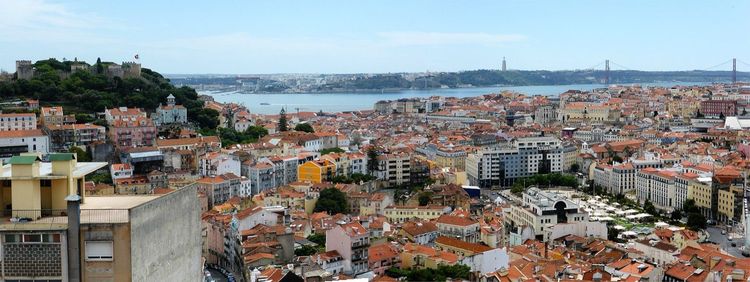
On summer Fridays, Lisbon performs a quiet vanishing act. By ten in the morning the office shirts are gone, the cacilheiro (the orange Tagus ferry) is packed with cool boxes and parasols, and the trains sliding out of Cais do Sodré smell of sunscreen. The city itself has no beach, and no lisboeta (Lisbon local) considers this a problem. The coast begins twenty minutes away, and it comes in four distinct flavours.
That is the real answer to the question every first-time visitor asks, and it changes how you should plan. You are choosing between an easy train-line beach, a fifteen-kilometre surf strip, a wild windswept cape, and a set of turquoise coves under a limestone ridge. Each comes with its own transport logic, water temperature, and crowd. Pick well and a beach day here beats many resort towns; pick badly and you will spend the afternoon hunting for parking with half of Lisbon. If what you actually want is bath-warm water and a sun lounger, that is a different region entirely: our best beaches in Portugal overview compares every coast, and the Algarve beaches guide covers the warmest of them honestly.
Read on for the four coasts, beach by beach, with the buses and trains checked for 2026, the water temperatures nobody advertises, and the spots locals keep going back to.
Key Takeaways
- Lisbon city has no swimming beach, but more than 30 real beaches sit 20 to 60 minutes away across four coastlines. Does Lisbon have beaches? →
- Easiest first beach: Carcavelos, 25 minutes by train from Cais do Sodré, with sand, surf schools, and the São Julião fort. The Estoril line →
- Where locals go: Costa da Caparica, reached by direct buses 3708, 3709, and 3710, or the ferry to Cacilhas plus bus 3011. Costa da Caparica →
- The Atlantic here runs 16 to 19°C. September gives the warmest sea of the year; June is brisker than most visitors expect. When the water is →
- For calm water in postcard turquoise, go south to Arrábida and plan around its summer access rules. Arrábida →
Does Lisbon have beaches?
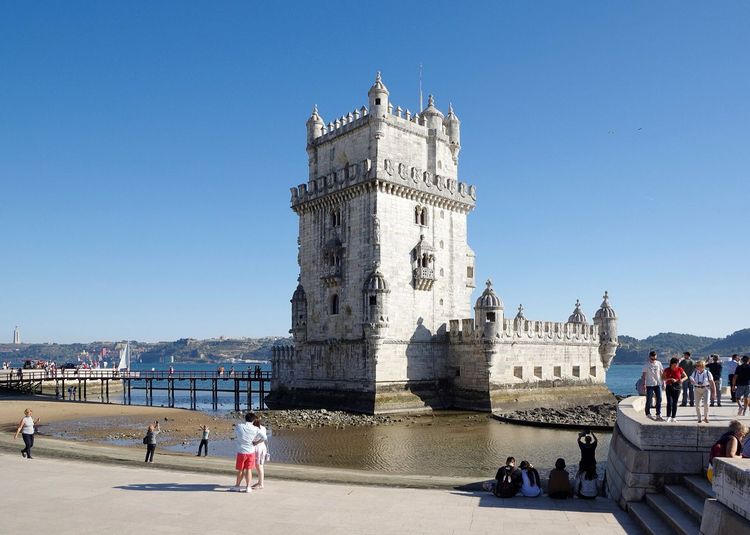
Lisbon has no swimming beach in the city centre, but three coastlines with more than 30 proper beaches sit 20 to 60 minutes away by train, bus, or ferry. The riverfront sand you may spot near Belém is for sunbathing gulls and optimistic teenagers, and locals treat the Tagus as scenery, not swimming water.
What the city has instead is one of Europe's best beach-commute systems. A coastal train leaves Cais do Sodré every 12 to 20 minutes for the Estoril coast, buses cross the bridge to Caparica's long sand all day, and the ferry ride to the south bank is a small cruise in itself. The sea is the catch, and it is better to hear it from us now: this is the open Atlantic, cool even in August. You will still swim. You will just do it with more character than in the Mediterranean.
The four coasts at a glance
| Coast | Getting there | Water | Best for |
|---|---|---|---|
| Estoril line (Carcavelos to Cascais) | Train from Cais do Sodré, 25 to 40 min | Cool, mostly calm | First beach day, families, no-car trips |
| Costa da Caparica | Bus 3708/3709/3710, or ferry + 3011 | Cool, surfy | Long sand, surf schools, sunsets |
| Sintra coast (Guincho, Adraga) | Cycle path or taxi from Cascais; car | Cold, wild | Wind sports, cliffs, drama |
| Arrábida (Galapinhos, Figueirinha) | Car or seasonal buses from Setúbal | Clearest and calmest | Turquoise coves, snorkelling |
Four coasts, four personalities. The sections below take them in order of effort, from the beach you can reach half-asleep to the one that rewards a proper plan.
The Estoril line: Carcavelos to Cascais by train
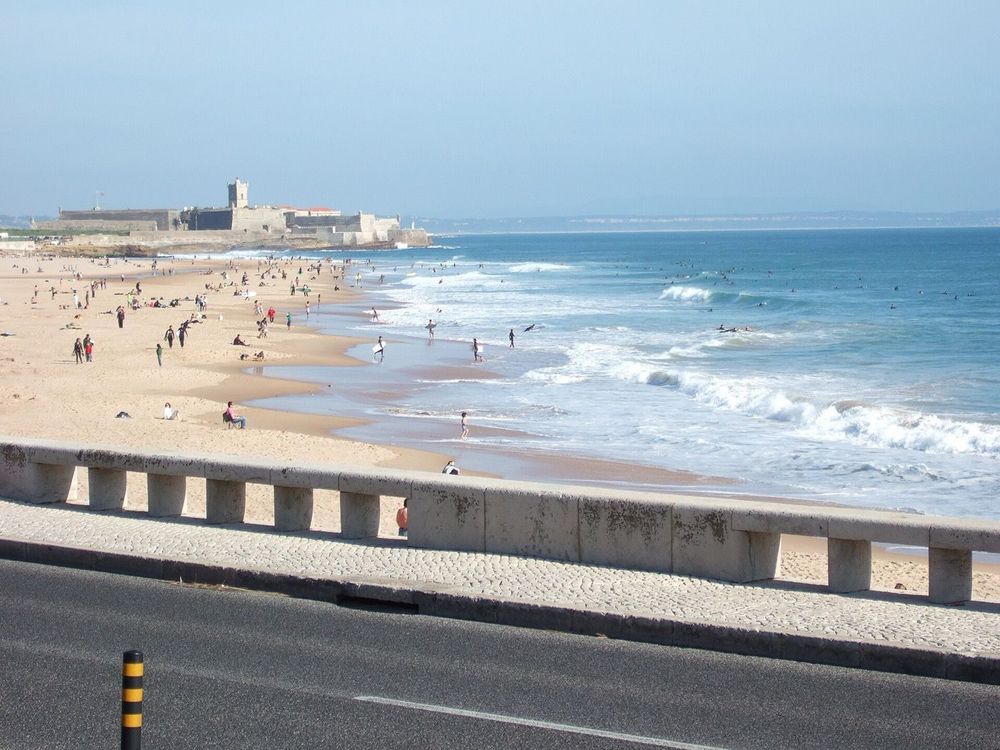
First beach day of the trip? Make it Carcavelos. The train from Cais do Sodré takes about 25 minutes, the beach starts two streets from the station, and the bay serves everyone at once: swimmers on the eastern half, surf schools mid-sand, and the 16th-century São Julião da Barra fort closing the view. This is the widest, easiest sand within city reach, which is exactly why we recommend it on a weekday morning rather than a Sunday afternoon. If the longboards tempt you more than the towels do, our surfing in Portugal guide explains why Carcavelos is the country's favourite learner wave.
Planning tip: Buy a navegante (the region's transit pass) at the machine and load it for the day; the same card covers the Cascais train, the Caparica buses, and the ferry, and it spares you a queue at every step.
The stations keep offering beaches as the line rolls west. São Pedro do Estoril hides a calm cove backed by low cliffs, popular with local families who never saw a reason to tell anyone. Estoril's Tamariz sits directly below the station with a garden promenade and more sunbeds than sand in August. Cascais town keeps three small, pretty bays, and Praia da Conceição is the one worth your towel, sheltered, walkable from the station, and framed by the old fort wall.
Local tip: From Cascais station, walk or cycle the paredão (the seafront promenade) back east towards Estoril at golden hour. The 2km path strings the coves together, and the swim stops along it beat anything you will find at midday.
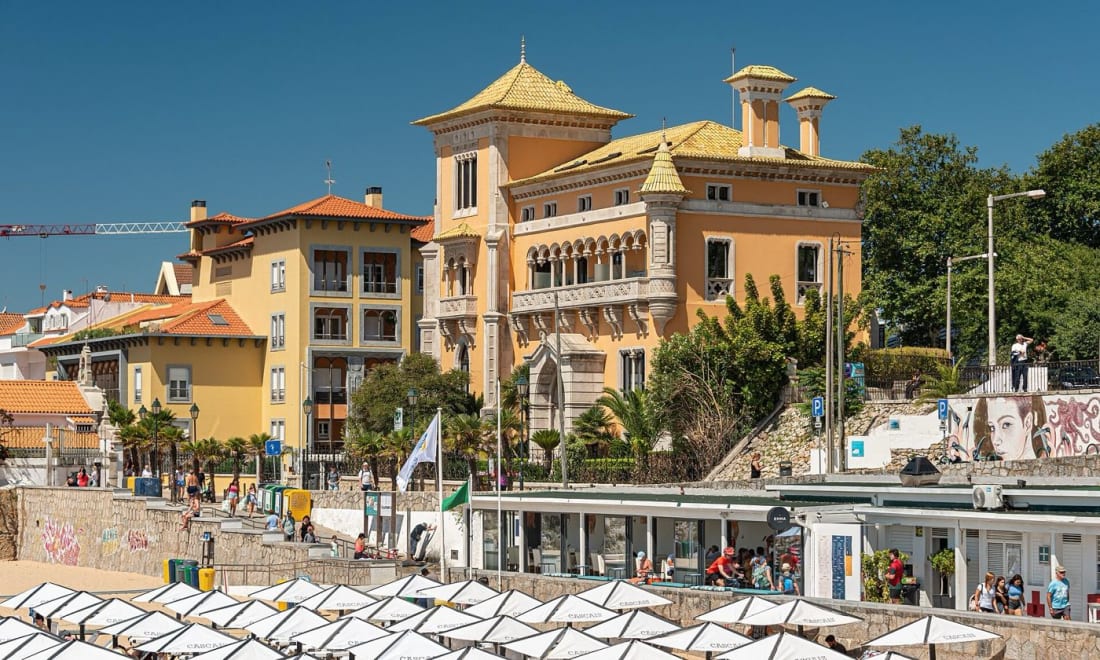
Photo: Jorge Franganillo, CC BY 2.0 (Wikimedia Commons)
One more station secret, this time for cold-water sceptics. At Oeiras, halfway down the line, the Piscina Oceânica is a 1960s saltwater pool built into the seafront, heated by nothing except sunshine yet always a degree kinder than the open ocean, with the river mouth as its infinity edge. Entry costs a few euros, towels colonise the concrete decks by mid-morning, and it solves the classic family standoff between children who want waves and grandparents who want none.
Costa da Caparica: where Lisbon actually swims
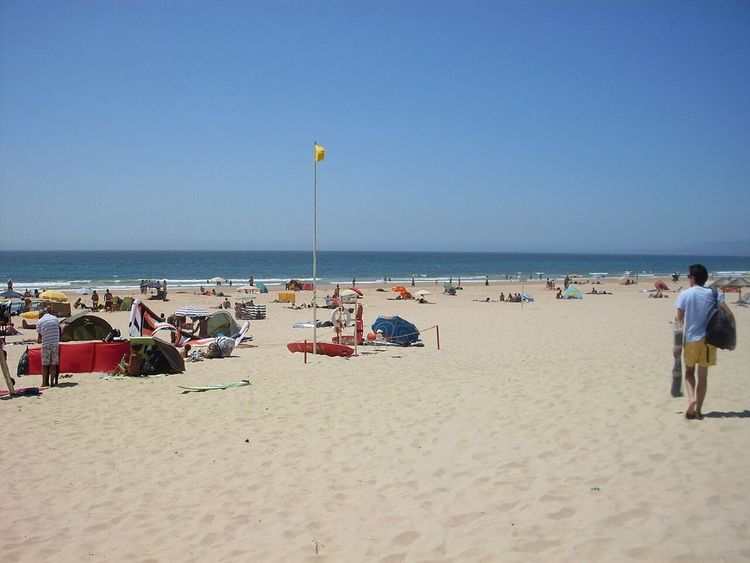
Ask where people from Lisbon go to the beach and the answer, overwhelmingly, is across the bridge. Costa da Caparica is a former fishing town attached to roughly 15km of uninterrupted areal (open stretch of sand) running south to Fonte da Telha. The Atlantic works one side and pine-backed cliffs hold the other. In between: surf schools by the dozen, striped barracas (canvas beach tents) rented by families who have held the same spot for generations, and beach bars that turn into sunset institutions.
Getting there got simpler than the old guidebooks admit. As of 2026, direct buses run from the city centre: 3708 from Cais do Sodré, 3709 from Marquês de Pombal, and 3710 from Areeiro, all landing at the Caparica terminal a short walk from the sand. The scenic route still works too, and we prefer it: ferry from Cais do Sodré to Cacilhas with the whole city skyline behind you, then bus 3011 to the coast.
Our full Costa da Caparica guide breaks the coast down beach by beach, with the bus numbers for the southern stretches.
The beach itself is a gradient. The town end has the esplanadas (terrace cafés), lifeguards, and easy everything; the further south you walk, the wilder and quieter the sand becomes, through nicknamed stretches every local ranks differently. Somewhere around the 20-minute mark, you will hear the cry of the bola de Berlim (custard-filled doughnut) sellers working the towels. Buy one. It is not optional heritage.
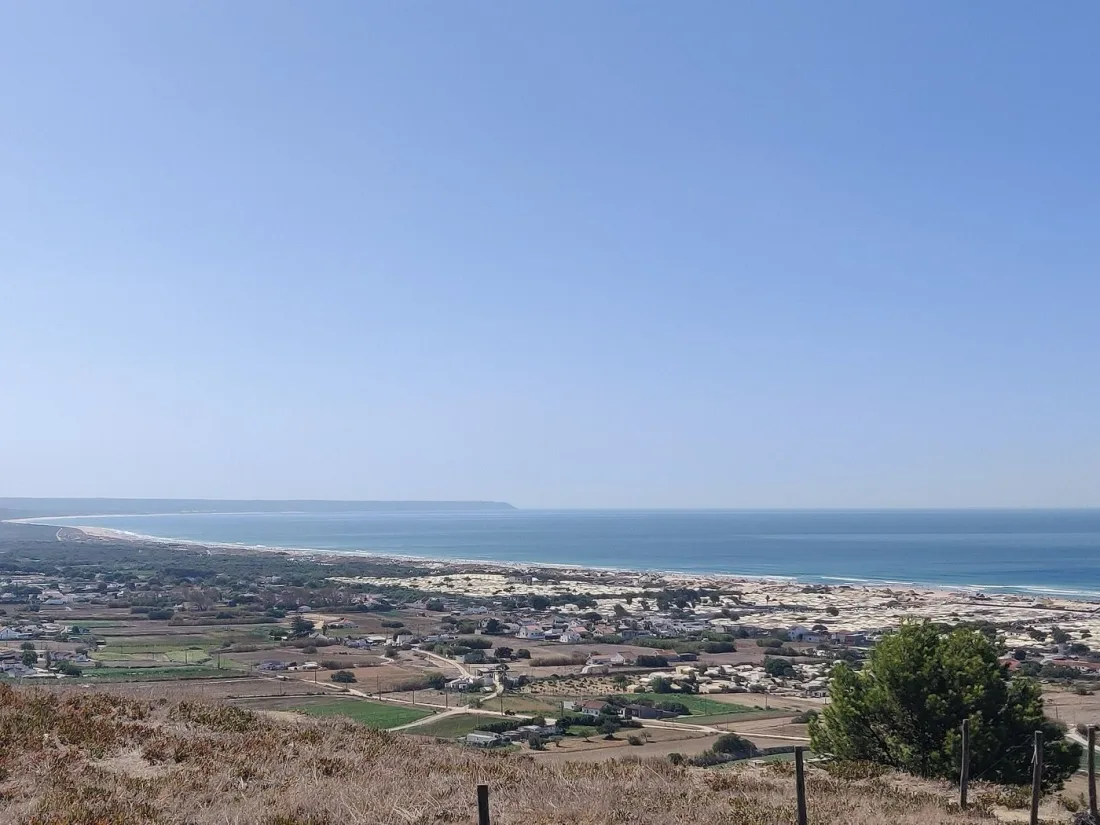
Photo: macielle, CC BY-SA 4.0 (Wikimedia Commons)
Caparica is also where Lisbon learns to surf, and autumn is its open secret. The summer schools thin out in late September, the swell organises itself, and the water hits its annual maximum while the esplanadas keep serving as if August never ended. If a surf lesson is on your list, book it here for the sandbar-friendly waves and the schools that teach in four languages.
Detour: Twenty minutes further south by car, the sea enters Lagoa de Albufeira, a lagoon with warm, flat water on one side of the sandbar and ocean surf on the other. Families park at the lagoon; kitesurfers claim the mouth.
Guincho and the wild Sintra coast
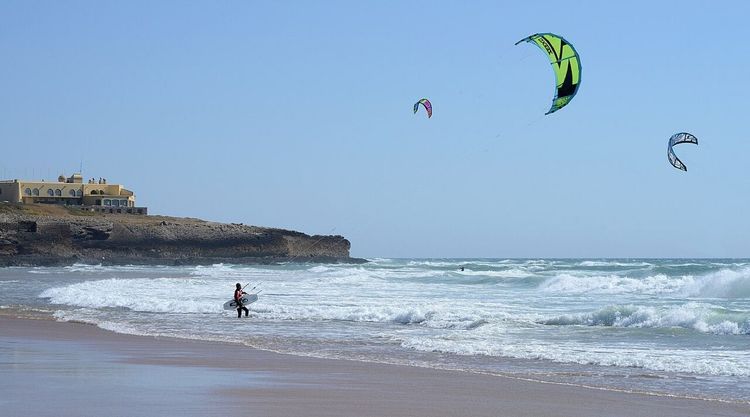
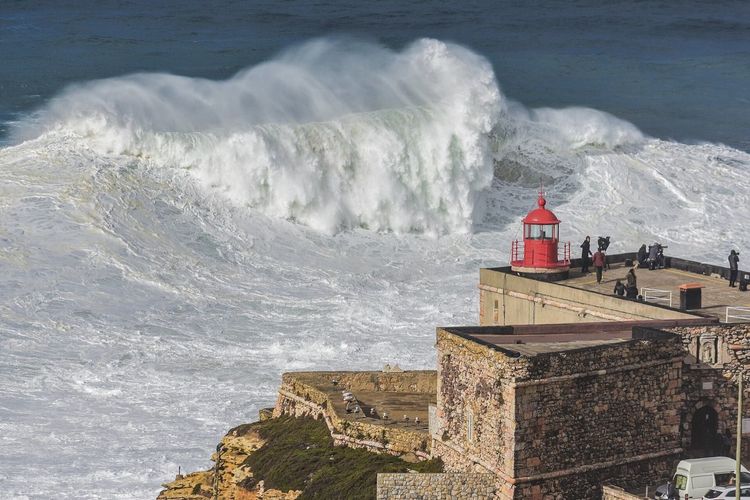
Past Cascais the coast turns a corner, faces north, and stops being polite. Praia do Guincho is the headline: a broad dune-backed arc under the Sintra hills where the nortada (the dry north wind of summer) blows most July and August afternoons at 20 knots or more. Sunbathers curse it; windsurfers and kitesurfers built a world scene on it. Swim here only when the flags allow, respect the currents, and hold the umbrella with both hands.
Guincho sits outside the metropolitan bus network, so reach it the local way: the coastal cycle path from Cascais covers about 9km of clifftop and dune, rentals are easy in town, and a taxi runs the same road in 10 minutes. Further north, Praia da Adraga hides between rock stacks at the end of a lonely valley road, with a single restaurant and cliffs that make everyone whisper. Praia da Ursa next door demands a steep scramble and repays it with the region's most dramatic scenery. These are beaches for staring and paddling more than for serious swimming, and they pair perfectly with the palaces above, as our Sintra day trip guide lays out.
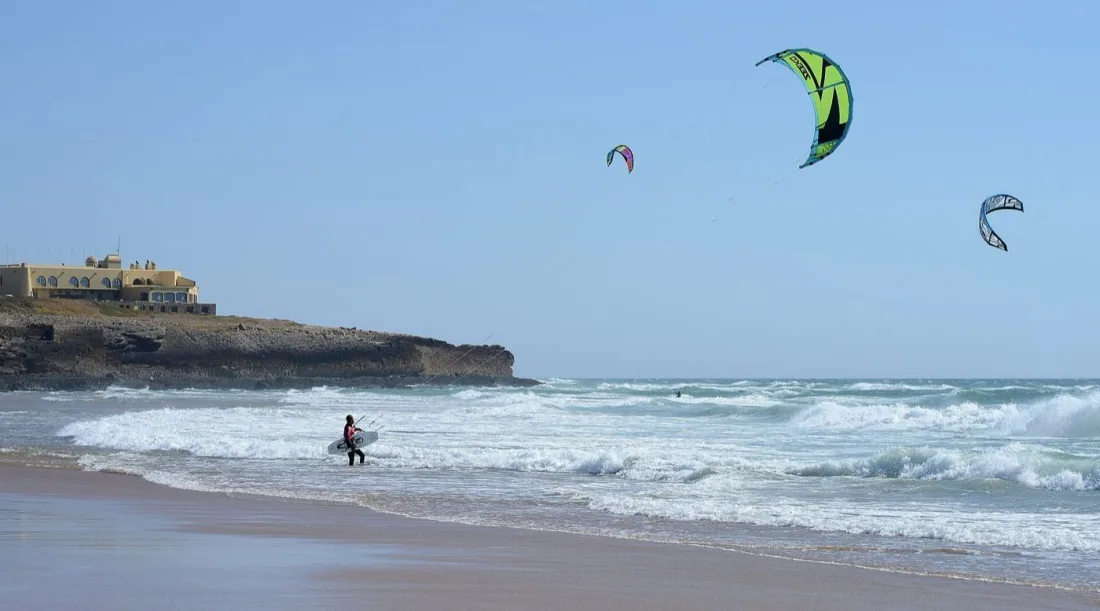
Photo: Alvesgaspar, CC BY-SA 3.0 (Wikimedia Commons)
The Sintra shore softens slightly further north. Praia Grande unrolls the widest sand on this coast, with a seawater pool at one end and, few visitors ever notice, dinosaur footprints fossilised in the southern cliff face. Praia das Maçãs behaves like a proper little resort village, complete with a summer-only heritage tram trundling down from Sintra town when it runs, which is a matter worth checking rather than assuming.
Our full Praia do Guincho guide covers the bus from Cascais, the swimming rules and how to time the wind.
Planning tip: Check the wind forecast before committing a day to this coast. On a strong nortada afternoon, choose Carcavelos or Caparica instead, and give Guincho a calm morning later in the week.
Arrábida: the turquoise exception
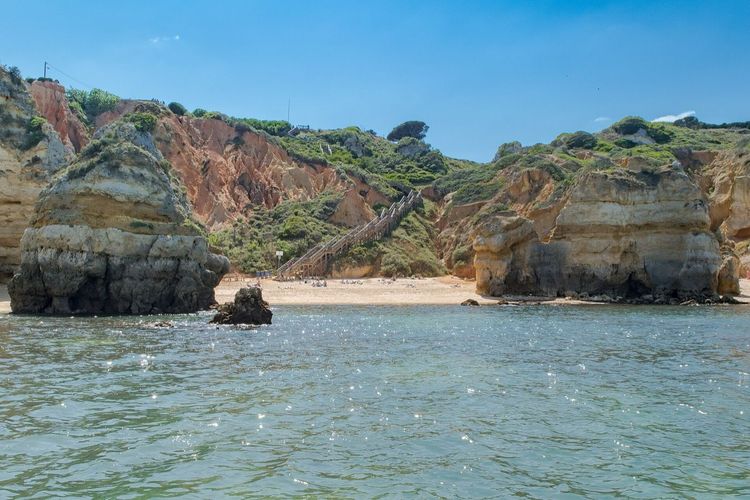
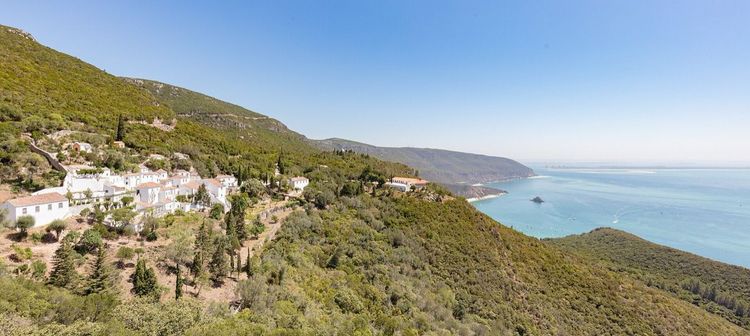
Everything the Atlantic coasts lack, the coves south of the Serra da Arrábida supply: sheltered water in improbable shades of green and blue, white pebble-free sand, and cliffs covered in Mediterranean scrub. Praia dos Galapinhos took a European best beach title in 2017, Figueirinha handles families with ease, and snorkelling here actually shows you fish. The water is the calmest and clearest within reach of Lisbon, and on a bright day the comparison with the Caribbean is only half a joke.
The price is logistics. Arrábida is an hour from the city, summer restricts private cars on the beach road, and carparks fill by breakfast. It rewards exactly one strategy, which is going early with a plan, and our full Arrábida Natural Park guide covers the buses, the beach rankings, and the wine villages behind the ridge. As a beach day, it is the region's best. As an improvised afternoon, it is the region's best traffic jam.
Local tip: If Arrábida's rules feel like too much, Sesimbra town beach delivers a similar sheltered bay with none of the access drama, plus a castle above and grilled fish on the front.
The ones to skip, and when
Every beach list needs its warnings, so here are ours. Skip Tamariz on an August weekend, when the sunbed rows leave a corridor of sand roughly the width of a yoga mat, and walk 15 minutes to São Pedro do Estoril instead. Skip driving to Guincho on a nortada afternoon, unless sand exfoliation is the goal. Skip Arrábida entirely on summer Sundays without an early start, because the road closes, the buses queue, and the famous coves stop being relaxing around 10am.
And one heresy we stand behind: skip the sea altogether on the first properly hot day of June. The whole city has the same idea at the same time, and the Atlantic has not warmed past 17°C. Save your beach energy for midweek, or better still for September, and spend that first scorcher the way locals do, in a shaded esplanada planning the summer properly.
When the water is actually warm
Here is the honest calendar. The sea off Lisbon runs about 16 to 17°C in June, 18 to 19°C in August, and holds its warmest, around 19 to 20°C, into late September, when the crowds have already gone home. The época balnear (the official bathing season) staffs the main beaches with lifeguards from roughly June to mid-September, and the flag system is not decorative: red means stay out, and the Atlantic means it.
Ask any lisboeta over sixty and they will tell you the family secret: you do not swim in this ocean in June, you negotiate with it in September. The sea spends all summer warming up for the people patient enough to wait.
Timing changes everything else too. Spring gives empty sand and cold swims, July and August give atmosphere and competition for every towel-width, and autumn gives the best sea, the best light, and half-price calm. If a proper beach holiday is the goal rather than beach days, the day trips from Lisbon rhythm works better than basing yourself at the coast, because restaurants and life after 7pm stay firmly in the city.
Practical Tips
Planning tip: Sunday is the hardest day everywhere on this coast. Trains pack by 10am, Caparica buses queue, and Arrábida closes its road to cars. Shift your beach day to Tuesday or Wednesday and the same sand doubles in size.
Local tip: Lisbon's beach food ritual is fixed: a galão (tall milky coffee) and a toast at the esplanada before the sand, a bola de Berlim on the towel, grilled fish long after the swim. Skip the beach-bar lunch menus at Tamariz and eat where the menus are handwritten, one street back from any seafront.
Check the flags and water quality before you commit. Portugal's beaches hold one of Europe's largest counts of Blue Flag awards, renewed every season, and the flagged beaches publish lifeguard hours on site. For buses and the ferry-plus-bus combinations, timetables live on Carris Metropolitana, and summer frequencies change in June.
Detour: For the strangest beach view of Lisbon, ride the ferry to Cacilhas and walk 15 minutes to Ponta dos Corvos on the Seixal bay, a thin sand spit where locals swim in flat water facing the whole city skyline. No lifeguards, no bars, and no tourists to speak of.
FAQ
How far is Lisbon from the beach?
The nearest real beach, Carcavelos, is about 20km from central Lisbon, which the coastal train covers in 25 minutes from Cais do Sodré. Costa da Caparica takes 30 to 40 minutes by direct bus, and Arrábida's coves sit about an hour south.
What is the easiest beach to get to from Lisbon?
Carcavelos is the easiest beach from Lisbon: a direct train from Cais do Sodré every 12 to 20 minutes, then a 25-minute ride. From station to sand is a five-minute walk, with no transfers involved anywhere.
Can you walk to a beach from Lisbon?
No, there is no swimmable beach within walking distance of central Lisbon; the Tagus riverfront is for strolling, not swimming. The fastest sand requires the 25-minute train to Carcavelos or the ferry-and-bus run to Caparica.
Is Cascais worth a day trip from Lisbon?
Yes, Cascais earns its day trip: three sheltered town beaches, the paredão promenade towards Estoril, a walkable old centre, and the wild Guincho dunes 10 minutes away. Go on a weekday, arrive before 11am, and it shows its best face, restaurants included.
What is the nicest beach near Lisbon?
For pure scenery, Praia dos Galapinhos in Arrábida is the nicest beach near Lisbon, with sheltered turquoise water under green cliffs. For the best effort-to-reward ratio, locals would hand the title to the quieter southern stretches of Costa da Caparica.
Can Lisbon be a beach holiday?
Yes, with the right expectations: base yourself in the city, treat the four coasts as a rotation, and accept an Atlantic that refreshes rather than bathes. Sun-lounger resort holidays with warm water belong to the Algarve, not Lisbon.
The last towel
There is a specific hour on this coast, around seven on a September evening, when the nortada dies, the sea goes glassy, and the Caparica beach bars turn their speakers down for the sunset they never charge for. The office shirts are back on the last ferry, salt-dried and unhurried. Lisbon does not have a beach, strictly speaking. It has something better: a city's worth of life with four coastlines waiting on rotation, twenty minutes and one good decision away. The sea is cold. Go in anyway.