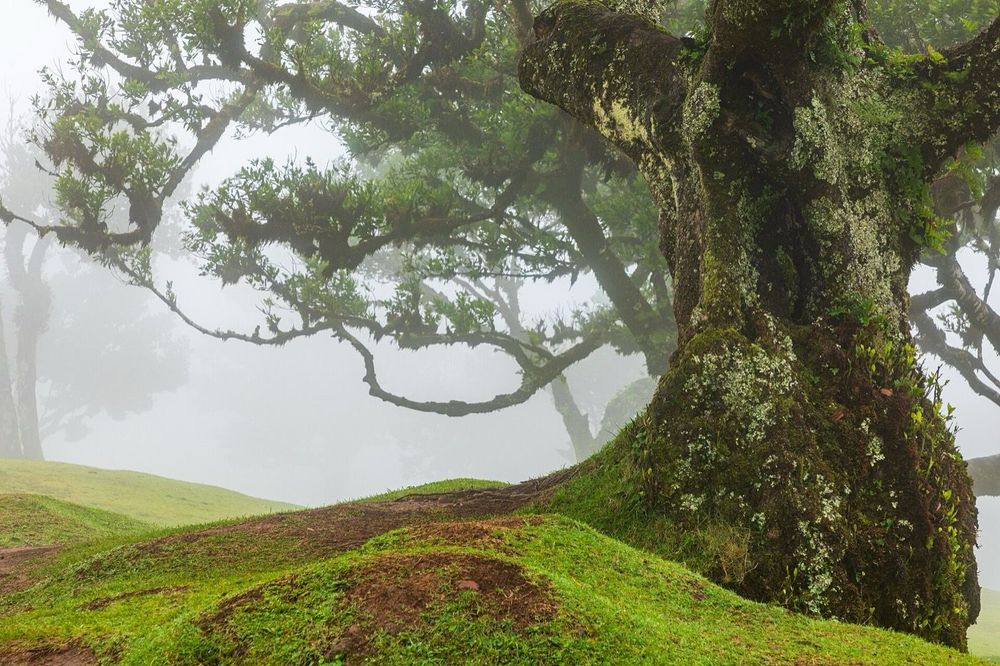
Fanal is the place your phone's photo roll has already seen: ancient laurel trees with trunks like melted candles, standing alone in white fog, somewhere between fairy tale and horror film depending on the light. It sits at about 1,150m on the northwest shoulder of the Paul da Serra plateau, a 200m stroll from a car park, which explains how a patch of UNESCO-listed forest became one of the most photographed places in Madeira. The trees have stood here for centuries. The crowds arrived in about five years.
That collision is the story of Fanal in 2026. New protection rules landed this year, half the internet has them wrong, and the walking around the grove is better than the car-park view suggests. This guide covers what the place actually is, how the fog works, the two marked trails that start here, and the exact state of the rules as of July 2026, checked against the park authority rather than last year's blog posts.
Key Takeaways
- Fanal is a grove of centuries-old 'til' laurels on Madeira's northwest plateau, and as of July 2026 visiting it is free, with no booking required. The new rules →
- The fog is frequent, on and off through most days, and the moody photos are a realistic expectation rather than a lottery win. The fog →
- Two marked hikes start here: the PR13 Vereda do Fanal (10.8km, 4 hours) and the PR14 Levada dos Cedros (7.2km, 3 hours), both €4.50 by advance booking. The hikes →
- Driving is the only practical way in: about 1 hour from Funchal on the ER209, with no direct bus. Getting there →
- The grove itself needs 1 to 2 hours. Since 2026 you stay on the marked paths, and the oldest trees stand behind fences. Time needed →
Is Fanal Forest worth it?
Yes, Fanal is worth the drive: it's the most atmospheric corner of Madeira's ancient laurel forest, and no other easily reachable spot on the island looks anything like it. The honest caveats are two. Mornings and weekends get busy, and since 2026 you experience the grove from marked paths rather than wandering freely among the trunks.
Neither caveat kills it. The fog swallows people as efficiently as it swallows trees, so even a busy day feels emptier than the car park implies. And the paths still put you close enough to the giants to count the moss species colonising one branch. If your idea of Madeira is levadas and sea cliffs, an hour up here recalibrates the whole island. It feels less like Portugal and more like somewhere Tolkien sketched and abandoned for being too on-the-nose.
The forest, explained
What you're looking at is 'laurisilva', the subtropical laurel forest that covered much of southern Europe until the ice ages scraped it away. Madeira keeps the largest surviving patch, about 15,000 hectares, UNESCO-listed since 1999, and Fanal is its most theatrical outpost. The stars are the 'til' trees (Ocotea foetens, a native laurel), several centuries old, grazed around by cattle for generations. That grazing is why they look the way they do: broad, low, twisted, each one standing alone in cropped pasture like an exhibit.
Push 50m past the famous specimens and the forest closes into proper jungle: younger laurels, tree heather, ferns to your waist, everything upholstered in moss. The transition is abrupt and worth the detour on its own. One more resident deserves mention. The cows are still here, wandering between the trees and materialising out of the fog like grey ships, and they have precisely zero interest in your photography.
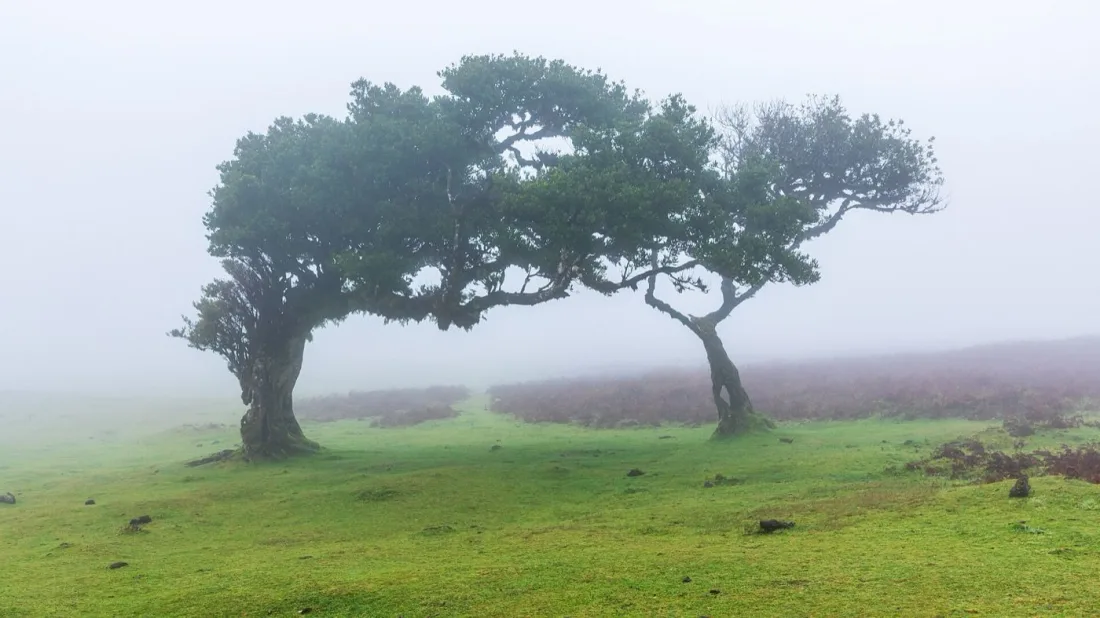
Photo: Dietmar Rabich, CC BY-SA 4.0 (Wikimedia Commons)
Ask anyone who works this plateau, the wardens, the farmers, the jeep drivers, and they will tell you the same thing: the fog always comes back. Plan around that fact and Fanal never disappoints.
Is Fanal Forest always foggy?
No, but close: cloud sits on Fanal most days, drifting in and out on the northeast trades, so the moody scenes are the default rather than a rare event. The physics aren't complicated. Moist Atlantic air rides the trades, hits Madeira's northern slopes, and stacks into a cloud layer at roughly 1,000 to 1,300m. Fanal, at 1,150m, sits exactly in the firing line, and locals call the resulting lid the 'capacete' (the cloud helmet that caps the high ground).
The practical version: on many days the grove cycles between white-out and washed sunlight every twenty minutes, and both states photograph well. If it's fog you're after, go early in the morning or from mid-afternoon, when the cloud bank most reliably climbs the slopes. If you want the trees sharp against blue sky, a dry east-wind day in winter is your best bet. Check the island webcams before committing the drive, and remember the plateau runs 8 to 10°C colder than Funchal. You'll be wearing everything you brought.
The new rules at Fanal in 2026
As of July 2026, entry to Fanal remains free and requires no booking, which surprises people who read about permit systems online. The changes that did arrive this year are about protection, and they change how you move rather than what you pay.
Fanal was getting loved to death: thousands of visitors a day treading the shallow roots, compacting the soil, and occasionally climbing the oldest trees for photos. It couldn't continue, and it didn't. So from early 2026 the IFCN, Madeira's forest and nature institute, rolled out a stricter regime. The oldest trees now stand behind low fences and you admire them from a respectful metre or two. Marked paths and boardwalk sections define where feet go, with more under construction through the year. Nature wardens patrol the site, and parking is regulated at designated areas rather than wherever the verge allows.
Two things are announced but not yet in force.
A daily visitor cap of around 3,000 people has been reported, and the institute is studying an access fee that would charge less for visitors arriving by tour or shared transport than by private car. Neither is implemented as of July 2026, so any blog describing timed entry slots at Fanal isn't describing the present, and check the official SIMplifica portal for the current state before you go. Rules here have a short shelf life.
The two marked hikes: PR13 and PR14
The grove is the postcard, and the walking is the meal. Two classified trails meet the Fanal road, and both count as official PR routes, which since 2026 means booking ahead and paying €4.50 per adult through SIMplifica, the same system covering Madeira's other paid trails.
| Trail | Distance | Time | Route | Character |
|---|---|---|---|---|
| PR13 Vereda do Fanal | 10.8km one way | ~4 hours | Assobiadores (1,420m) to Fanal (1,130m) | Open plateau, valley views, then laurels |
| PR14 Levada dos Cedros | 7.2km one way | ~3 hours | Fanal (1,090m) to Curral Falso (840m) | Levada channel through deep forest |
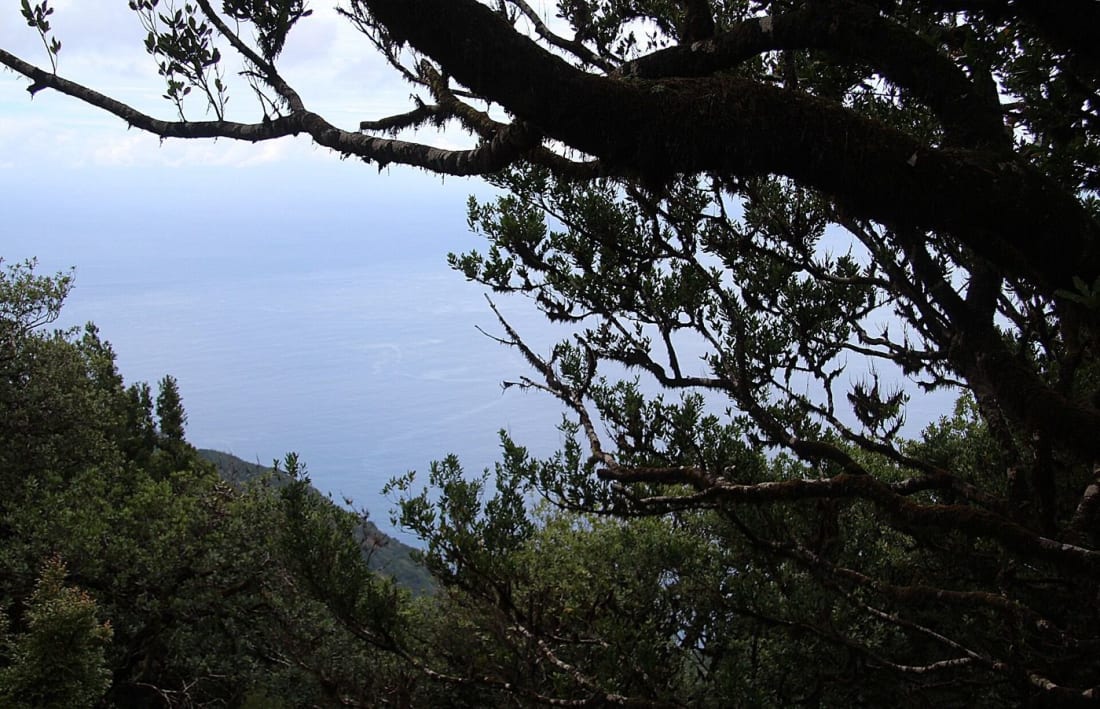
Photo: GerritR, CC BY-SA 4.0 (Wikimedia Commons)
The PR13 is the bigger day.
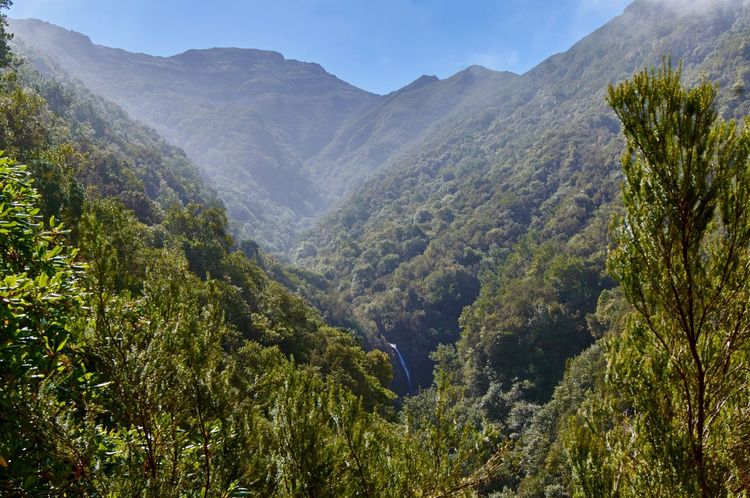
You'll start high on the Paul da Serra at Assobiadores, cross moorland that could pass for Scotland until the mist parts over an Atlantic valley, then drop gradually into thickening laurisilva until the famous grove announces the finish. It's a 'vereda' (a footpath, as opposed to a levada's water channel), so you'll get honest ups and downs rather than canal-flat walking, with about 290m of net descent and a moderate grading most regular walkers handle comfortably.
The PR14 follows the Levada dos Cedros downhill from Fanal to Curral Falso above Ribeira da Janela, tracking a 17th-century water channel through forest that's denser and greener with every kilometre. It's the quieter of the two and the better choice in thick fog, since the levada does the navigating for you. Both routes are one-way walks, so solve the logistics before you start: two cars, a taxi arranged from Porto Moniz, or a tour that shuttles you. Walking a stretch out and back from Fanal costs nothing in planning, and you'll still see the best of the forest. For how these two rank against the island's other big walks, our Madeira hiking guide puts all nine in order, and the levada logic gets its own explainer in the levada walks guide.
How do I get to Fanal from Funchal?
Driving is the only practical way: Fanal is about a 1-hour drive from Funchal, and no public bus reaches the forest itself. The fast route runs the VE4 towards São Vicente, then climbs to the plateau and follows the ER209 northwest; a slower, prettier version goes via Ribeira Brava and across the full Paul da Serra. The final stretch of the ER209 is narrow and winding, and it's frequently inside the cloud, so you'll want to drive it patiently. Fog that photographs like a dream at the grove behaves like a wall on the road, and the plateau's free-range cows treat the tarmac as their own.
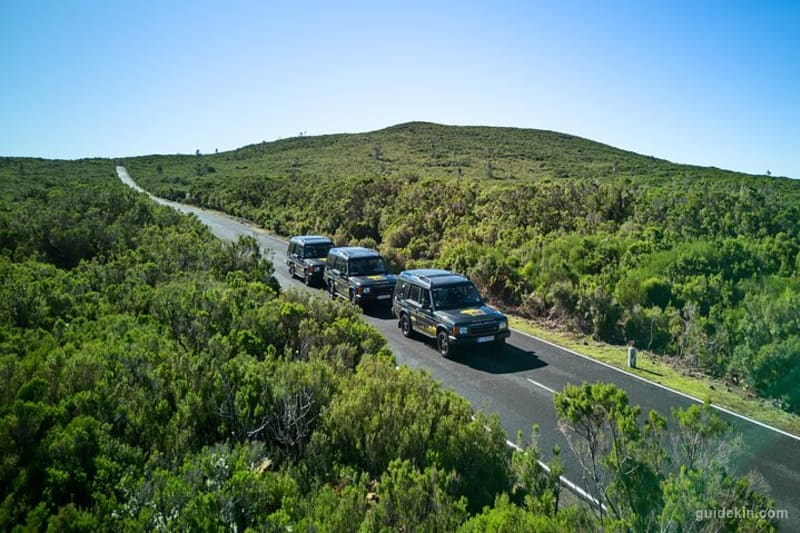
Without a car, you have two realistic options. The nearest buses stop down at Porto Moniz and Ribeira da Janela on the coast, and a taxi can carry you up the rest. Simpler still, join a tour: Fanal is a fixture of the island's 4x4 circuits, and the jeep and 4x4 tours on Madeira pair it with Porto Moniz and the northwest coast in one loop, driver included, fog stress not included. Guided hiking tours cover the PR routes with transport solved.
Coming or going, fill the tank in Funchal or São Vicente. There is nothing resembling a petrol station on the plateau, and the ER209 is a bad place to gamble.
How long you need, and what to bring
Budget 1 to 2 hours for the grove itself: that's enough to walk the marked loop slowly, wait out one fog cycle, and photograph the big tils from every legal angle. Add the short stroll to Lagoa do Fanal, a shallow seasonal pond about 1km away near the old forestry station, which doubles the scenery for twenty minutes of effort. With the PR13 or PR14 attached, Fanal becomes a full day.
Packing is about the temperature gap. It can be 26°C on the Funchal seafront and 15°C in the fog at Fanal, with a wet wind on top, so you'll want a warm layer and a shell whatever the forecast says. Footwear with grip matters even for the grove, since damp boardwalk and mud are the default surfaces. You won't need a head torch here, but a lens cloth is the most used item in any photographer's pocket: the fog beads on glass within minutes. And pack out everything you bring in. The wardens are polite about it once.
Photographing Fanal without the clichés
Fanal is the easiest hard photo on the island: easy because every direction contains a subject, hard because ten thousand people shot the same tree last month. A few field notes from repeated visits help.
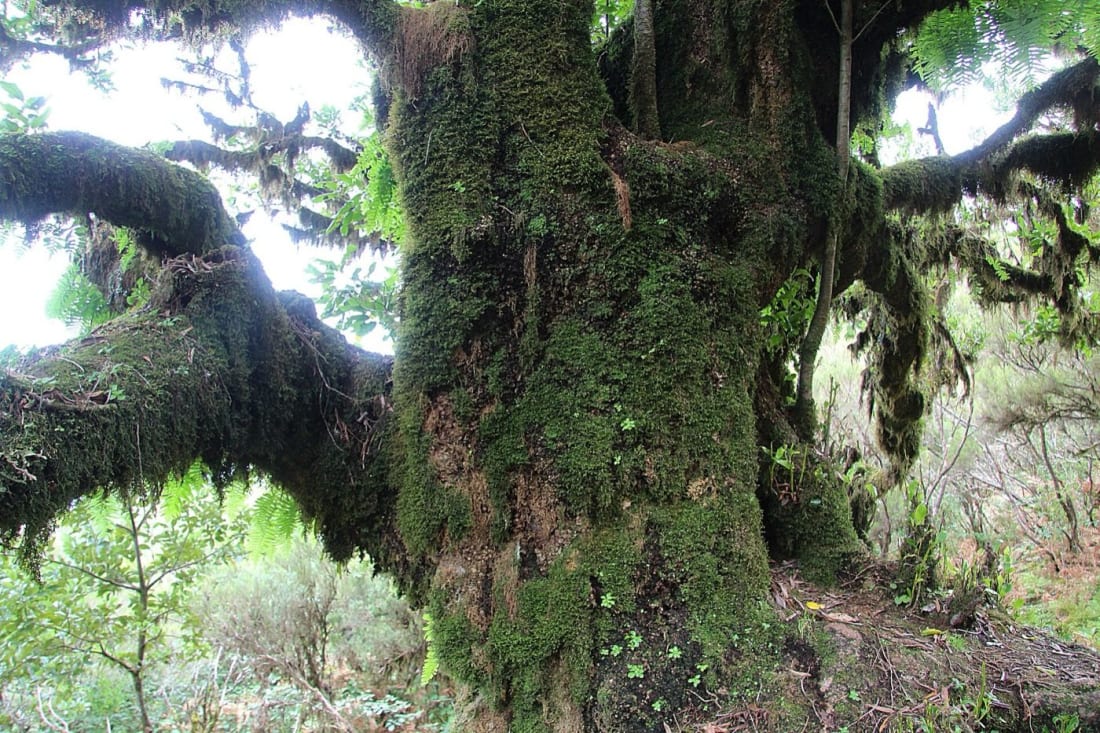
Photo: GerritR, CC BY-SA 4.0 (Wikimedia Commons)
Work one tree at a time. The classic images isolate a single til against clean fog, and that needs patience more than gear: pick your specimen, frame it, and wait for the cycle to erase the background walkers. The fog is your studio assistant, and it's punctual about returning. Wide scenes work best in the thinner mist that follows a white-out, when layers of trees separate into grey silhouettes at different depths.
People improve these photos more often than they ruin them. A figure in a red jacket at the right distance gives the trees their scale, which is the thing screens flatten. And mind two pieces of etiquette that the wardens now enforce: stay on the paths even when the perfect angle argues otherwise, and leave the fences out of frame with your feet, not by climbing them. The forest has survived six centuries of weather. It's the tripods it needs protecting from.
If you'd rather point a camera at something that moves, wait for the cows. They drift through the grove on their own schedule, and a laurel with a grey cow beneath it is the most Madeiran photograph there is.
When to go
For atmosphere, aim for early morning or late afternoon on any day with northeast winds, which is most days from spring through autumn. The middle of the day brings tour buses and the thinnest fog, which isn't a great combination for photographs and is a fine one for picnics. Weekends add local families to the mix, and the grove is at its busiest on sunny Sunday afternoons, when half of Funchal seems to drive up for the cool air.
Seasonally, Fanal has no closed months. Summer gives the most reliable fog theatre and the mildest temperatures. Winter brings clear-sky days when the plateau turns crisp and the views run to the sea, plus occasional storms that shut the experience down entirely. If your Madeira trip is short, slot Fanal into the first flexible morning and keep a second slot spare, the same tactic that works for the island's high peaks. Weather moves fast up here, and the drive's short enough to gamble twice.
Making a day of the northwest
Fanal pairs naturally with the coast below it, and you'll regret skipping it. Twenty minutes down the hill, Porto Moniz holds its famous lava pools, natural seawater baths built into black volcanic rock, and the swim after a foggy forest morning is one of Madeira's great temperature whiplashes. Seixal, ten minutes further east, adds a black-sand beach under green cliffs and a small harbour where the brave jump from the pier. The Ribeira da Janela valley, directly below Fanal, hides the island's most photogenic sea stacks just offshore.
Do it as a loop: Funchal to Fanal for the morning fog, PR14 or the grove walk, then down to Porto Moniz for the pools and lunch, and back along either coast. It's the exact circuit the jeep tours run, for good reason, and self-driving it lets you steal the hours the buses can't.
One sequencing note from experience: do the forest before the coast, not after. Fog is most reliable through the morning, the pools are at their best in afternoon sunshine, and the ER209 is a calmer drive uphill in daylight than downhill at dusk. Reverse the loop and you'll likely meet Fanal at its emptiest of fog and fullest of people, which is exactly the wrong trade.
FAQ
Is Fanal Forest free to visit?
Yes, as of July 2026 the Fanal grove is free, with no ticket or booking required. Only the classified hiking trails that start there, the PR13 and PR14, carry the €4.50 fee booked through SIMplifica, and a future access fee for the grove is under study.
How long is the Fanal Forest walk?
The grove itself is a gentle wander of 1 to 2 hours on marked paths. The full PR13 Vereda do Fanal runs 10.8km one way in about 4 hours, and the PR14 Levada dos Cedros covers 7.2km in about 3 hours.
Why is Fanal Forest famous?
Fanal is famous for its centuries-old til laurel trees standing isolated in pasture, photographed in the fog that caps the plateau most days. The grove is part of Madeira's UNESCO-listed laurisilva, the largest surviving laurel forest on Earth.
What are the new rules at Fanal?
Since early 2026 the oldest trees are fenced, visitors must stay on marked paths and boardwalks, wardens patrol the site, and parking is restricted to designated areas. A daily visitor cap and an access fee have been announced as under study but were not in force as of July 2026.
Can you visit Fanal without hiking?
Yes: the famous trees stand within a few hundred metres of the car park on flat, marked paths, so the classic Fanal experience needs no hike at all. The PR trails are the optional deep cut.
Is Fanal suitable for children?
Yes, the grove is one of Madeira's easiest big sights: flat ground, short distances and cows to negotiate with. Keep children close in thick fog, since visibility can drop to a few metres in minutes.
The table at the end of the fog
Finish where the mountain meets the sea. Drive down to Porto Moniz, take a table above the lava pools, and order grilled 'espada' (the island's black scabbard fish) with a cold Coral while your jacket steams dry on the chair. The fog you spent the morning inside will still be up there on the plateau, visible from the terrace like weather that doesn't belong to this island. That's the Fanal trick: one hour, two climates, and a camera roll that needs no filter. Book the trail if you're walking, check the rules week-of, and let the forest do the rest.