There is no better way to understand Madeira than to walk one of its levadas. These are the slim irrigation channels that thread the whole island, running water from the wet, green north to the dry, sunny south, and the slender paths beside them have become the finest network of walking trails in Portugal. Follow one and you slip into the island's secret interior: dripping laurel forest, hidden waterfalls, and tunnels carved by hand through the heart of a mountain.
This is hiking with the climbing taken out. Because the channels follow the contour of the land, most levada walks stay gloriously flat, which means almost anyone can reach scenery that would otherwise demand a mountaineer. The trade-offs are tunnels that need a torch, the odd cliff edge without a railing, and a few trails you now have to book. Get those right and Madeira opens up. For the wider island, start with our things to do in Madeira guide; this one is all about the walks.
Read on for what a levada actually is, the best walks for every level, the one mountain trail worth breaking the rule for, and exactly what to pack.
Levadas are the gentle half of the island's trail network. For the peaks, the PR1 ridge and the 2026 booking fees, our new guide to hiking in Madeira covers the other half.
Key Takeaways
- A levada is an irrigation channel, and the flat maintenance paths beside them are Madeira's best walking trails. What is a levada →
- The classics are the 25 Fontes (PR6) and Caldeirao Verde (PR9), both moderate and both unforgettable. The best walks →
- Several popular trails now need a cheap pre-booked slot, and the tunnels need a headtorch. How they work →
- The Pico do Arieiro to Pico Ruivo ridge is not a levada, but it is the island's greatest hike. The ridge walk →
- Bring grippy waterproof shoes, layers and a light, and start early to beat the cloud. What to bring →
What Is a Levada, Anyway?
A levada (from the Portuguese levar, to carry) is a narrow stone or concrete channel that carries water across the island. Madeira is steep and lopsided: rain falls on the green north and the high peaks, while the warm south, where people wanted to farm, runs dry. So from the second half of the 15th century, settlers began cutting channels to move the water, first to feed the island's sugar-cane fortunes, later its vineyards and banana terraces.
Building them was brutal work. With no way to reach the sheer ravines, the island used rocheiros, men lowered on ropes in wicker baskets to hack platforms and channels straight into the cliff face with picks and bare hands. For the first four centuries the work was private, paid for by the landowners and the water associations known as heréus; only from the 19th century, as the wine economy faltered, did the State step in to fund the harder routes. Over five centuries they built a staggering network, today roughly 3,100km of channels in total, including tens of kilometers tunneled clean through the mountains. The maintenance walkways that run alongside, once used only by the levadeiro who tends the water, are the paths you walk today.
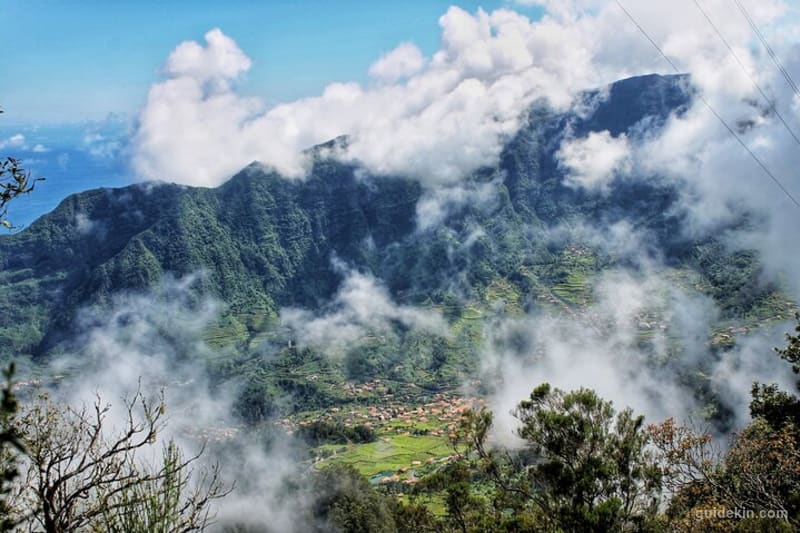
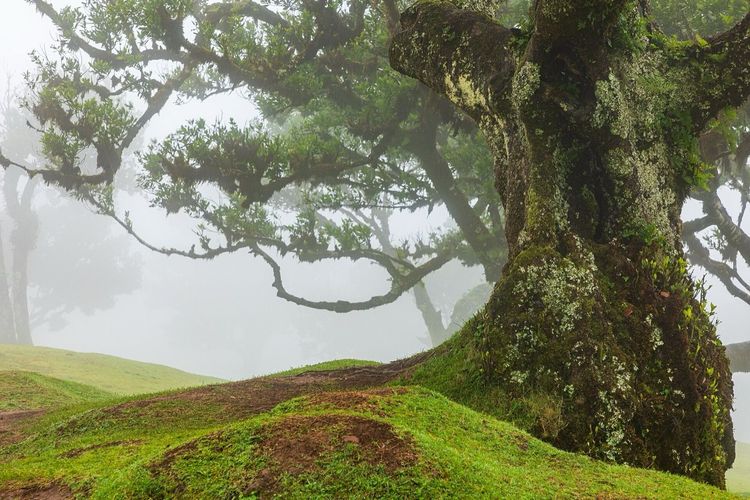
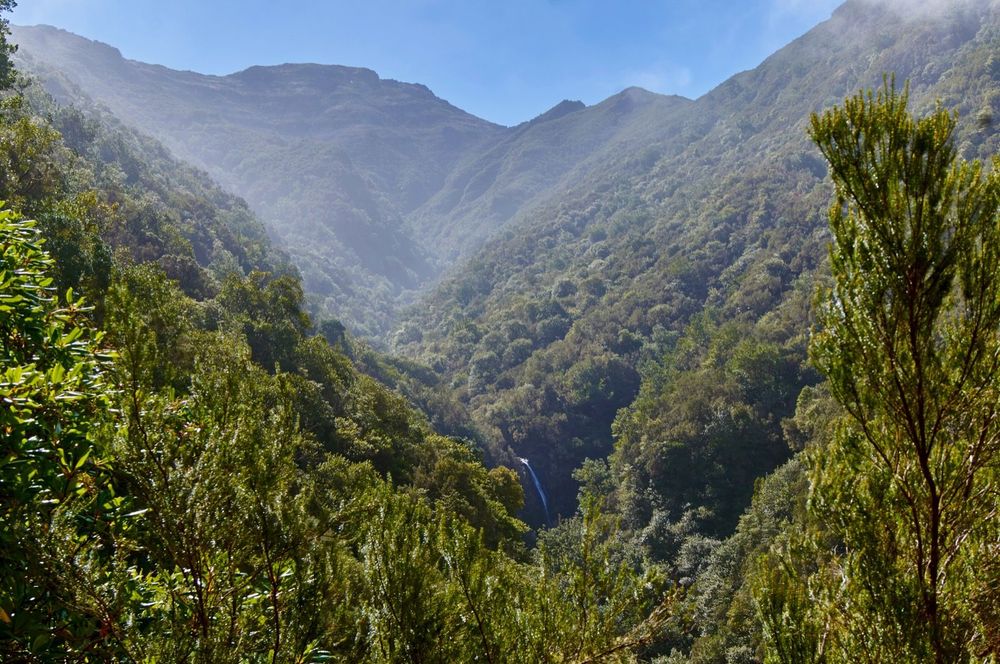
Many of the best trails thread through the laurisilva (the ancient laurel forest), a relic subtropical woodland that once covered much of southern Europe and survives here as a UNESCO World Heritage site, listed in 1999. Walking a levada through it, under dripping ferns and moss-furred trees, is the closest Madeira comes to time travel.
Local tip: Think of the levadas as the island's living museum, still doing the job they were built for. The water beside your boots is on its way to someone's banana patch, which is exactly why you keep your feet, and your litter, out of the channel.
How Levada Walks Work
The genius of a levada walk is the gradient, or lack of one. Because the water has to flow at a gentle, steady fall, the paths barely climb, so you get high-mountain scenery on near-flat ground. That said, "flat" is not the same as "easy." Some sections are cut into vertical rock with a long drop and no railing, a few are narrow and slippery, and several pass through unlit tunnels.
So two things are non-negotiable. First, a headtorch: trails like the Caldeirao Verde run through several pitch-black tunnels, and a phone light will do at a pinch but a proper head torch is far better, and mind your head where the roofs dip. Second, check the booking rules. To manage crowds and safety, several of the most popular trails now require a pre-booked time slot through the official SIMplifica system, at around 4.50 euros per person per trail, so sort it before you drive out.
What you will not find is signposted comfort. There are no cafes, no toilets and usually no phone signal on these trails, just the channel, the forest and the steady sound of running water beside you for hours on end. That simplicity is most of the appeal, but it also means you carry everything you need and tell someone your plan, especially on the longer northern routes where help is a long way off.
Planning tip: Match the trail to your nerve, not just your fitness. If exposed edges frighten you, choose a wide, forested levada like the Levada do Rei over a cliff-hugging one, and you will enjoy the day far more. The official Visit Madeira site grades and lists every PR (the numbered "pequena rota" trails) with current closures, so check it the night before.
The Best Levada Walks

A levada path hugs the cliff beside the Risco waterfall near Rabaçal. Photo: anagh, CC BY-SA 3.0 (Wikimedia Commons)
Levada das 25 Fontes (PR6). The island's most famous walk, named for the "25 springs" that feed a clear poca (rock pool) at its end. From the Rabacal plateau it runs about 4.3km one way, roughly three hours there and back at an easy-to-moderate pace, through deep laurel forest. Most people pair it with the short Levada do Risco spur to a tall waterfall. It gets busy, so book your slot and start early.
Levada do Caldeirao Verde (PR9). The other classic, and our pick if you only do one. Starting near Santana in the green north, it runs about 6.5km each way, around 13km and five to six hours round trip, through four hand-cut tunnels (headtorch essential) to the Caldeirao Verde, a cauldron-like basin where a thin waterfall drops into an emerald pool. The strong of leg can push on to the wilder Caldeirao do Inferno.
Levada do Rei (PR18). The gentle, green alternative. This one feels like walking through a rainforest corridor, following the channel up the Ribeiro Bonito valley to its source spring, with barely an exposed edge the whole way. It is the levada we send anyone nervous about heights.
Local tip: For an easy taster with a huge payoff, the short Levada dos Balcoes (PR11) near Ribeiro Frio is barely a couple of kilometers to a miradouro (viewpoint) that opens onto the central peaks. It is the levada to do with kids, tired legs, or only an hour to spare.
And the One Ridge Walk to Break the Rule For
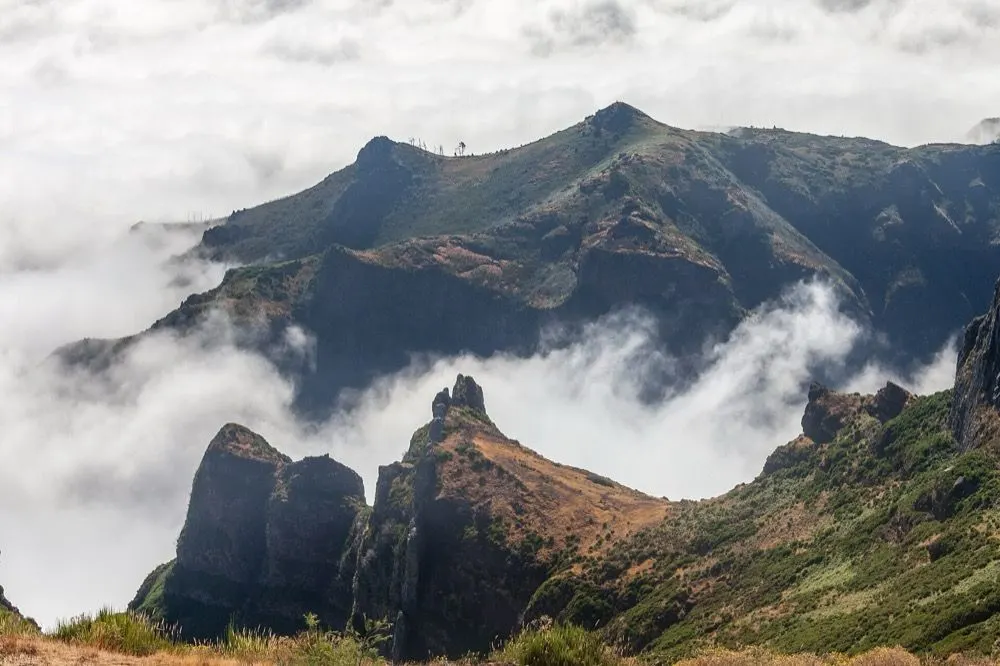
Madeira's central peaks rise above the clouds near Pico do Areeiro. Photo: Luis Miguel Bugallo Sánchez (Lmbug, CC BY-SA 4.0 (Wikimedia Commons)
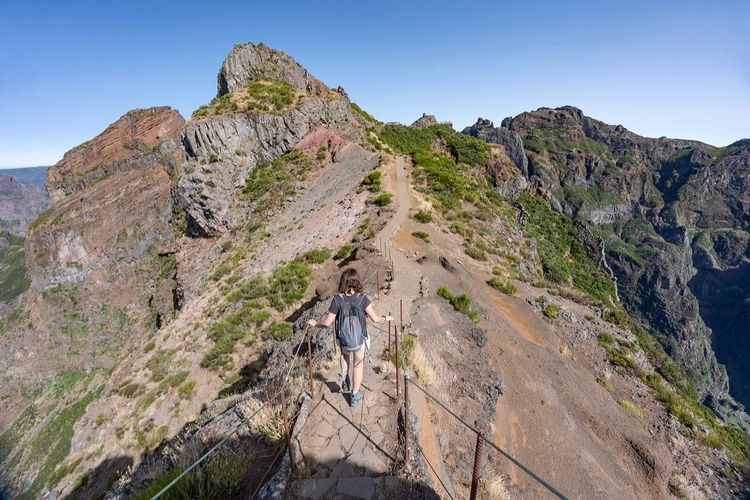
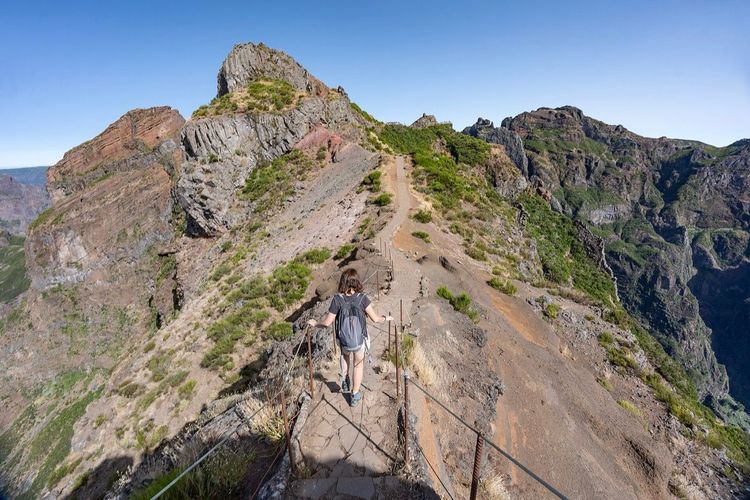
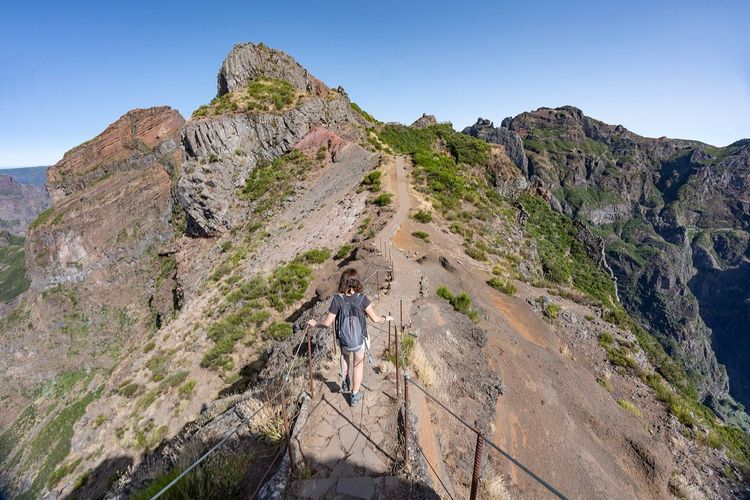
Not every great Madeira walk is a levada. The island's single most spectacular trail is the PR1, Vereda do Areeiro (a vereda is a high mountain footpath, the opposite of a flat levada), the ridge that links Pico do Arieiro to Pico Ruivo, at 1,862m the island's highest peak. This is a real mountain hike, not a flat channel: stone steps, stairs cut into the rock, tunnels and long exposed sections, all of it above the clouds with the whole island falling away on either side.
A few practical notes, because this one has rules. After a long closure the route reopened in a managed form, currently running one way only, from Pico do Arieiro to Pico Ruivo, on Friday, Saturday and Sunday, with a timed ticket (around 10.50 euros) booked in advance through SIMplifica. Bring three layers including a rain shell, take trekking poles for the steep stone descents, and start before 9am, because the cloud rolls in by mid-morning and steals the view.
"If you do one big walk on Madeira, make it the dawn ridge from Pico do Arieiro. You climb in the dark, the sun comes up over a sea of cloud, and you understand the whole island in a single hour." - Guidekin team
Detour: Time it for sunrise. Drivers and tours leave Funchal in the dark to reach the Pico do Arieiro car park before dawn, when the peaks float on a sea of cloud and the light turns the rock to copper. It is the most photographed half hour on the island, and it earns it.
Two More Walks Worth the Drive

The forest path to the Casa do Rabaçal, gateway to some of the island's best walks. Photo: Asurnipal, CC BY-SA 4.0 (Wikimedia Commons)
When you have ticked off the headline levadas, two very different trails show the range of the island. The Levada do Furado (PR10), running from Ribeiro Frio toward Portela, is one of the oldest and most beloved classic levadas, about 11km of lush, fern-draped forest with a few exposed balconies and long, easy gradients. It is the walk locals send you on when the famous ones are booked out.
For total contrast, drive to the island's far eastern tip and walk the Vereda da Ponta de Sao Lourenco (PR8). This is no green levada: it is a bare, wind-scoured peninsula of red and ochre volcanic cliffs dropping into a deep-blue Atlantic, roughly 8km round trip with almost no shade. After days in the dripping laurel forest, this arid, lunar finger of land feels like a different planet, which is the whole point.
Local tip: Do Ponta de Sao Lourenco early or late, never at midday. There is no tree for an hour in any direction, the sun is fierce, and the wind that cools you also pushes you around on the narrow sections, so bring water, a hat and steady feet.
What to Bring, and Stay Safe
Madeira's mountains make their own weather, so pack for all of it. The essentials for any serious levada walk:
- Grippy, ideally waterproof shoes. The paths are wet, mossy and uneven, and smooth soles are an accident waiting to happen.
- A headtorch. Non-negotiable for the tunnel trails like PR9.
- Layers and a rain jacket. It can be sunny in Funchal and pouring at altitude on the same morning.
- Water and snacks. There are no shops on the trail.
- A booked slot where required. Check SIMplifica before you set out.
On safety: take the exposed, unrailed sections slowly, keep clear of the channel edge, and turn back if the cloud closes in or the path is flooded. People with serious vertigo should pick the forested, sheltered levadas and skip the cliff-edge ones, of which there are plenty of better alternatives.
Guided or On Your Own?
Self-guided is easy on the wide, forested trails if you have a car and have done your homework. But there is a strong case for a guide on Madeira, and it is mostly about logistics: many of the best walks are linear, finishing miles from where they start, so a guided trip solves the transport, sorts the booking, and frees you to look up instead of at a map.
A guide also reads the weather and the terrain, which matters on the exposed routes. To compare options, browse Madeira levada walks and hikes or the wider range of Madeira walking tours, and pick the trail that matches your level rather than the one with the best photos.
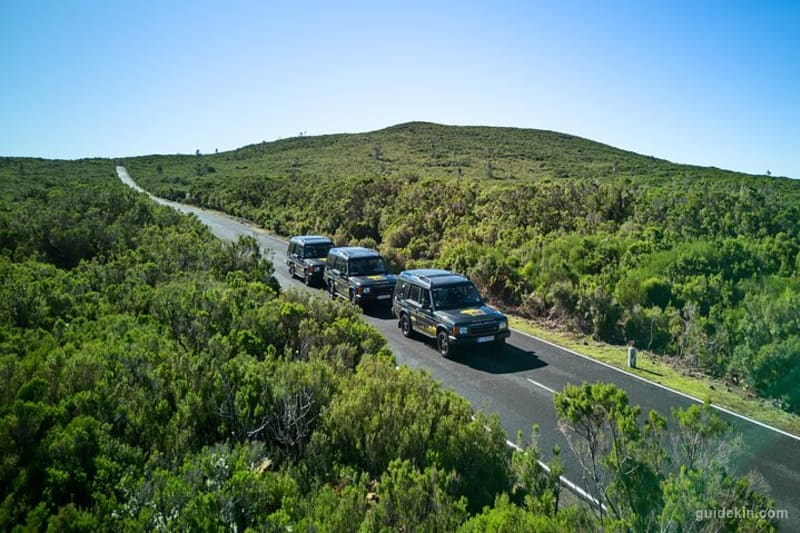
The transport question is the real one. Public buses do reach a few trailheads, but they are slow and infrequent, and they rarely help on a one-way route where you finish a valley away from where you parked. So most independent walkers rent a car, while those who would rather not drive the island's hairpin roads book a guided walk or a hiking transfer that drops you at the start and collects you at the end. Either way, sort the logistics before the morning of the walk, because working it out at the trailhead wastes the best light of the day.
Madeira Levada Walks at a Glance
| Trail | Distance (round trip) | Time | Level | Highlight |
|---|---|---|---|---|
| Levada dos Balcoes (PR11) | ~3 km | 1-1.5 hrs | Easy | Peaks viewpoint, family-friendly |
| Levada do Rei (PR18) | ~10 km | 3-4 hrs | Easy-moderate | Rainforest, no exposure |
| Levada das 25 Fontes (PR6) | ~9 km | 3-4 hrs | Moderate | Spring-fed pool + Risco waterfall |
| Levada do Caldeirao Verde (PR9) | ~13 km | 5-6 hrs | Moderate | Tunnels + emerald waterfall |
| PR1 Arieiro to Ruivo (ridge) | ~7 km one way | 3-4 hrs | Hard | Highest peak, above the clouds |
Where to Base Yourself for the Walks
Most visitors base in or around Funchal and drive out to the trailheads, which works because nowhere on Madeira is more than about 90 minutes away. It puts the restaurants, the airport and the south-coast sunshine on your doorstep, and most guided walks pick up from here.
If hiking is the whole point of your trip, consider a night or two in the green north, around Santana or Sao Vicente, so you wake up beside the Caldeirao Verde and Levada do Rei trailheads instead of driving an hour to reach them. We'd split the difference on a longer trip: a few nights in Funchal for the city and the south, then a couple up north for the best of the levadas, swapping a long morning drive for a short one.
Local tip: Wherever you sleep, fill the car the night before with water, snacks and your packed boots. The best trail light is early, and the difference between a 7am and a 10am start is the difference between an empty path and a conga line.
When to Go
You can walk the levadas year-round, but the driest, clearest stretch is roughly April to September. Winter brings more rain and more closures, and the high peaks can be cold and socked in even when Funchal is warm. Whatever the month, mornings beat afternoons: the cloud tends to build over the interior after lunch, so an early start buys you the views.
Crowds follow the same rhythm as the weather. The 25 Fontes and Caldeirao Verde can feel like a slow procession from mid-morning in July and August, while a shoulder-season weekday start leaves you sharing the laurel forest with little more than birdsong. If your dates are flexible, aim for late spring or early autumn, when the trails are open, the springs are full and the island is at its greenest.
Check trail status before every walk. Madeira closes levadas for landslides, repairs and weather, and the official Visit Madeira list is the only one that matters; a trail that was open last week may not be today.
Practical Tips
- Book early where required. The headline trails need a SIMplifica slot, and PR1 sells out its weekend tickets fast.
- Start before 9am. You beat both the crowds and the midday cloud.
- Drive or take a guided transfer. Trailheads are scattered and often linear, so public transport rarely lines up.
- Pack the headtorch and the rain jacket every time, even on a sunny morning.
- Respect the channel. The water is in use, so keep feet, dogs and rubbish out of it.
- Know your limit with heights. There is a perfect levada for every comfort level, so choose honestly.
FAQ
What is a levada in Madeira?
A levada is a narrow irrigation channel built to carry water across the island, the first cut in the 15th century. The flat maintenance paths beside them now form Madeira's network of walking trails, roughly 3,100km of channels in all.
Which is the best levada walk in Madeira?
The two classics are the Levada das 25 Fontes (PR6) and the Levada do Caldeirao Verde (PR9). If you only do one, we'd pick Caldeirao Verde for its tunnels and waterfall. For an easy option, the Levada dos Balcoes is short and stunning.
Do you need to book levada walks?
Several of the most popular trails now require a pre-booked time slot through the official SIMplifica system, at around 4.50 euros per person, and the PR1 ridge walk needs a separate ticket. Check before you go, because rules change.
Are the levada walks dangerous?
Most are safe and near-flat, but some have unrailed cliff edges and dark tunnels. Bring a headtorch and grippy shoes, take exposed sections slowly, and if you fear heights, choose a forested levada like the Levada do Rei. Accidents almost always come down to the avoidable: smooth-soled shoes on wet rock, no light in a tunnel, or pushing on when cloud and rain have rolled in.
How do you get to the trailheads?
Most walkers drive, since trailheads are scattered and buses are slow and sparse. On the linear routes you finish far from your car, so a guided walk or a hiking transfer that handles the pickup is often easier than self-driving, especially for the PR1 ridge and the northern levadas.
Do you need a guide for the levadas?
Not for the easy, forested trails if you have a car. But a guide handles the transport on linear routes, sorts the bookings and reads the weather, which is genuinely useful on the exposed walks.
When is the best time to walk the levadas?
April to September is driest and clearest, and mornings beat afternoons year-round because the interior clouds over after lunch. Always check the official trail status the day before.
Lace Up and Follow the Water
The levadas are Madeira's masterpiece, five centuries of stubborn engineering turned into the gentlest way to walk into wild country. Pick a trail that fits your nerve, pack the torch and the rain jacket, and let a hand-cut channel lead you to a waterfall no road can reach. Walk just one and you will understand why the island's hikers keep coming back, year after year. The famous trails earn their crowds, but it is the quiet ones, the forested levadas where you hear nothing but water and birdsong, that tend to stay with you long after the tan has faded and the rest of the photos blur together. When you are ready to plan it properly, browse Madeira tours and experiences and choose the walk, and the pace, that is right for you.