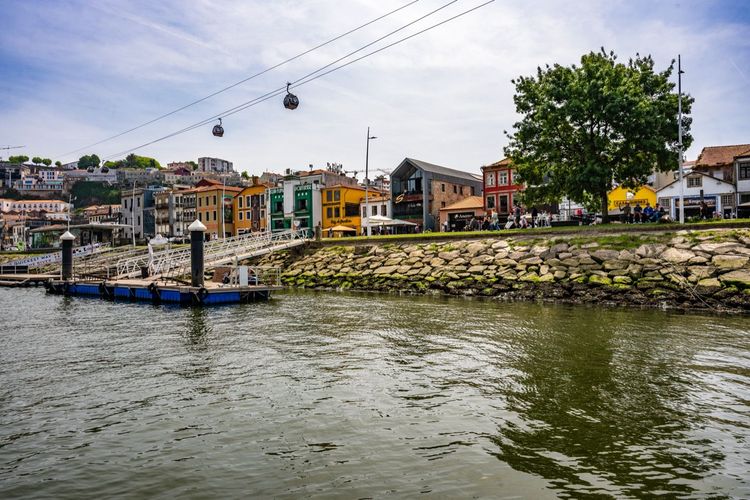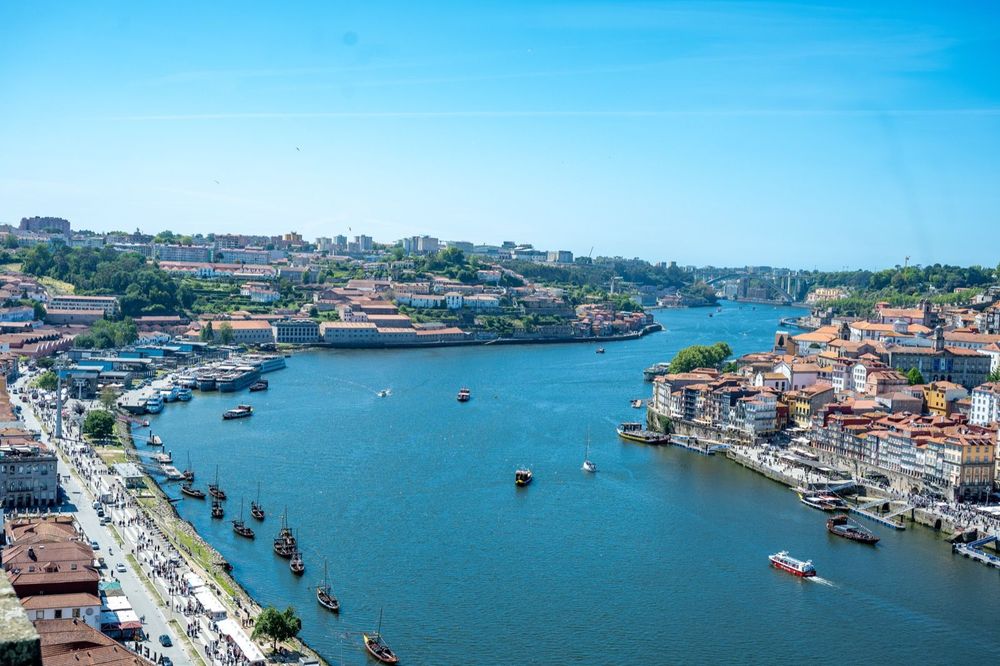
Porto turns its best face to the river. Down in the Ribeira, the city's oldest quarter, tall houses in ochre, blue and faded terracotta stack so steeply up the gorge that you can walk in a front door on one lane and out onto a rooftop on the next. The Douro slides past below, the great iron bridge arcs overhead, and across the water the port lodges of Gaia wait with a glass of something dark and sweet. This is the postcard, and for once the postcard is right.
The trick is to enjoy it without falling into the obvious traps. The restaurants lined along the quay charge a view tax for mediocre food, and the crowds peak at exactly the wrong hours. Walk one street back, come at the right time, and Ribeira gives you the real thing. If you are building a wider trip, our Porto in 2 days itinerary sets the frame; this guide is the slow, riverside heart of it.
Read on for how to work the Ribeira, when to cross the bridge for port, and where to eat without paying the tourist markup.
Key Takeaways
- Ribeira is Porto's UNESCO-listed old riverfront, a maze of tiled houses below the Dom Luis I Bridge. A short history →
- Walk the top deck of the bridge for the best free view in the city, then cross to Gaia for the port lodges. Crossing the bridge →
- Tour one port cellar properly rather than rushing three; Sandeman and Graham's are the classics. Port wine in Gaia →
- Eat one street back from the quay, not on it, for better food at honest prices. Where to eat →
- Come for a weekday morning or late afternoon, and brace for the wild Sao Joao festival on June 23. When to go →
A Short History: Porto's Working River
Ribeira means "riverbank," and that is exactly what this was: Porto's working port since the 12th century, where medieval traders unloaded goods from across Europe and the wider world. The whole historic center earned its UNESCO World Heritage listing in 1996, recognized for showing the city's slow evolution from Gothic through Renaissance to Baroque, and many of the buildings you walk past went up between the 16th and 18th centuries.
It was never a grand quarter. It was a crowded, hard-working tangle of warehouses, fishermen and dockhands, and that is why it feels so alive today rather than embalmed. The narrow granite townhouses, painted and tiled and patched over centuries, climb the hillside so tightly that the rooflines stagger up the slope like a crowd straining for a better view of the water.
Down on the Cais da Ribeira, the riverfront promenade, the old merchant warehouses now hold the cafes and restaurants, and the Praca da Ribeira opens behind them, ringed by those tall tiled facades. Tucked in the lanes is the Casa do Infante, the medieval customs house where, by tradition, Prince Henry the Navigator was born in 1394.
Local tip: Look up and behind, not just at the water. The steep lanes climbing away from the quay, with their azulejos (painted ceramic tiles), drying laundry and tiny grocers, are where Ribeira still lives its real life, a minute's climb from the souvenir stalls.
How to Get to Ribeira, and Around
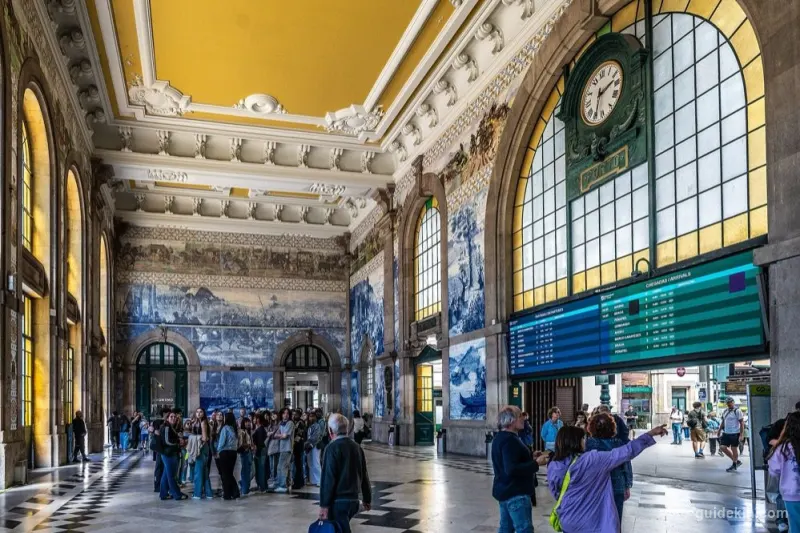
Ribeira sits at the bottom of everything, so you will almost always arrive by going down. From the Sao Bento railway station, whose entrance hall is lined with some 20,000 azulejos telling the history of Portugal, it is a steep ten-minute walk down through the old streets to the water. The metro and most of the city center sit on the plateau above, and the climb back up at the end of the day is the price of the view.
To save your legs, the Funicular dos Guindais runs up the slope between the Ribeira riverside and the Batalha district near Sao Bento, a quick, scenic cable ride beside the medieval Fernandina wall. Otherwise it is all on foot: the quarter is tiny, the lanes are stepped and cobbled, and a car is useless down here.
Planning tip: Wear proper shoes. Ribeira is built on a slope of worn calcada (traditional stone paving) and stairways, beautiful and ankle-testing in equal measure, so leave the smooth soles behind. A small-group Porto walking tour is the easiest way to read the history into the stones if you would rather not navigate alone.
The Cais da Ribeira and Praca da Ribeira
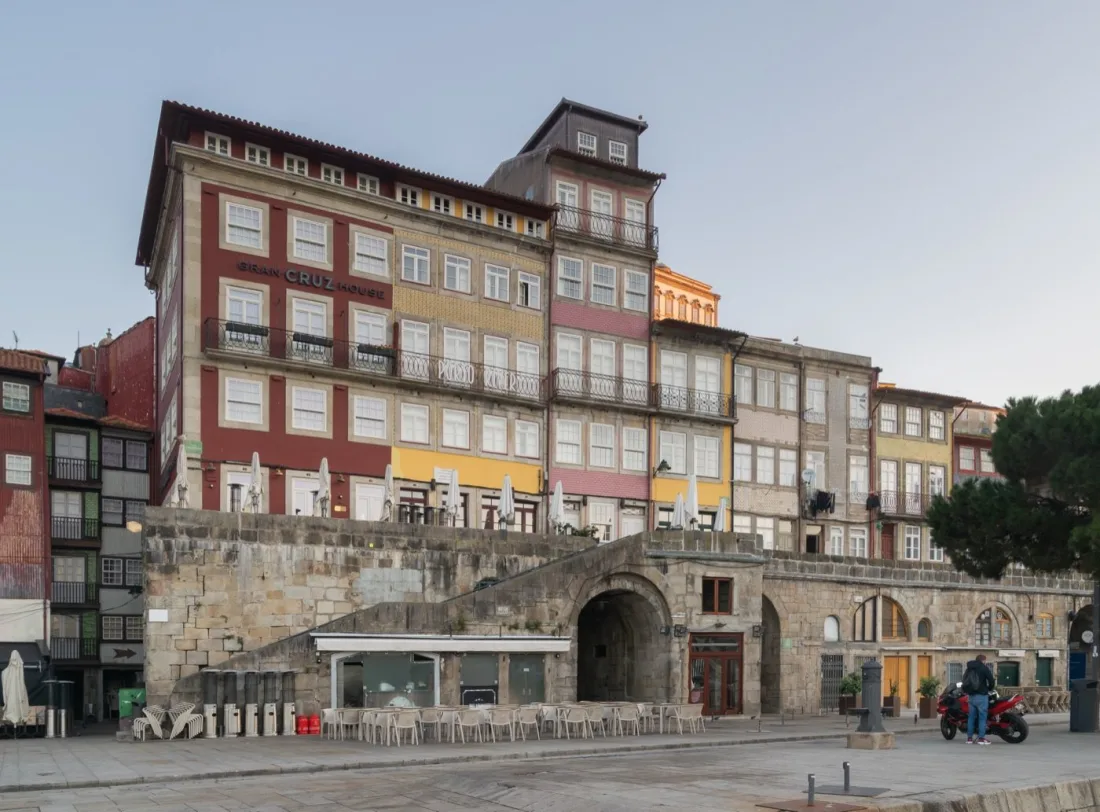
The colourful houses and old arcades of the Cais da Ribeira. Photo: Krzysztof Golik, CC BY-SA 4.0 (Wikimedia Commons)
The heart of it is the waterfront itself. Wander the Cais da Ribeira with the river on one side and the warehouse-restaurants on the other, then duck into the Praca da Ribeira, the square where locals and visitors share the same view of the bridge. The houses here are the ones you will photograph, six and seven storeys of tile and shutter, with washing strung between the windows and a cat asleep on every third sill. Do not rush it. Buy a coffee, sit on the steps, and let the river traffic and the buskers fill an hour. Ribeira is a place to linger, not to tick off.
This is also where the rabelos (the flat-bottomed wooden boats) are moored, the vessels that once carried barrels of port down from the Douro Valley to the cellars of Gaia. The barrels travel by truck now, but the rabelos still bob at the quay, mostly running sightseeing trips, and they make the prettiest foreground for a photo of the bridge.
"The single best thing to do in Ribeira costs nothing: find a step on the quay near sunset, watch the light turn the river gold and the Gaia lodges pink, and let the city come to you." - Guidekin team
Beyond the Quay: Churches, Palaces and the Old Wall
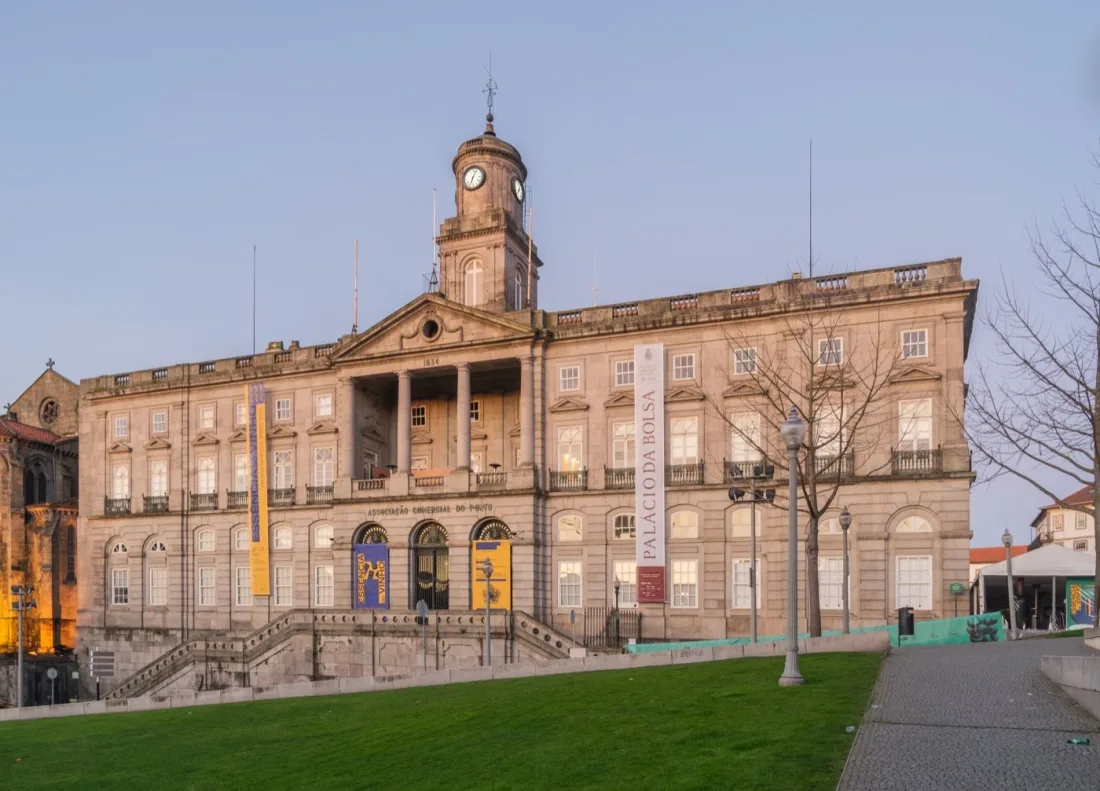
The Palácio da Bolsa, Porto’s grand 19th-century stock exchange. Photo: Krzysztof Golik, CC BY-SA 4.0 (Wikimedia Commons)
Ribeira is not all riverfront. A short, steep climb into the lanes brings you to some of Porto's richest interiors. The Igreja de Sao Francisco looks plain and Gothic from the street, then stuns you inside: nearly every surface is smothered in gilded Baroque woodcarving, hundreds of kilos of gold leaf, including a famous carved Tree of Jesse. It is one of the most extravagant church interiors in Portugal, and there is a small entry fee.
Next door, the Palacio da Bolsa, Porto's 19th-century stock exchange, hides the Salao Arabe (Arab Room), a dazzling Moorish-revival hall that took almost two decades to decorate; you can only see it on a guided tour, and it is well worth the ticket. Up above the river stands the Se do Porto, the fortress-like cathedral begun in the 1100s, with a terrace miradouro (viewpoint) that looks straight down over the rooftops to the water.
Threaded between them, look for the granite Muralha Fernandina, the surviving stretch of Porto's 14th-century city wall and a reminder of how small and defensible this river town once was.
Detour: We'd pair Sao Francisco and the Bolsa in one short loop, since they sit side by side just above the quay; together they take about ninety minutes and show you the kind of gold the port trade once paid for.
Crossing the Dom Luis I Bridge
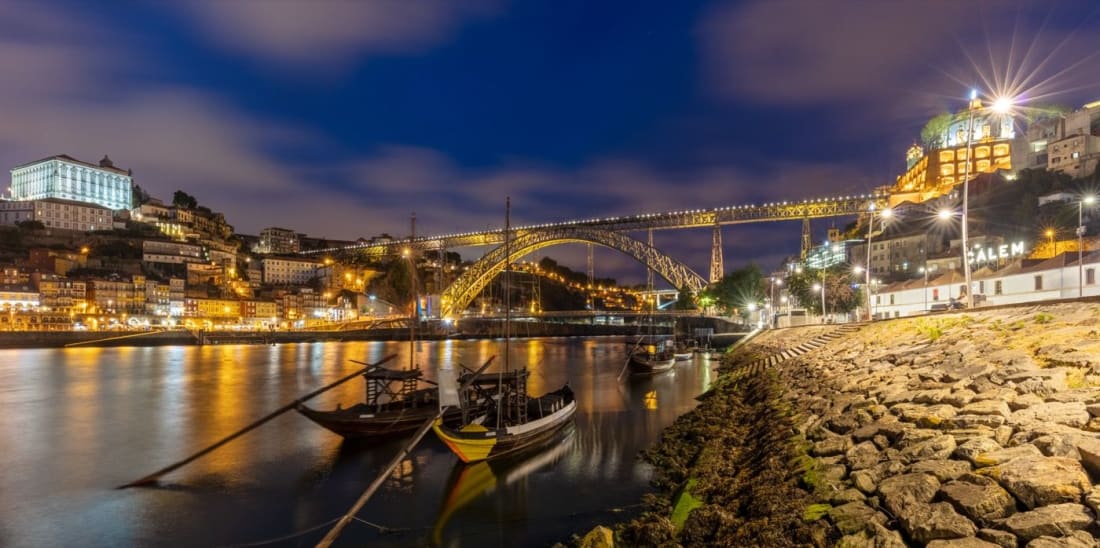
The Dom Luis I Bridge over the Douro at blue hour. Photo: Diego Delso, CC BY-SA 4.0 (Wikimedia Commons)
The Ponte Dom Luis I is Ribeira's defining landmark, a double-decked iron arch opened in 1886 and designed by Theophile Seyrig, a partner of Gustave Eiffel, which is why it looks like a cousin of a certain tower in Paris. Cars and pedestrians share the lower deck at river level; up top, the metro crosses, and a walkway runs alongside it.
Walk the upper deck. It is free, it is open all hours, and the view back over Ribeira's tiled cliff of houses and out along the Douro is the finest panorama in Porto. Go slowly. Stop in the middle. The drop to the river is dizzying, and the photo is worth the nerve. On the far side, climb a few minutes more to the Miradouro da Serra do Pilar, the monastery viewpoint that frames the whole scene, bridge, river and old town in one shot.
Detour: Time the upper-deck crossing for the half hour before sunset. You walk over with the light behind Ribeira, reach Gaia as the lodges warm to gold, and you are conveniently standing among the port cellars exactly when a glass starts to sound like a good idea.
Port Wine in Vila Nova de Gaia
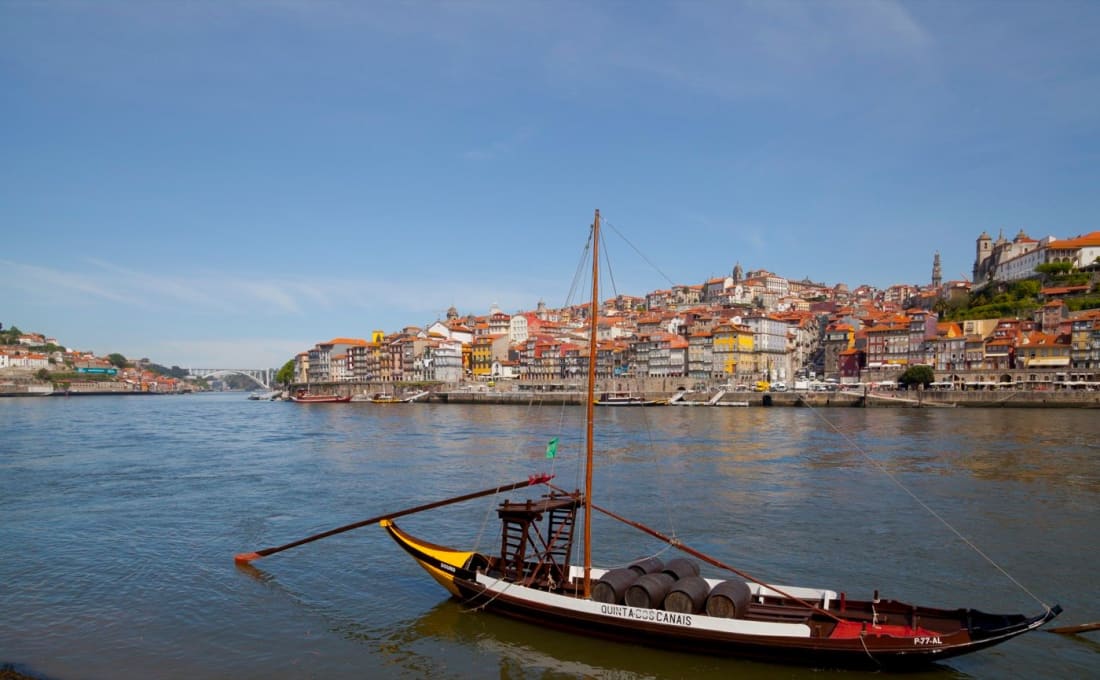
A rabelo boat with port barrels on the Douro, Porto rising behind. Photo: Diego Delso, CC BY-SA 3.0 (Wikimedia Commons)
Cross the bridge and you are in Vila Nova de Gaia, technically a separate city, where the port lodges have aged their wine in cool riverside cellars for centuries. Vinho do Porto (port, the fortified wine) was shipped from here all over the world, and a cellar tour is the one paid experience in the area worth planning around.
The grande dame is Sandeman, founded in 1790 and instantly recognizable by its caped-and-hatted "Don" logo; its guides still dress as the Don, and tours run roughly from a 50-minute visit with three tastings at around 22 euros up to a 90-minute old-tawny tasting near 50 euros (2026). Up the hill, Graham's, established in 1890, gives one of the most polished tours in the city, with around 2,000 oak casks and a tasting room looking back over the river; Taylor's is the other classic name, with a lovely garden terrace.
Learn the basics before you go and the tasting lands better. Tawny port is barrel-aged to a nutty, caramel smoothness; vintage is bottle-aged, bold and built to last decades. And for the local trick on a warm afternoon, order a porto tonico, white port over ice with tonic and a twist of lemon, the way Porto itself drinks in summer.
Local tip: Do not try to "collect" cellars. One unhurried tour, with a proper tasting and the story behind the wine, beats three rushed ones. Book ahead in summer, and browse Porto wine tours or the lodges of Gaia to compare before you commit.
A Douro River Cruise
The classic way to see the river is the Six Bridges cruise, a 50-minute loop on a rabelo-style boat that takes you under the city's six bridges and gives you the Ribeira-and-Gaia panorama from the water, the angle the postcards are shot from. They leave all day from both banks, cost only a few euros more than a fancy coffee, and are the rare boat trip that is genuinely worth it.
If the river gets under your skin, the same quays sell full-day cruises up into the Douro Valley, the terraced wine country where port is actually grown. Compare the short hops and the day trips among the Porto boat tours before you choose.
Where to Eat, and Where Not To
Here is the one rule that will save your trip: do not eat on the quay. The restaurants with the best river view and the pushiest waiters charge a premium for ordinary food. Walk one street back from the water and the quality climbs as the prices fall.
Look for the small, traditional places in the lanes just inland, the kind serving bolinhos de bacalhau (codfish fritters), grilled sardines and hearty Porto plates to a room of regulars. Adega Sao Nicolau, on Rua de Sao Nicolau, is a long-standing favorite, with cheaper, more traditional spots a few doors along. Order petiscos (small sharing plates) in a back-lane tasca (tavern) and you will eat better, and for less, than anyone sitting on the quay.
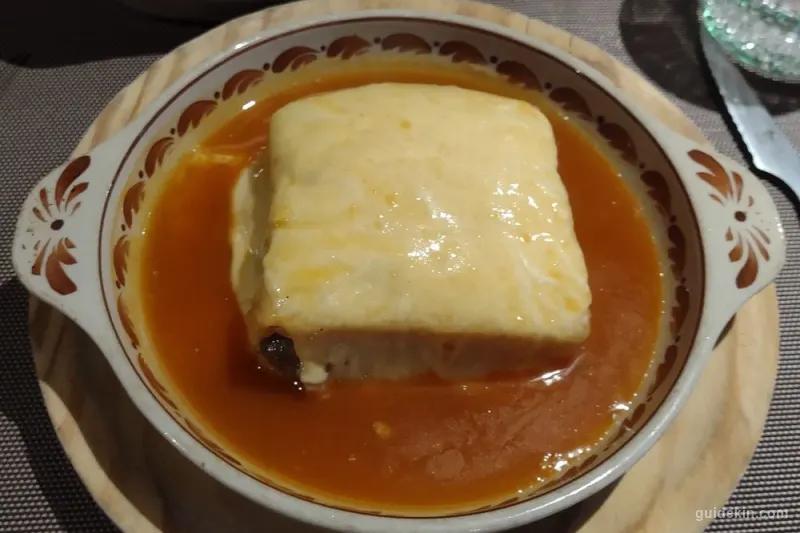
And no first visit to Porto is complete without a francesinha, the city's outrageous sandwich of cured meats and steak under melted cheese, drowned in a beer-and-tomato sauce; it is a meal, a dare and a local institution all at once. The other signature is tripas a moda do Porto (tripe stew), the dish that gave the locals their proud nickname, the tripeiros, or tripe-eaters, after they reputedly handed their best meat to Henry the Navigator's ships back in the 1400s.
Detour: For the full picture without the guesswork, a guided Porto food tour walks you past the tourist traps to the counters and tascas locals actually use, which is the fastest way to eat well in a single evening.
A Half-Day Wander Through Ribeira
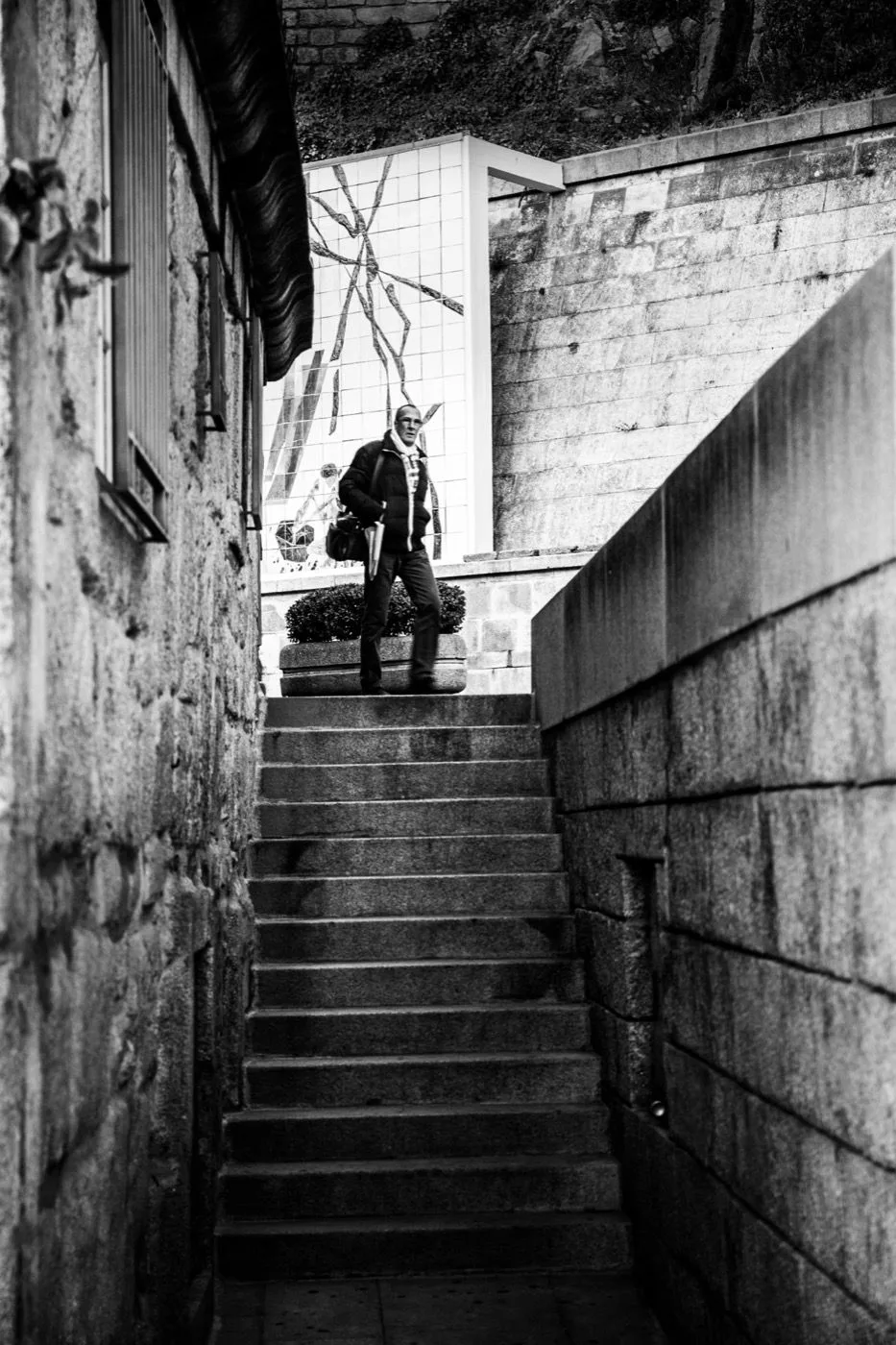
One of Ribeira’s steep stepped lanes leading down to the river. Photo: Sergio Miranda, CC BY 2.0 (Wikimedia Commons)
If you like a thread to follow, this loop runs about three to four hours, more with a long lunch. Start up at Sao Bento for the azulejo hall, then walk down through the lanes to the Se for your first view of the river. Drop to the Cais da Ribeira, wander the Praca da Ribeira and the quays, and duck into the gilded Igreja de Sao Francisco on the way.
Then cross the lower deck of the Dom Luis I Bridge into Gaia, tour one port lodge, and time your walk back over the upper deck for sunset. Finish with dinner one street back from the water. It is a full day, mostly downhill and then across, and it shows you the best of Porto without a single taxi.
Planning tip: Do the climbing early and the port late. The lanes are quietest before the lunch crowds, the cellars are cooler and calmer in the morning, and a glass of tawny tastes a great deal better once the walking is behind you.
Ribeira at a Glance
| Spot | What it is | Time | Cost (2026) |
|---|---|---|---|
| Cais da Ribeira and Praca da Ribeira | Tiled riverfront and main square | 1 hr | Free |
| Ponte Dom Luis I (upper deck) | Best panoramic view in Porto | 30-45 min | Free |
| Miradouro da Serra do Pilar | Monastery viewpoint over the bridge | 30 min | Free (church small fee) |
| Sandeman / Graham's (Gaia) | Port lodge tour and tasting | 1-1.5 hrs | ~€22-50 |
| Six Bridges cruise | 50-min Douro boat loop | 50 min | Budget |
| Sao Bento station | 20,000-tile azulejo hall | 15 min | Free |
Where to Stay
Sleeping in or just above Ribeira means waking to the river and the church bells, though it comes with stairs, cobbles and a little late-night noise drifting up from the quay. Boutique hotels and guesthouses fill the restored townhouses on the slope, and a room a little higher up the hill trades a few steps for quiet and a rooftop view.
Across the water, Vila Nova de Gaia is the clever alternative: many of its hotels look straight back at Ribeira's tiled cliff, often for less money, and you wake up on the doorstep of the port lodges. We'd weigh a riverview room in Gaia against a lane in Ribeira itself, and book early either way, because the rooms with the view are always the first to go.
When to Go
For the calmest Ribeira, come on a weekday morning or in the late afternoon; the quay and the bridge are busiest in the evenings, when everyone arrives for sunset and dinner at once. Spring and early autumn give the kindest weather, while summer is warm, lively and crowded.
Then there is the wild card. On the night of June 23, Porto erupts for the Festa de Sao Joao, one of Europe's great street parties, when the whole city, Ribeira very much included, fills with grilled sardines, bonfires, music and the cheerful local tradition of bopping strangers on the head with squeaky plastic hammers. If you want chaos and joy, come for it; if you want quiet, pick almost any other night.
Practical Tips
- Walk one street back to eat. The quay restaurants sell the view, not the food. The lanes behind are better and cheaper.
- Do the bridge on foot. The upper deck is the best free view in Porto, so cross it rather than just photographing it.
- Book a cellar in advance. Summer port tours fill up; reserve your Gaia lodge tour a day or two ahead.
- Mind the hills and the cobbles. Ribeira is steep and slippery underfoot, so wear grippy shoes and use the funicular if your legs are done.
- One cellar, done well. Resist cramming in three port tours; one good tasting teaches you more.
- Avoid June 23 if you want calm. Sao Joao is glorious chaos, not a quiet riverside evening.
FAQ
Is Ribeira worth visiting in Porto?
Absolutely. It is the city's UNESCO-listed historic heart, the most beautiful stretch of the Douro riverfront, and the gateway to the port lodges across the bridge. Just eat one street back from the water and you will love it.
How do you get from Ribeira to the Gaia port cellars?
Walk across the Dom Luis I Bridge, which links the two banks directly; the lower deck is at river level and the upper deck gives the best views. It takes about ten minutes on foot, and the cellars cluster just across the water.
Which port cellar should you visit in Gaia?
Sandeman (founded 1790) and Graham's (1890) are the classic, polished choices, with Taylor's a close third. Pick one, book ahead in summer, and take an unhurried tour rather than trying to visit several.
Where should you eat in Ribeira?
One street back from the quay, not on it. Look for small traditional spots like Adega Sao Nicolau in the lanes behind the waterfront, and try a francesinha at least once.
Is the Six Bridges river cruise worth it?
Yes. The 50-minute loop is cheap, scenic and gives you the famous Ribeira-and-bridge view from the water. For more, the same quays sell full-day cruises up into the Douro Valley.
When is the best time to visit Ribeira?
Weekday mornings and late afternoons are calmest, spring and autumn have the best weather, and June 23 brings the huge Sao Joao street festival if you want the party.
Let the River Lead
Ribeira rewards the unhurried. Trace the tiled lanes up from the quay, walk the high deck of the bridge as the light goes, and cross to Gaia for a glass of port with Porto laid out in front of you. There is no rush and no wrong order to any of it, which is exactly why the riverbank is where the city feels most like itself. When you are ready to turn the wandering into a proper day, browse Porto tours and experiences and let the river, and a local guide, lead the way.