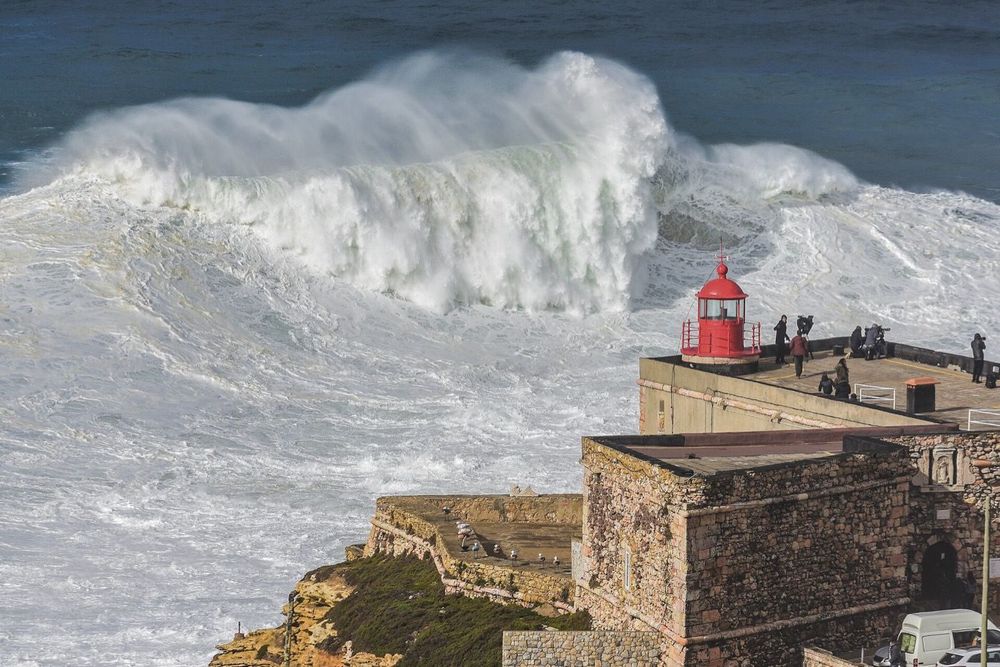
I grew up on an island in the middle of the Atlantic, and I thought I knew what the ocean could do. Then I stood on the cliff at Nazaré in December and watched a wall of water the height of an office block rise out of a calm-looking sea. Five thousand people went silent at once. Nothing detonates like this anywhere else in Europe. Nowhere close.
The numbers behind that moment are simple and absurd. Nazaré's Praia do Norte holds the world record for the largest wave ever surfed, 26.21m (86ft), and on the right winter day the sets rolling past the lighthouse make even that look ordinary. Better still for you: watching costs nothing, and the show sits 120km north of Lisbon. With a little planning you can time a visit to the exact days the giants arrive. This guide covers the why, the when and the how, from a hiker who usually measures drama in summit metres and had to recalibrate.
Key Takeaways
- Big wave season runs October to March, with the most reliable giants from November to February. Summer Nazaré is a normal, lovely beach town. When can you see →
- The size comes from the Nazaré Canyon, an underwater gorge about 230km long and up to 5,000m deep that ends right at Praia do Norte and focuses Atlantic swell like a lens. Why are the waves →
- The world record stands at 26.21m (86ft), set by Sebastian Steudtner in 2020. Garrett McNamara's 2011 ride of 23.77m (78ft) started the whole story. How big are the →
- Watching is free from the cliffs around the lighthouse; the fort beneath it charges a few euros and puts you closest to the action. Where to watch →
- Giant days are forecast-driven, not scheduled: you'll know 2 to 4 days ahead. Follow the swell charts and stay flexible. When can you see →
- No car needed: buses run from Lisbon in about 2 hours, and day tours from Lisbon pair Nazaré with Óbidos year-round. Getting to Nazaré (and →
Why are the waves at Nazaré so big?
The waves are big because of the Nazaré Canyon, a submarine gorge up to 5,000m deep that points at Praia do Norte like a loaded barrel. The canyon runs roughly 230km out to sea, and swell travelling down it moves faster and loses less energy than swell crossing the shallow shelf beside it. Where the two arrive together, they stack into a single, sudden peak.
That's the short answer, and it deserves a moment of respect, because almost nowhere else on Earth does deep ocean reach this close to a beach. The canyon head sits a few hundred metres from the sand, and for scale, the gorge beneath those fishing boats is nearly three times the depth of the Grand Canyon. It's been quietly funnelling storm energy at this coastline since long before anyone thought to name it.
Three more ingredients finish the recipe, starting with the winter storms in the North Atlantic that send long-period swell straight down the canyon's throat. The headland bends part of that swell sideways, so wave trains cross and merge rather than arriving politely in line. And the local current running off the beach holds the wave faces up that fraction longer. That's why Nazaré's giants look less like waves and more like collapsing buildings. On Madeira we build our villages high and hide from a sea like this. Nazaré sells it tickets.
How big are the waves at Nazaré?
On a strong winter day, sets at Praia do Norte run 8 to 15m, and the season's standouts push past 20m (65ft). That's a six-storey building, and the official world record, measured and ratified by Guinness, is Sebastian Steudtner's 26.21m (86ft) ride from October 2020.
The record book reads like a short history of the place. Garrett McNamara, invited by locals who suspected their monster could be ridden, surfed 23.77m (78ft) in November 2011 and put Nazaré on every front page in the surf world. Rodrigo Koxa nudged it to 24.38m (80ft) in 2017, Steudtner took the current crown three years later, and Maya Gabeira's 22.4m (73.5ft) wave from the same winter remains the largest ever surfed by a woman, anywhere. Bigger rides have almost certainly happened since; several are still in the measuring queue, because certifying a moving mountain of whitewater turns out to be genuinely hard science.
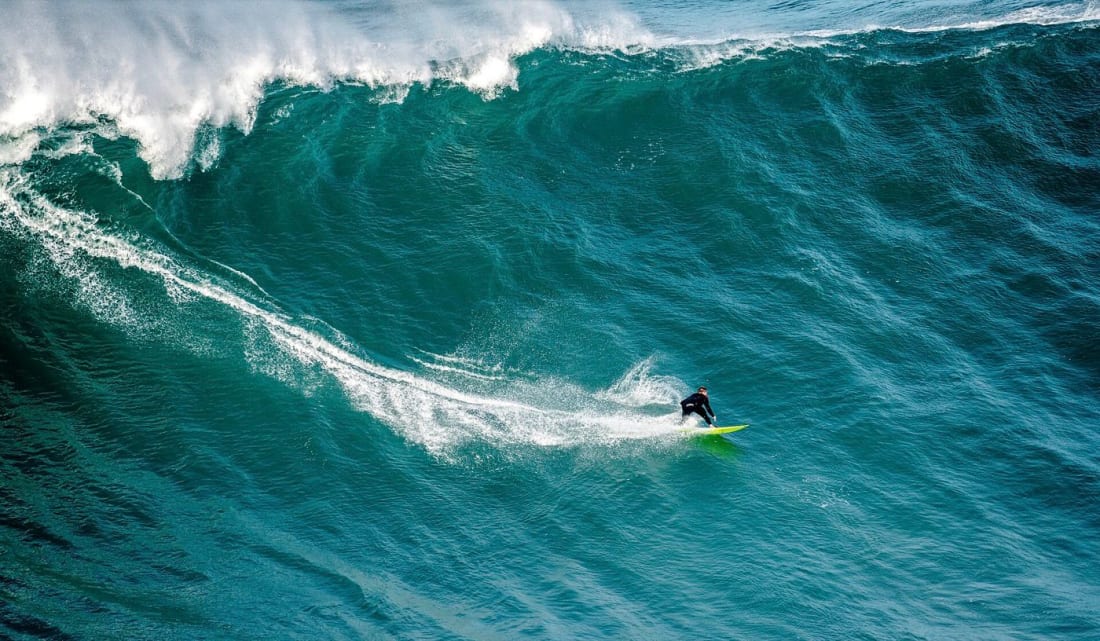
Photo: Carlos Eduardo Joos, CC BY 2.0 (Wikimedia Commons)
Numbers undersell it, though, because what the cliff gives you is scale you can feel in your chest. The jet ski shrinks to a toy, and the surfer becomes a falling dot under the lip. I've stood above a 300m sea cliff at home without blinking. My first proper set at Nazaré made me step back from the rail.
When can you see big waves in Nazaré?
Big wave season at Nazaré runs from October to March, and the most consistent giants arrive between November and February, when North Atlantic storms line up one after another. Individual swells are forecast only 2 to 4 days ahead, so treat any visit as a window, not an appointment.
Here's the honest month-by-month picture:
| Months | Giant-wave odds | What you'll likely see |
|---|---|---|
| Jun to Aug | Very low | Beach-town Nazaré, small surf, rare storm surprises |
| Sep | Low but rising | First serious swells, surfers returning |
| Oct | Good | Season opens, first big days |
| Nov to Feb | Best | Regular big days, giant days, competition windows |
| Mar | Good, fading | Late-season swells, thinner crowds |
| Apr to May | Low | Occasional big days, calming sea |
Two notes from the fine print. First, "season" doesn't mean daily giants; even in January, Nazaré spends plenty of mornings looking like a postcard of a calm fishing town. That's its own kind of pleasant. Second, the ocean ignores the calendar when it feels like it: in August 2025 the leftovers of a hurricane sent 8m surf into the peak of beach season. January 2026's Storm Kristin was so violent that the town paused big wave surfing entirely while it repaired the damage. The Atlantic writes the schedule here. Everyone else just reads it.
How to actually catch a giant day
Watch the forecast, not the guidebook. From about 72 hours out, swell charts (the national sea forecast at IPMA or any surf forecast app) show the storm energy heading for Portugal. The big-wave community starts buzzing well before it lands. What you're looking for is simple: swell height above 5m at long period, with light or offshore wind. When those line up between October and March, drop your plans, pack your warmest jacket and go.
A few practical rules for the day itself. Arrive early: on famous swells you'll share the clifftop with crowds in five figures, and parking near the Sítio fills before sunrise. Mornings usually bring the cleanest conditions before the wind picks up, and give yourself two or three days in the area if you can. Swells peak, shift and fade, and the difference between a good day and a historic one is often just Tuesday versus Wednesday.
Where to watch: the fort, the cliffs and the town below
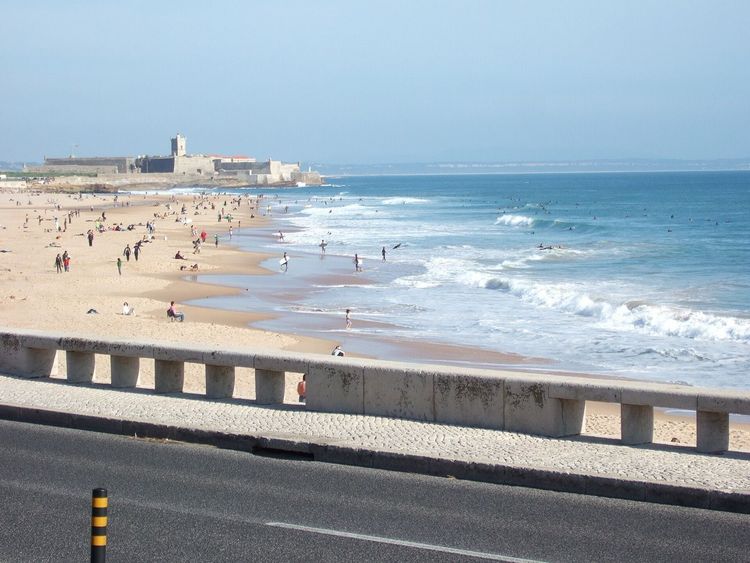
All the viewing happens around the red lighthouse you've seen in every Nazaré photo, which crowns the Forte de São Miguel Arcanjo, a 16th-century fort on the headland above Praia do Norte. Entry costs a few euros and buys the closest legal view of the take-off zone, and the small exhibition of battered big-wave boards inside doubles as a museum of near-death experiences.
The cliffs around the fort are free, open and honestly just as good. Spread along the paths north of the lighthouse and you'll get the full arena view: the peak rising out of deep water, tow teams threading jet skis between moving mountains, and the crowd noise rolling along the cliff with each set. Bring layers (the wind cuts in winter), something waterproof to sit on, and more patience than you think you need. Sets arrive in pulses, and you'll learn that the ocean rewards the people still watching at minute forty.
The strangest sound at Nazaré isn't the wave. It's a few thousand strangers inhaling at once, and then the boom arriving a beat late, like thunder that forgot its lightning.
Getting between the town and the clifftop is a pleasure in itself: the Sítio, Nazaré's upper neighbourhood 110m above the sand, connects to the beach town by a funicular that has been running since 1889. Ride it up, walk the 15 minutes out to the lighthouse, and on the way back detour to the Suberco viewpoint for the classic look down over the town beach and its drying racks.
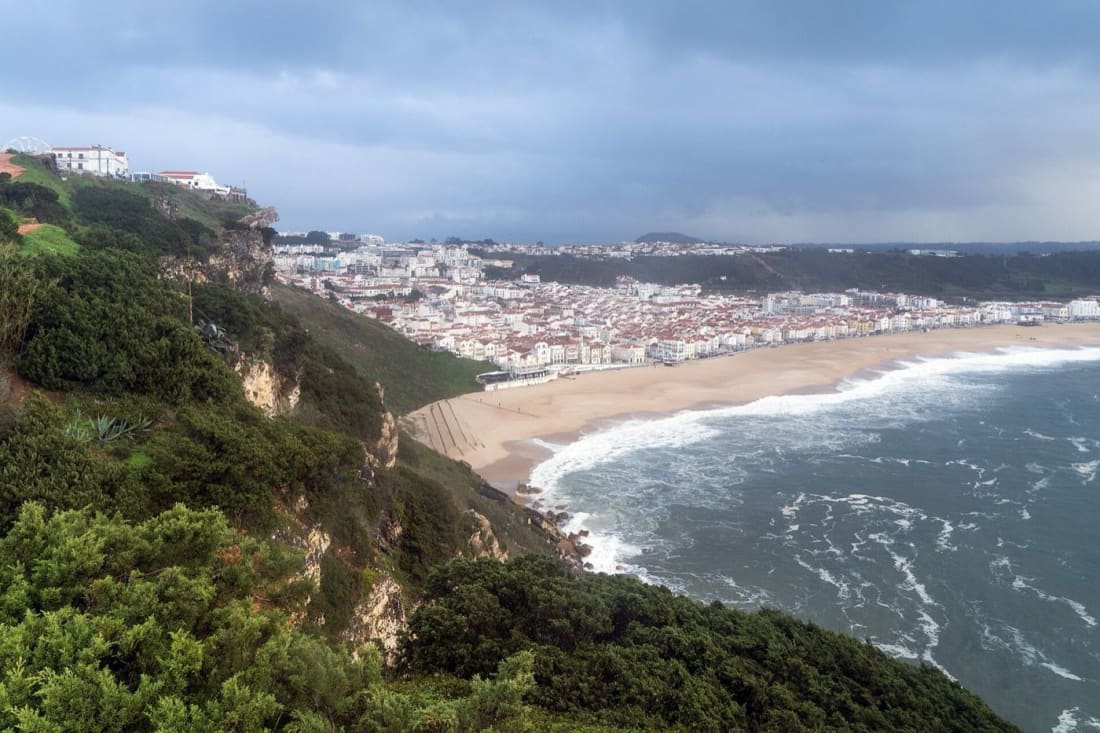
Photo: Alexkom000, CC BY 4.0 (Wikimedia Commons)
Can you see the surfers up close? Closer than feels reasonable. The take-off zone sits a few hundred metres off the fort. With any zoom lens (or the patience of simply standing there) you'll watch the teams work: one driver, one surfer, whipping into waves no paddler could catch. Tow-in surfing was controversial once. At Nazaré it's just the entry fee, and after one set you understand why.
Not just a wave: the town wrapped around it
Here's what the wave-chasing crowds sometimes miss: Nazaré was famous in Portugal long before McNamara's 2011 ride, as one of the country's most stubbornly traditional fishing towns. The seven-skirted dress of the fisherwomen, the racks of silver fish drying on the beach, the church of Nossa Senhora da Nazaré up in the Sítio that gave the town its name: none of it is staged for surf tourists. The sea here fed families for centuries and took its share of them, and the town's respect for the ocean predates anyone riding it for sport.
That history matters when people ask the darker question. Have surfers died at Nazaré? Yes: Brazilian big-wave veteran Márcio Freire died surfing Praia do Norte in January 2023, the first professional lost at the wave, and rescues happen every season. The safety operation (jet skis, spotters on the cliff, radios linking them) is world-class precisely because everyone here knows what the Atlantic is. The fishermen's families knew it first.
Off the cliff, give the town a proper afternoon. Eat grilled fish at a beachfront 'tasca' (a simple family-run eatery), and try the local 'carapaus secos' (butterflied dried mackerel, the town's signature snack) if you're braver than average. Then walk the main beach and ride the funicular at golden hour. Summer visitors get a bonus: Praia da Vila, the town beach, is calm and family-friendly, everything Praia do Norte is not. Swim there; leave the north beach to the professionals even on its quiet days, since the currents don't take holidays.
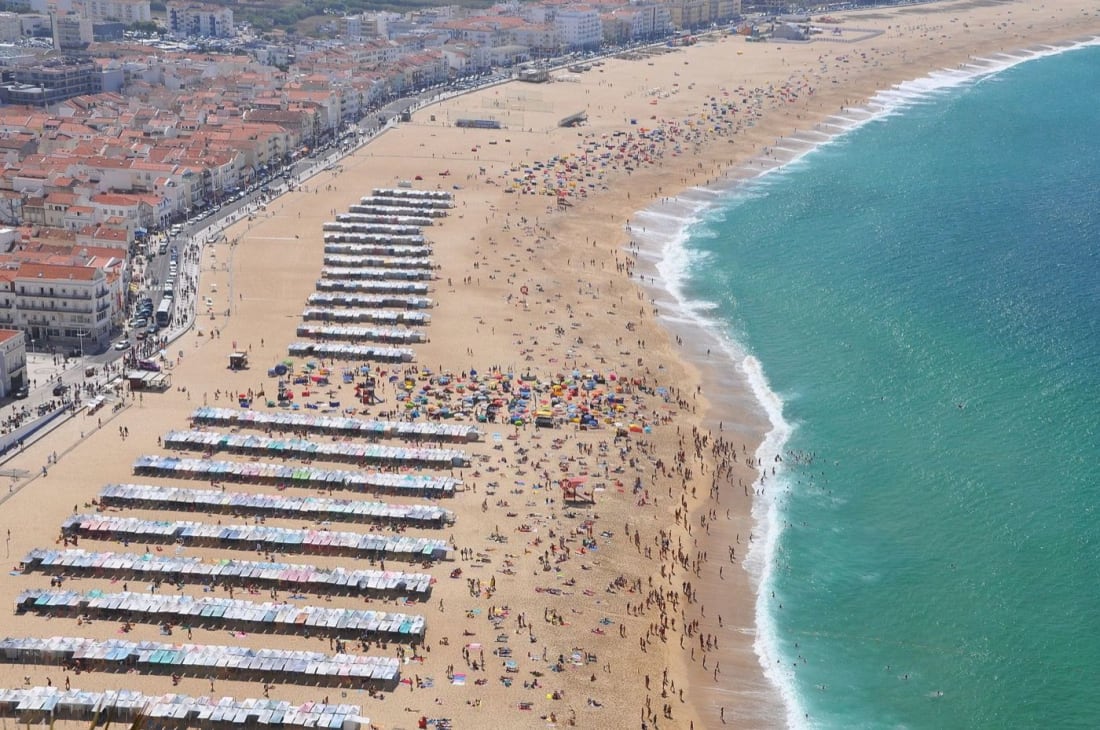
Photo: JRodSilva, CC BY-SA 4.0 (Wikimedia Commons)
Getting to Nazaré (and whether to stay the night)
Nazaré sits 120km north of Lisbon and about 215km south of Porto, on the coast west of the A8 motorway. Driving from Lisbon takes about 1h20, and buses make the trip in roughly 2 hours from Sete Rios or Oriente stations. From Porto, count on 2h by car down the A17, and note that there's no train station; the ocean got all the infrastructure votes here.
If you'd rather not organise it, the classic move is a combined day trip: Nazaré tours from Lisbon usually pair the wave lookout with the walled medieval town of Óbidos 40km south, and several add Fátima or Batalha's monastery, turning a wave-watching mission into a rounded day out. The same combinations run as Nazaré stops from Porto, often as scenic transfers between the two cities. For everything else within reach of the capital, our best day trips from Lisbon guide ranks the options.
Should you stay overnight? On a forecast giant day, absolutely: the best light and lightest winds usually come early, and the crowds arrive by mid-morning. Waking up 10 minutes from the lighthouse beats leaving Lisbon at 5am. Book the moment the forecast firms up, because the town's guesthouses sell out with the swell. On an ordinary visit, an afternoon and a sunset do the job beautifully.
What to bring on a big-wave day
Dress like you're going hiking, not to the beach: the clifftop in December is windy, exposed and 10 degrees colder than it looks from a café. Waterproof jacket, warm layer, hat, decent shoes for the dirt paths along the cliff edge. Add sunglasses (winter light off the Atlantic is brutal), water and snacks, because the food vans near the lighthouse draw queues on famous days. You'll want a zoom lens or binoculars; the action is closer than at any other big wave on Earth, but "close" still means a few hundred metres.
And treat the edge like the edge: people cluster along unfenced cliff paths for the view, the ground is sandy and undercut in places, and rogue sets have washed over lower viewpoints before. Stay behind barriers where they exist, keep children on the landward side of you, and remember that every safety rule in this town was written by the sea.
FAQ
What is the biggest wave ever surfed at Nazaré?
The official world record is 26.21m (86ft), ridden by Germany's Sebastian Steudtner at Praia do Norte in October 2020 and ratified by Guinness World Records. It's the biggest wave ever surfed anywhere, and larger rides at Nazaré are still awaiting official measurement.
Can you watch the big wave surfers for free?
Yes. The cliffs around the Nazaré lighthouse are open and free, and you'll have full views of Praia do Norte and the take-off zone. The 16th-century fort under the lighthouse charges a small entry fee and gets you closest, with a big-wave exhibition inside.
Is Nazaré worth visiting in summer?
Yes, but for different reasons: summer Nazaré is a relaxed beach town with calm swimming and good seafood, and the funicular and Sítio viewpoints work year-round. The giant waves are a winter phenomenon; June to August seas are usually small.
How do I get to Nazaré from Lisbon?
Drive north on the A8 for about 1h20 (120km), or take a direct bus from Lisbon's Sete Rios or Oriente stations, roughly 2 hours. There's no train. Organised day tours combine Nazaré with Óbidos and Fátima if you'd rather skip the logistics.
When is the Nazaré big wave competition?
The Tudor Nazaré Big Wave Challenge has no fixed date: organisers wait for a giant swell inside the October-to-March window and confirm the event only days ahead. The most recent edition ran in December 2025, and any big winter swell brings free-surfing sessions that are nearly as spectacular.
End the day the Nazaré way, down in the lower town once the light goes. Order the grilled catch of the day and a cold Sagres at a family 'tasca' two streets back from the beach, where the walls wear photographs of boats and the waves that tested them. Raise the glass to the canyon out there in the dark. It's been throwing giants at this coast for a few million years, long before anyone thought to applaud.