Few cities reward wandering like Lisbon. Built across seven hills above the Tagus, it is a place of yellow trams grinding up impossible streets, miradouros (viewpoints) that throw open the whole city at sunset, and tiled lanes where fado drifts from open doors after dark. You can fill days here with grand monuments and museums, or simply follow the calçada (mosaic pavement) downhill and see where it takes you, and both count as time well spent.
This guide rounds up the best things to do in Lisbon, from the unmissable sights to the experiences that locals would actually point you toward. You will find the famous tram and the castle, the monuments of Belém and a fado night, plus the sunset spots, the day trip everyone should take, and the corners worth your time once the headline attractions are done. For the full picture of the city, pair it with our complete Lisbon travel guide.
Read on for the top experiences, a quick comparison of the essential sights, and the practical tips that help you skip the worst of the queues.
Key Takeaways
- Ride Tram 28 early, before the crowds and the pickpockets pile on, or take the quieter loop instead. The famous tram →
- Climb to São Jorge Castle and the surrounding miradouros for the city's finest views. Castle and viewpoints →
- Get lost on foot in Alfama and Mouraria, the oldest and most atmospheric quarters. The old quarters →
- Hear live fado in a small neighborhood house, not a polished dinner show. Where to hear fado →
- Give a full day to Sintra's palaces, the best day trip from the city. Day trip to Sintra →
- A Lisboa Card and a few early starts save you both money and queue time. Practical tips →
Ride the Iconic Tram 28
No ride in Lisbon is more famous than the canary-yellow elétrico (tram) number 28, which rattles and screeches through the oldest parts of the city on its way from Martim Moniz to Campo de Ourique. It threads the narrow lanes of Alfama, climbs to the cathedral and the castle, and rolls through Graça and Estrela, a moving sightseeing tour for the price of a transit ticket. The vintage wooden carriages, polished by a century of passengers, are an attraction in their own right. The first electric trams ran here in 1914, and the Remodelado cars still in service date from the 1930s, all riveted wood, brass fittings and hand-cranked controls. Across a route of roughly 7km (4.3 miles), the little tram climbs gradients that would defeat a modern bus, which is exactly why it has never been retired. The ride doubles as a sightseeing tour, passing the Sé cathedral, the castle walls and a string of viewpoints, and on a good day the clang of the bell and the squeal of the wheels on the tight curves are half the fun.
It is also one of the city's busiest tourist rides, which brings two problems: long queues and busy pickpockets. From mid-morning to early evening the cars run packed, the wait at Martim Moniz can stretch past an hour in summer, and the crush near the doors is a known hotspot for theft. The view is worth it, but the timing matters.
Local tip: Ride before 9am for a seat and the morning light on the tiles, or skip the 28 entirely for the circular Tram 12E, which loops Alfama and Mouraria in about 25 minutes with far shorter queues. A ticket bought onboard runs about €3.30, against roughly €1.90 with a rechargeable Navegante card, so tap on with a card and keep your bag in front of you.
Climb to the Castle and the Best Viewpoints
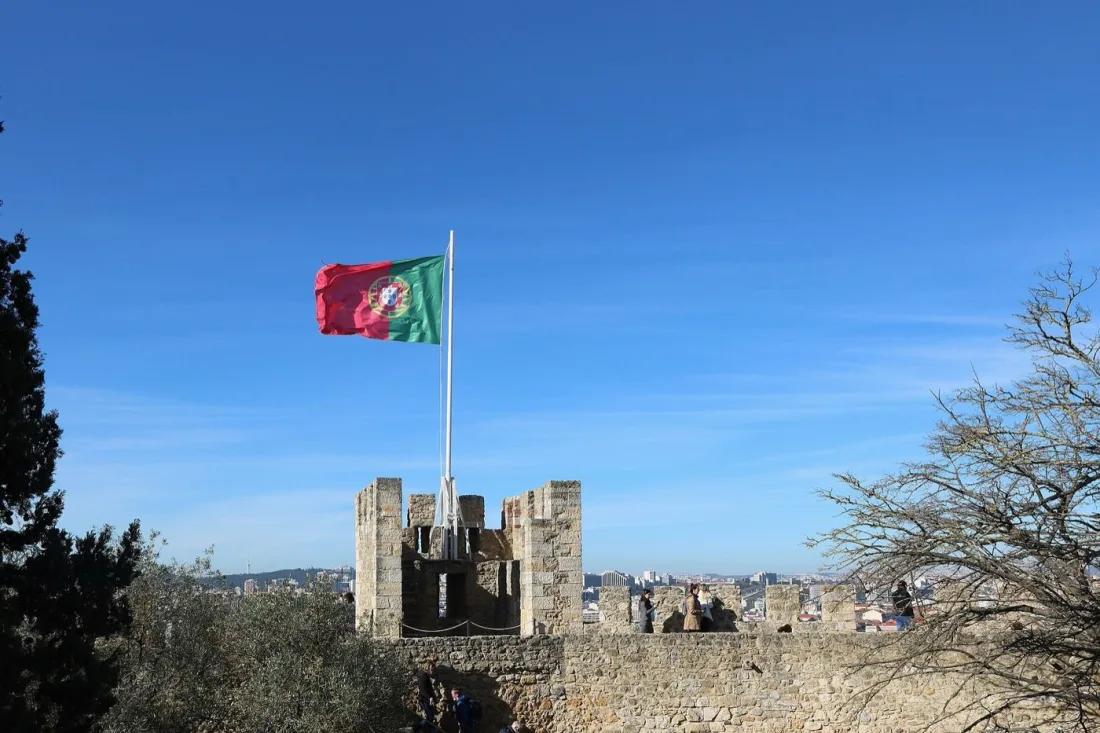
Photo: Ingo Mehling, CC BY-SA 4.0 (Wikimedia Commons)
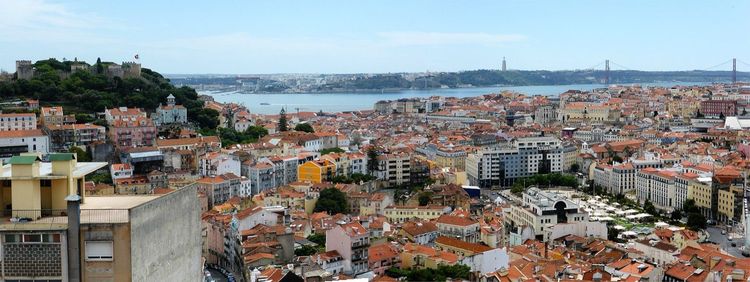
Lisbon was born on the hill now crowned by São Jorge Castle, and climbing to it is the single best way to grasp the city's shape. The ramparts walk gives you the whole sweep of the baixa, the river and the red roofs tumbling toward the water, with peacocks strutting the grounds and archaeological layers underfoot. Adult entry is around €17 in 2026, with the gates open daily, and buying online trims the worst of the high-season ticket line. The hilltop has been fortified for over a thousand years, by Romans, Moors and Portuguese kings in turn, and the castle you walk today took its present shape after the Christian conquest of 1147. The official Castelo de São Jorge site lists current hours and ticket options.
You do not have to pay for a great view, though. Lisbon's miradouros are free, open and scattered across every hill, and choosing one for the golden hour is among the city's purest pleasures. The terrace of Santa Luzia frames Alfama through tiled arches and bougainvillea, Portas do Sol throws open the rooftops to the river, and Senhora do Monte, higher and quieter, gives the widest panorama of all.
Detour: For a view with a glass in hand, the Miradouro de São Pedro de Alcântara sits at the top of the Glória funicular above Bairro Alto, while the Santa Catarina terrace draws a younger crowd at sunset. Both are free, both are lovely, and both beat any paid observation deck in town.
Wander the Old Quarters of Alfama and Mouraria
Some of the best things to do in Lisbon cost nothing but a pair of comfortable shoes. The medieval maze of Alfama, the one district that largely survived the 1755 earthquake, is made for aimless wandering, all blind alleys, hanging laundry, tiny chapels and sudden views. Let yourself get lost, follow the sound of a singer rehearsing, and you will understand the city better than any monument can teach you. Our Alfama neighborhood guide maps the corners worth finding.
Just over the castle hill, Mouraria is rougher, less visited and every bit as rewarding, the other birthplace of fado and now the city's most multicultural quarter. Together the two districts tell the whole story of working-class Lisbon, and the walk between them takes only a few minutes. Along the way, the twin-towered Sé cathedral, begun in 1147, anchors the foot of the hill, while the white dome of the National Pantheon and the tiled cloisters of the São Vicente de Fora monastery reward the climb. On Tuesday and Saturday mornings, the Feira da Ladra flea market spreads across Campo de Santa Clara, the city's finest spot for a rummage and some people-watching.
Local tip: Wander these lanes in the early morning or the late afternoon, when the light is soft and the day-trippers are elsewhere, and stop for a coffee wherever the locals are sitting. The flat grid of the baixa below and the elegant streets of Chiado above make the natural other half of a walking day.
See the Monuments of Belém
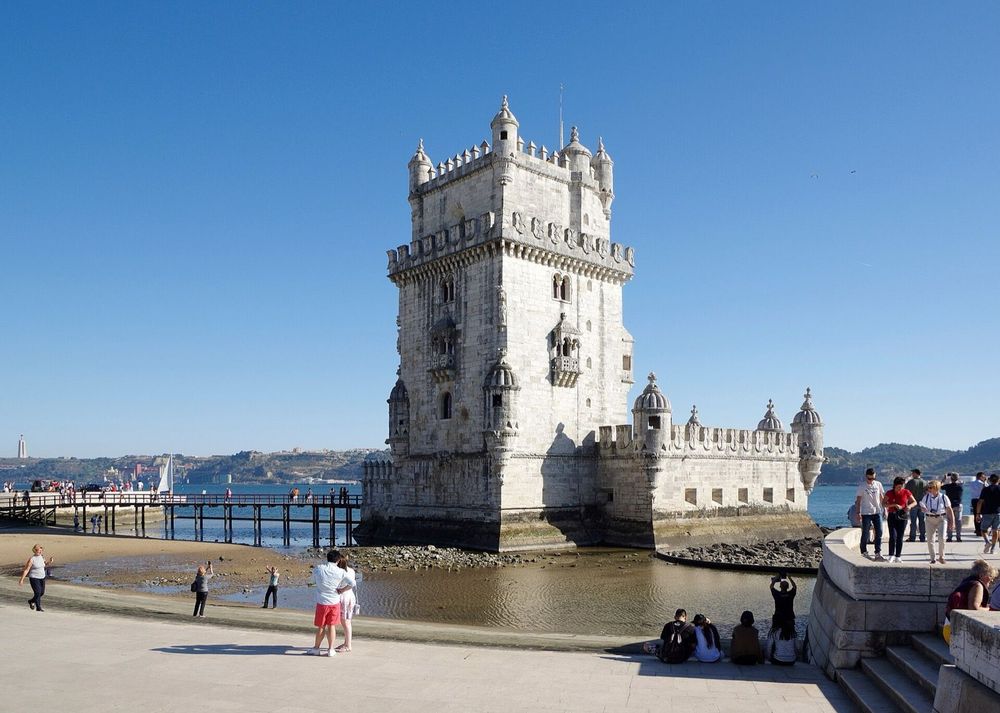
About 6km (3.7 miles) west of the center, the riverside parish of Belém holds Lisbon's grandest monuments, raised on the wealth of Portugal's age of exploration. The Torre de Belém stands guard in the river, a filigreed limestone fort that has become the city's emblem, while the vast Mosteiro dos Jerónimos nearby is a masterpiece of Manueline stonework and the resting place of the explorer Vasco da Gama. Both were listed by UNESCO in 1983, and both reward arriving early. The Torre de Belém went up around 1519 to guard the harbour mouth, while the monastery took most of the 16th century to build, funded by a tax on the spice trade that Vasco da Gama's voyages had opened. Leave time for the riverfront itself, where the Padrão dos Descobrimentos monument rises over the water and the wave-patterned plaza makes a fine place to watch the boats slide by. The MAAT museum next door, with its walkable white roof, has quietly become a sunset spot in its own right.
Between them runs a riverfront of gardens, the soaring Padrão dos Descobrimentos monument, and the modern art museum at the MAAT. And just inland waits the reason many people come at all. The original pastéis de nata (custard tarts) are baked to a guarded 1837 recipe at Pastéis de Belém, and served warm with a dusting of cinnamon.
Planning tip: The queue for the Jerónimos monastery can run 30 minutes or more by late morning, so reach Belém near opening or book a timed ticket ahead, and pair the monuments with the tarts to make a relaxed half-day. The tram 15E or the train from Cais do Sodré gets you there in about 20 minutes.
Hear Live Fado
Lisbon's signature sound is fado, the mournful, century-old song of longing the Portuguese call saudade, and hearing it live is one of the most moving things to do in the city. Born in the taverns of Alfama and Mouraria, fado joined UNESCO's list of Intangible Cultural Heritage in 2011, but it never needed a stage. In the right room, a single guitarist and a singer can silence a crowd. To understand it first, the small Museu do Fado in Alfama traces the music's history and its greatest voice, Amália Rodrigues, who carried fado from these streets to the world before her death in 1999.
The contrarian rule matters here. The big dinner-show houses near the castle serve fado to tour groups at a premium, but the real thing happens in small backstreet casas de fado (fado houses) where the singing is often unannounced. Choose one of those, order a few plates and a bottle, and wait for the lights to drop.
"If you do one thing after dark in Lisbon, let it be an unannounced fado night in a backstreet tasca, where the song still belongs to the neighborhood." - Guidekin team
Local tip: Most small fado houses ask for a minimum spend rather than a ticket and expect silence during each song. Arrive after 9pm, and let our guide to where to eat in Lisbon point you to the rooms that get it right.
Watch the Sunset Over the Tagus

Photo: Eduardo Pereira, Public domain (Wikimedia Commons)
Lisbon does sunsets better than almost anywhere, and watching the light turn the river to copper is a nightly ritual worth joining. The whole city tilts west toward the water, so the miradouros, the rooftops and the riverbank all fill with people as the sun drops. It costs nothing, and it never gets old. In summer the sun drops around 9pm, late enough for a long, slow build-up over a drink; in winter it slips away closer to 5:30pm, turning the after-work hour to gold. Either way, get there 20 minutes early to claim a ledge, since the best spots fill fast.
For the classic view, claim a spot at a hilltop terrace like Senhora do Monte or Graça, with the castle silhouetted against the glow. Down at the water, the broad steps of the Cais das Colunas on Praça do Comércio let you sit with your feet almost in the Tagus, while a sunset ferry across to Cacilhas costs the price of a transit fare and turns the skyline gold from the deck.
Detour: For something special, a small-group sunset sailing on the Tagus pushes out beneath the 25 de Abril bridge as the light fades, with the whole illuminated city sliding past. It is the kind of experience worth booking ahead in summer.
Lisbon After Dark
The city does not slow down when the sun goes. As the miradouros empty, the bars fill, and Lisbon's nightlife spreads across a few distinct quarters. Bairro Alto is the loud, lovable heart of it, a warren of tiny bars where the crowd drinks in the street and drifts from door to door until the small hours. Downhill, Cais do Sodré has grown from sailors' dive bars into the city's coolest strip, anchored by the pink-painted Rua Nova do Carvalho, better known as Pink Street.
For something quieter, the rooftop bars scattered across the hills trade thumping music for sunset views and a slow cocktail, while the docks at Alcântara and the riverfront clubs draw the dance-till-dawn crowd. And running beneath all of it is fado, still sung in the backstreet houses of Alfama and Mouraria long after midnight.
A night out here starts late, often after 11pm, and the bars rarely empty before 2 or 3am. Keep a little cash for the small places, and let the evening wander between a sunset drink, a fado room and a street-side beer in Bairro Alto.
Take a Day Trip to Sintra

Photo: Michael Gaylard, CC BY 4.0 (Wikimedia Commons)
If you give Lisbon only one day outside the city, give it to Sintra. Forty minutes by train from Rossio station, this misty, forested hilltown of palaces and gardens feels like another world, and it is the most popular day trip from the capital for good reason. The candy-colored Pena Palace crowns the heights, the romantic Quinta da Regaleira hides its initiation well and underground tunnels, and the ruined Moorish Castle walls ride the ridge with views to the sea. Pena Palace, finished in 1854 as a royal summer retreat, is the showpiece, a riot of domes and clashing colours on the highest peak. With more time, the gardens of Monserrate and the windswept cliffs of Cabo da Roca, the westernmost point of mainland Europe, round out a full day. Most visitors try to cram in too much, so pick two sites and savour them rather than racing past four. Pena Palace and Regaleira make the classic pair, with the Moorish Castle a scenic walk between them for anyone with energy to spare.
Sintra rewards an early start and a plan, because the crowds and the narrow hill roads can clog by midday. Buy palace tickets online, take the train rather than driving, and use the local bus or a tour to link the sites that sit miles apart.
Planning tip: Pena Palace and Regaleira are the two to prioritize if time is short, and both should be booked ahead in high season. Our Sintra day trip guide lays out the smartest route, and the best day trips from Lisbon cover Cascais, Óbidos and more.
Beyond the Highlights: Markets, Museums and the River
Once the headline sights are done, Lisbon keeps giving. And it keeps giving cheaply. Many of its best corners ask nothing but your curiosity and a free afternoon. Food lovers graze the Time Out Market at Cais do Sodré, where 30 of the city's best kitchens share a hall, then hunt for tinned-fish souvenirs nearby. Design and street-art fans head to LX Factory, a converted industrial complex under the bridge in Alcântara, now full of bookshops, studios, restaurants and some of the city's boldest murals. It is busiest on Sundays, when a market fills the lanes, and the view up to the underside of the 25 de Abril bridge is worth the trip alone.
Museums reward a rainy day or a slower pace. The Museu Nacional do Azulejo tells the story of Portugal's painted tiles in a former convent. The Gulbenkian holds a world-class art collection in serene gardens. And out east, the Oceanário de Lisboa, one of Europe's great aquariums, is a sure hit with children. Add the wrought-iron Santa Justa lift, built in 1902 and rising 45 meters to a rooftop view, and a ride across the river to the giant Cristo Rei statue, and you have days more to fill. Back in the center, the grand riverside square of Praça do Comércio, the wave-patterned calçada of Rossio, and the roofless, earthquake-ruined Carmo Convent all reward a slow look as you pass. Across the water, a cable car at Almada lifts you to the foot of the giant Cristo Rei statue for one of the widest views back over the bridge and the city, an easy and underrated half-day by ferry.
Local tip: For a half-day that mixes it all, ride a ferry from Cais do Sodré to Cacilhas for fresh seafood and a skyline view, or browse the Feira da Ladra flea market in Alfama on a Tuesday or Saturday morning for the city's best people-watching.
At a Glance: The Best Things to Do
A quick guide to the highlights, with rough costs and how long to give each. Mix one or two paid sights a day with the free pleasures, and you will not burn out or break the bank. Most of these sit within a short walk or a single tram ride of one another.
| Thing to do | Best for | Time | Cost |
|---|---|---|---|
| Ride Tram 28 | The classic city ride | 45 min | €1.90 with a card |
| São Jorge Castle | History and the best view | 2 hrs | €17 |
| Belém monuments | Grand sights and tarts | Half day | €10 to €18 each |
| A fado night | Culture after dark | Evening | Minimum spend |
| Sunset miradouro | Free romance | 1 hr | Free |
| Day trip to Sintra | Palaces and forest | Full day | €40 and up |
| Oceanário | Families | 2 hrs | Around €25 |
| LX Factory | Design and street art | 2 hrs | Free to browse |
Practical Tips
- Lisboa Card: If you plan to see several paid sights, the Lisboa Card covers public transport plus free or discounted entry to many monuments, and it usually pays for itself in a busy day or two. A 24-hour card costs around €27 in 2026, a 72-hour version about €44, and it covers the trains out to Sintra and Cascais.
- Beat the queues: Buy tickets online for São Jorge Castle, the Jerónimos monastery and the Sintra palaces, and start early. The big sights are calmest in the first hour after opening.
- Getting around: Pick up a rechargeable Navegante card and tap on for trams, the Metro, buses and the funiculars. The center is walkable, but the hills are real, so plan your routes downhill where you can.
- Wear the right shoes: The calçada pavements are beautiful and lethally slippery, especially when wet, so bring shoes with grip and take the steep lanes slowly.
- Book the experiences: Sunset sailings, fado nights and Sintra tours fill up in summer. A Lisbon sightseeing tour is the fastest way to link the highlights, and you can browse all Lisbon tours to build your own days.
FAQ
What are the best things to do in Lisbon?
Ride Tram 28, climb São Jorge Castle, wander Alfama, see the monuments of Belém, hear live fado and watch the sunset over the Tagus. Save a full day for the palaces of Sintra, the best trip out of the city.
How many days do you need in Lisbon?
Two to three days cover the main neighborhoods and sights comfortably, with a spare day for Sintra or the coast. The city is compact, so you can see a lot on foot in a short visit.
What is there to do in Lisbon for free?
Plenty. The miradouros, the old quarters of Alfama and Mouraria, the riverfront, the sunset and the street art of LX Factory all cost nothing. Many museums also have free or reduced-entry hours.
What are the top attractions in Lisbon?
São Jorge Castle, the Belém Tower and Jerónimos monastery, the Santa Justa lift, the Alfama viewpoints and the Time Out Market top most lists. Sintra's palaces are the one to add just outside the city.
Is Lisbon good for families?
Very. The Oceanário is a world-class aquarium, the trams and funiculars feel like rides to children, and the riverside and castle grounds give space to roam. Flat Belém and Parque das Nações are the easiest areas for strollers.
What can you do in Lisbon at night?
Hear fado in Alfama, watch the sunset from a miradouro, then join the bar crowds of Bairro Alto and Cais do Sodré. A sunset river cruise or a late dinner of petiscos rounds out a Lisbon evening.
Where to Start
If you have just arrived, keep the first day simple: ride a tram up to the castle, wander down through Alfama as the light softens, and end on a miradouro with the river turning gold below. Do that on your first evening, and Lisbon has you for the rest of the trip. There is no single right way to see the city. Some days call for a packed run of castles and monuments. Others are better spent on one long, slow wander with no plan at all. Lisbon rewards both, and the best trips usually mix the two. Whatever you choose, leave room for the unplanned: the tram you hop on for no reason, the tasca (tavern) you stumble into, the viewpoint you find by getting lost. Those are the moments people remember long after the monuments blur together. When you are ready to go deeper, browse our handpicked Lisbon tours and experiences and build the rest of your days around the things you most want to see.